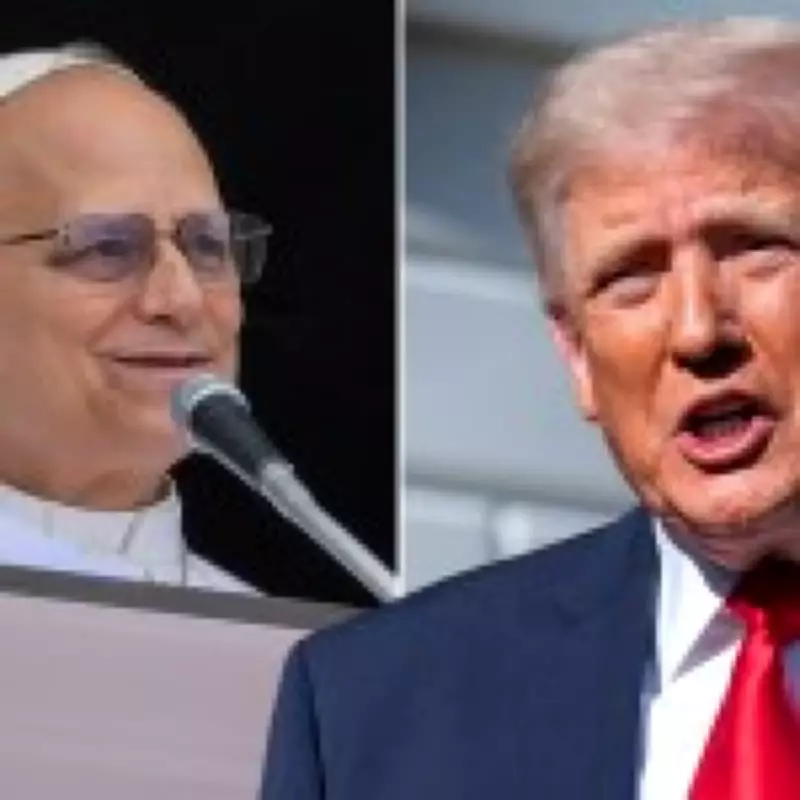
In a remarkable development that has captivated global observers, Pope Leo XIV has emerged as a formidable critic of Donald Trump's political rhetoric, particularly targeting what many perceive as the former president's messianic self-image. The confrontation escalated dramatically over the weekend when Trump launched a blistering 334-word attack on the pontiff via Truth Social, calling the first American pope "WEAK on Crime" and "terrible for Foreign Policy."
The Trigger: A Sermon Against "Delusion of Omnipotence"
The catalyst for this extraordinary clash occurred when Pope Leo XIV stood before worshippers in St. Peter's Basilica and delivered a powerful sermon condemning wars fueled by what he described as the "delusion of omnipotence." While not explicitly naming Trump, the pontiff's message clearly referenced the former president's threats against Iran, particularly Trump's stated willingness to destroy "an entire civilization" - a country of 93 million people.
"He called threats to destroy an entire civilization 'truly unacceptable,'" the Pope declared, adding the theological rebuke that "Jesus does not listen to the prayers of those who wage war, but rejects them." This moral stance, delivered from one of Christianity's most sacred spaces, represented a direct challenge to Trump's approach to international conflict and power projection.

Trump's Escalation and Symbolic Imagery
Trump's response was characteristically combative and visually provocative. Beyond his verbal assault on the pontiff, the former president posted an AI-generated image depicting himself as a Christ-like figure laying healing hands on a supplicant, with eagles and American flags dominating the celestial background. Although quickly deleted, this digital creation provided stark visual evidence of what critics describe as Trump's divine pretensions.
The former president's attack extended beyond the Pope himself, with Trump expressing baffling preference for the pontiff's brother Louis, whom he described as "all MAGA." This unusual familial comparison highlighted Trump's expectation that an American-born pope would naturally align with his political movement - an assumption that has proven dramatically incorrect.
Media Amplification and Political Realignment
The conflict quickly reverberated through conservative media channels, with Fox News host Sean Hannity questioning on air whether Pope Leo had "even read the Bible." This suggestion that the leader of 1.4 billion Catholics lacked basic scriptural knowledge demonstrated the extraordinary nature of the political realignment occurring around this confrontation.
Remarkably, polling data indicates significant shifts in American Catholic sentiment following the exchange. A recent NBC News poll shows Pope Leo with a net favorability of plus 34 among American voters, substantially ahead of Trump, JD Vance, and Marco Rubio. Even more telling, new Fox News polling reveals Trump's approval among Catholic voters has dipped below waterline, despite 55% of American Catholics supporting him in the 2024 election.
Institutional Catholic Response
The institutional Catholic Church has begun responding to the controversy, with the president of the US Conference of Catholic Bishops breaking cover to express being "disheartened" by Trump's Truth Social attack. The bishop emphasized that "the Pope is not his rival," a statement that appears lost on Trump, who has built much of his political career on creating and nurturing one-sided rivalries.
This development places millions of Catholic MAGA supporters in a difficult position, forced to choose between their religious leader and their political champion. The question being posed, however indirectly, is becoming increasingly clear: Christ or Trump? The man in white papal robes or the figure in the red MAGA hat?
The Broader Significance: Decency Versus Power
What makes this confrontation particularly significant is its transcendence of purely religious or theological debate. As the author notes from Belfast - a city still bearing scars of religious conflict - this dispute represents "a litigation of basic decency" rather than doctrinal disagreement. The Pope possesses a unique luxury unavailable to most politicians: the ability to challenge the world's most powerful figures without concern for political retaliation or "losing a phone call."

This dynamic has transformed Pope Leo XIV from a purely religious figure into what many perceive as "the last functioning adult in the room" - a sober voice of reason in increasingly chaotic global politics. His willingness to directly confront what he views as dangerous messianic impulses represents a rare check on power in an era when such checks have become increasingly scarce.
A Showdown With Lasting Implications
The Trump-Leo confrontation matters far beyond the immediate exchange of insults and theological positioning. Each time Trump "picks a new fight - with a pope, a prime minister, a judge, a weather forecaster - he hands another person a reason to root for the other side," as the analysis notes. In this case, that "other side" includes approximately 53 million American Catholic adults, a substantial voting bloc with demonstrated political influence.
While many observers may never accept the Pope's religious authority as divinely ordained, his emergence as a principled adversary to Trump's "dictatorial impulses" has created unexpected political alliances. The pontiff's refusal to be impressed by power, his willingness to speak uncomfortable truths to that power, and his embodiment of basic human decency have positioned him as an unlikely champion for those concerned about the erosion of democratic norms and ethical governance.
This developing story represents more than just another Trump-generated controversy destined for the archives of political absurdity. It demonstrates that "the social construct by which we agree not to threaten to annihilate civilian populations is being enforced, right now, by a small number of people willing to talk back." That one of those people happens to lead the worldwide Catholic Church makes this confrontation particularly historic and potentially transformative for both religious and political landscapes.