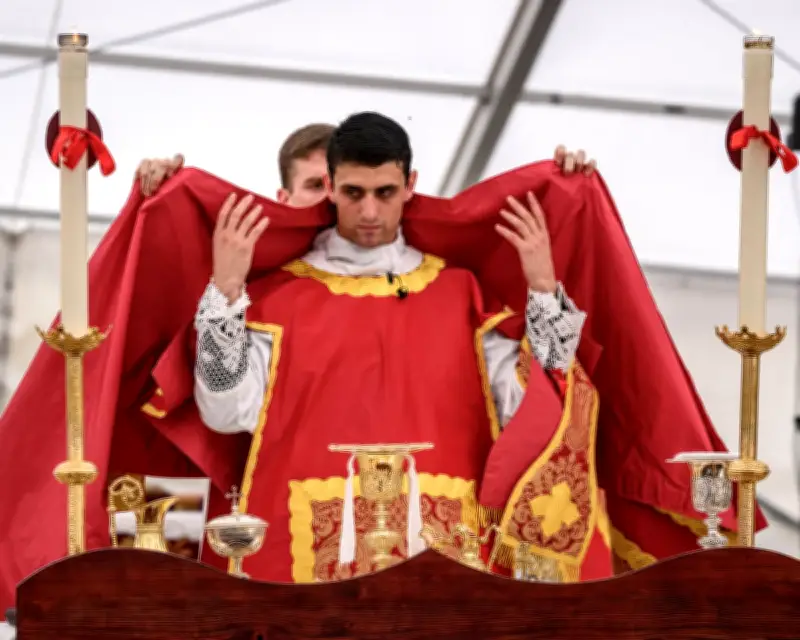
Pope Leo has made a last-ditch attempt to persuade the ultra-conservative Society of Saint Pius X (SSPX) to abandon plans to ordain four new bishops without Vatican approval, calling the move a 'schismatic act' and a 'sin of extreme gravity'. The ordination ceremony is scheduled for 1 July at the SSPX seminary in Ecône, Switzerland.
Background on the Society of Saint Pius X
Founded in 1970 by Archbishop Marcel Lefebvre in the Swiss village of Ecône, the SSPX opposes liberalising reforms from the Second Vatican Council (1962-1965), including the introduction of mass in local languages instead of Latin. The society has gained a significant following in the US, with a large operations base in Kansas, as well as in France, Argentina, and other countries. It has nearly 1,500 priests, seminarians, and other vocational members.
The Vatican's Warning
Church law stipulates that ordaining bishops without papal approval can provoke a schism, an intentional rupture of church unity, and could lead to automatic excommunication of the newly ordained bishops and the consecrating bishop. In a letter to SSPX Superior General Rev. Davide Pagliarani, Pope Leo wrote: 'I plead with you and ask you with all my heart: please turn back! I urge you to consider carefully the spiritual good of the faithful, because the schismatic act you are about to undertake would deprive them of the licit and, in some cases, even valid reception of the sacraments.' He added, 'I pray for you, because to tear the seamless garment of Christ is a sin of extreme gravity.'

SSPX Response
Marc-André Mabillard, media manager for the SSPX, told the Associated Press that the society is changing 'absolutely nothing' in its plans, expressing 'great sadness to not be understood by our leader.' He added: 'We don't fear it. It pains us immensely, but we believe that the good we seek is greater than the pain that will be inflicted upon us.'
Historical Context and Consequences
In 1988, Archbishop Marcel Lefebvre and four bishops he ordained without permission from Pope John Paul II were excommunicated, including British Bishop Richard Williamson. In 2009, Pope Benedict XVI lifted the excommunications, but shortly before, Williamson caused uproar by denying the Holocaust. Christopher White, author of Pope Leo XIV: Inside the Conclave and the Dawn of a New Papacy and a senior fellow at Georgetown University, said: 'The fact that he’s made it clear that there will be consequences, namely excommunication, attests to the gravity of the situation – and that he’s not willing to turn a blind eye to rogue, schismatic behaviour simply for the sake of preserving a false unity.'
Pope Leo had previously appealed to the SSPX and told journalists last week that if the society made the 'choice' to continue on the trajectory of schism, then 'I’m sorry, but we must move forward.' The ordinations risk further straining the church's relationship with rightwing and traditionalist Catholics and could be the first significant crisis for the pontiff, who since his election in May last year has prioritised unity within the Catholic church.