Hours after the US-Iran ceasefire was announced, residents of south Lebanon began racing back to their villages. One man filmed his arrival in Harees, only to find an Israeli armoured vehicle parked less than 100 metres ahead, forcing him to turn around. 'It was packed with explosives. I guess they still want to blow things up,' said Abdullah al-Ali, a municipal official in Harees, noting that two other explosive-laden vehicles had been discovered nearby.
The Lebanese army and civil defence warned people not to return, stressing that the war—which has claimed nearly 3,800 lives in Lebanon—was not over. Israeli shelling met those attempting to return south of Nabatieh, where soldiers remain stationed.
A Fragile Truce
This is the third ceasefire declared in Lebanon in less than two months and the fourth in two years. Unlike previous truces, war-weary Lebanese greeted this one not with victory signs but with questions about its durability. 'How many times has this happened before? I have mixed feelings, there's joy, but there's a fear in the back of my head that won't go away,' said Ghia Hajo, a 25-year-old displaced from Abbasieh.

Hajo watched videos of friends returning to their villages but hesitated to go herself. 'We want to go and not have to leave our bags unpacked. We want to be 100% sure,' she said.
Official Reactions and Uncertainties
Lebanese officials welcomed the ceasefire, which followed a broader US-Iran truce. However, its application in Lebanon remained unclear. Hezbollah halted attacks, and Israeli strikes mostly stopped, except for shelling and two drone strikes near its troops. Israel's defence minister, Israel Katz, stated that Israeli troops would not withdraw from the 'security zone' in south Lebanon, an area of at least 600 sq km along the border.
Under previous ceasefires, Israel continued airstrikes in southern Lebanon. Hezbollah warned on Monday it would not allow this to repeat, backed by Tehran, which has shown it would strike Israel if red lines were crossed.
Unresolved Conflict
The fundamental issues driving the war remain unsolved. The conflict began when Hezbollah launched rockets at Israel on 2 March in retaliation for the killing of Iran's supreme leader. Israel invaded, aiming first to destroy Hezbollah, then to disarm it, achieving neither.
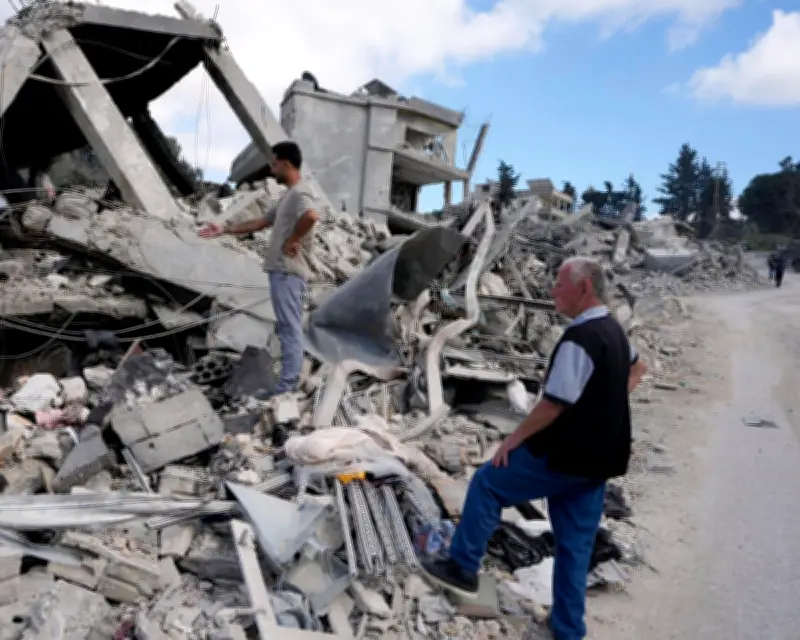
As the day progressed, cars heading south swelled into a flood. For some, the return brought solace—the call to prayer echoed in al-Sultaniyeh, which for weeks had only heard explosions. For others, it confirmed their worst fears. One man found his family home flattened in Seddiqine. 'My house is gone,' he choked out, unable to explain why it was destroyed.
The war, lasting just over 100 days, left thousands of homes and shops destroyed, dozens of villages occupied and flattened, over 1 million displaced, and thousands dead. Reconstruction remains unaddressed as the war's end remains uncertain.
For residents of occupied villages, many bulldozed by Israelis, the war will not end until their land is free. 'We miss our villages, but they became a sorry sight, bulldozed systematically,' said Ahmad Abu Taan, a 56-year-old from Taybeh. 'We will return, hopefully under a truce. And when we do, then I'll tell you how I feel,' he said, an Israeli drone buzzing overhead.