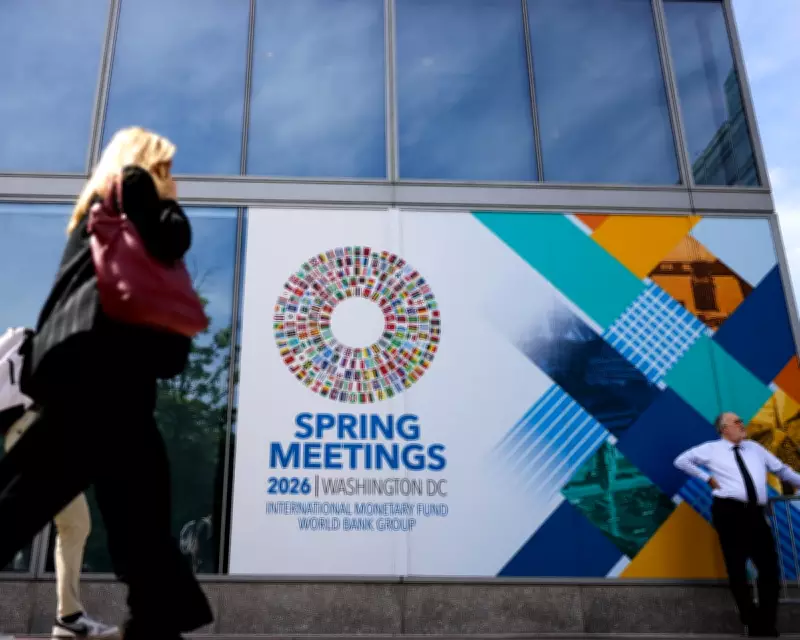
Iran War Casts Deep Shadows Over IMF-World Bank Meetings in Washington
The atmosphere at the International Monetary Fund and World Bank spring meetings in Washington DC this week has been described as profoundly sombre, with the ongoing Iran war casting a long shadow over global economic discussions. Finance ministers and central bank governors gathered in the sweltering US capital, where a record-breaking April heatwave mirrored the mounting tensions and concerns about worldwide economic stability.
Global Economic Outlook Darkened by Conflict
Kristalina Georgieva, the managing director of the IMF, addressed the assembly with a chilling message. She noted that while living standards had been showing signs of improvement globally, the Iran war has dramatically altered the landscape. "Some countries are in panic," Georgieva stated, emphasizing that "the sooner it ends, the better for everybody." The conflict has triggered the most severe energy shock since the 1970s, raising the spectre of a global recession and a renewed surge in the cost of living that disproportionately impacts the most vulnerable populations.
Mohamed El-Erian, former IMF deputy managing director and current chief economic adviser at Allianz, characterized the gathering as a "twilight-zone meeting." He identified three major shadows hanging over the discussions: concern for the global economy as a whole, the disproportionate impact on specific countries that receive little attention, and the added insult that the United States, which initiated what many view as a war of choice, will be relatively less affected than other regions.

Transatlantic Tensions and Diplomatic Disagreements
UK Chancellor Rachel Reeves joined her global counterparts in highlighting the tangible pain felt by households and businesses due to higher energy prices stemming from the conflict. In a notable public critique, Reeves described the Iran war as a "mistake" and a "folly" that has failed to enhance global security. Her comments came ahead of a one-on-one meeting with US Treasury Secretary Scott Bessent, underscoring the diplomatic friction present at the meetings.
Despite the public disagreements, those close to Reeves insist her meeting with Bessent remained cordial, acknowledging the significant shared interests between the UK and US in areas such as artificial intelligence, financial services, and trade. However, the underlying tension was a major topic of conversation at a cocktail party hosted at the British ambassador's residence, attended by hundreds of diplomats and financiers, including Bank of England Governor Andrew Bailey and Barclays CEO CS Venkatakrishnan.
Shifting Global Cooperation and Economic Hedging
The agenda for the IMF meetings, originally focused on global cooperation, AI adoption, job creation, and poverty eradication, has been severely complicated by the geopolitical crisis. David Miliband, former UK foreign secretary and current head of the International Rescue Committee, observed that many attendees are now focused on how to hedge against American decisions. "Everybody is talking about how you hedge against American decisions," Miliband said. "You can't do without them, because they're 25% of the global economy. But, in a lot of fora, they've pulled out."
This shift represents a stark irony, as the meetings take place in institutions founded under US leadership after World War II to promote global cooperation and prevent the economic conditions that lead to conflict. Yet, the current gathering is dominated by discussions on how to navigate a world where the traditional Western alliance is no longer the central pillar of international relations.
The Limits of Economic Policy in a Geopolitical Crisis
Economists at the meetings acknowledged that while they debate the best policy responses to the economic shock of the Iran war, the real power to effect change lies not within the halls of the IMF or World Bank, but two blocks away at the White House. "It is not clear they can do anything about it," El-Erian remarked, highlighting the frustration felt by many attendees.

Despite the tensions, most countries recognize they cannot afford to completely sever ties with the United States, particularly given the booming US economy driven by advancements in AI, such as Anthropic's powerful Mythos model. El-Erian summarized the prevailing sentiment: "They want to go long the private sector and short the mess. But it's almost impossible to do." The meetings concluded with a sober recognition that the path to global economic stability is now inextricably linked to the resolution of the Iran conflict, leaving finance chiefs to navigate an increasingly fragmented and uncertain international landscape.