Green Party's Muslim Vote Triumph Sends Shockwaves Through British Politics
The Green party's remarkable success in securing Muslim votes during recent byelections in Gorton and Denton has created significant tremors throughout Westminster, prompting intense recriminations and accusations from opposition parties who perceive another major realignment unfolding within British politics.
Unexpected Victory Margin and Political Fallout
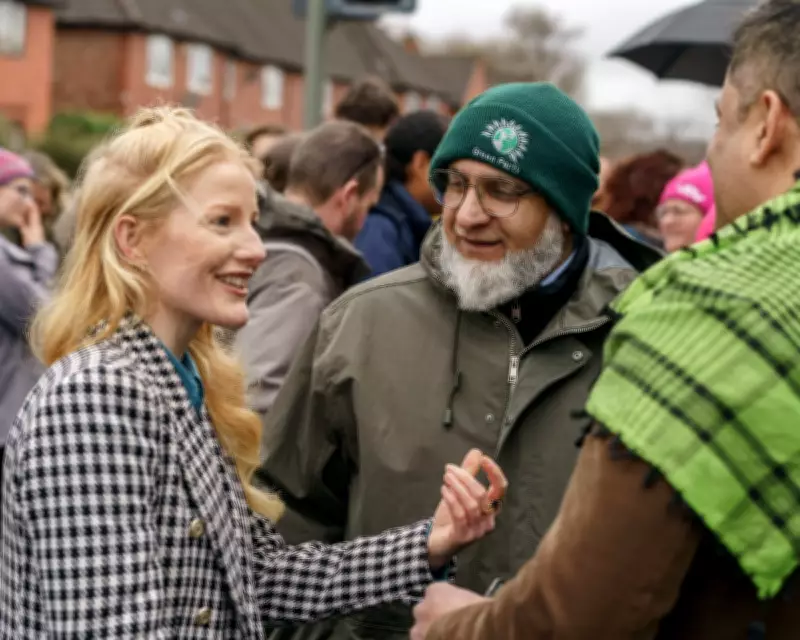
Political analysts confirm that Hannah Spencer's unexpectedly wide margin of victory was delivered in substantial part by a significant shift of Muslim voters abandoning Labour to support the Greens. This development has sparked immediate backlash from both Labour and Reform UK, who have accused the Greens of engaging in sectarian politics.
The accusations center on several controversial campaign elements, including the Green party's utilization of Indian Prime Minister Narendra Modi in campaign materials, their endorsement by firebrand former MP George Galloway, and allegations of potential voter manipulation during the electoral process.

Labour's Internal Concerns and Starmer's Response
Labour leader Keir Starmer addressed party MPs directly on Friday, stating clearly: "Their divisive, sectarian politics is a sign that the Greens are not the harmless environmentalists they pretend to be." Despite this public condemnation, senior Labour figures privately acknowledge that the Greens' demonstrated ability to mobilize Muslim voters indicates the leftwing party is beginning to construct the kind of sophisticated political machinery that Labour itself has depended upon for decades.
One Labour source revealed: "The Greens were executing extensive outreach with mosques, convincing community members they represented the best chance to defeat Reform. When progressive voters sought a unifying party, persuading Muslim community networks that you represented the strongest winning option made an enormous difference."
Traditional Muslim Support Shifts Dramatically
Labour has historically relied heavily on Muslim voter support. Just before the last general election, a Savanta poll indicated nearly two-thirds of Britain's approximately four million Muslims intended to vote Labour. However, recent months have seen growing anger within Muslim communities regarding Labour's position on Gaza, compounded by frustration with the party's immigration policies.
Several Labour MPs reported encountering Muslim voters expressing particular displeasure with Home Secretary Shabana Mahmood, one of the country's most prominent Muslim politicians. One MP explained: "Numerous constituents expressed anger toward Shabana and our overall immigration approach. Multiple individuals noted that current immigration rules would have prevented their own parents from establishing lives in Britain."
Accusations of Sectarian Campaigning Intensify
The allegations from Labour and Reform regarding sectarian campaigning focus on specific details. First, a Green campaign video in Urdu criticized the government for maintaining overly close ties with Narendra Modi, India's Hindu nationalist prime minister who remains particularly polarizing among those of Pakistani heritage.
Second, George Galloway's last-minute endorsement of the Greens raised concerns, given his history of conducting divisive campaigns in areas with substantial Muslim populations. Finally, Reform and Conservative parties highlighted a Democracy Volunteers report warning of widespread "family voting," where one family member accompanies another into voting booths with potential influence over their ballot.
Reform's Strong Reaction and Muslim Community Response
Matt Goodwin, Reform's candidate for the seat, claimed a "dangerous Muslim sectarianism" had emerged and declared there was "one general election left to save Britain." Nigel Farage made broader claims about "serious questions regarding democratic process integrity in predominantly Muslim areas."

These accusations have provoked anger among prominent British Muslims, who argue Reform is attempting to delegitimize an entire community by connecting the "family voting" report to legitimate voter outreach efforts. They emphasize that tailoring messages to specific demographic groups represents a universal feature of political campaigning.
Wajid Akhter, secretary general of the Muslim Council of Britain, condemned what he termed "gutter rhetoric from a desperate political class unwilling to grant ordinary British voters the dignity they deserve." Shaista Gohir, who leads the national charity Muslim Women's Network UK, stated: "Muslims possess every right to support the party that listens to them and aligns with their concerns, just as many voters now appear aligned with Reform."
Historical Context and Green Party Defense
This is not the first instance where concerns have emerged regarding how family and religious networks might influence voting patterns among British Muslims. A 2015 academic report from Manchester and Liverpool universities noted: "These networks tend toward reciprocity while being hierarchical and patriarchal, potentially undermining voter individual and free choice principles."
Green officials counter that voter fraud typically occurs most prominently in postal ballots, and Labour actually won the postal vote in these elections. Experts additionally suggest any voter manipulation would unlikely have been sufficiently widespread to challenge Spencer's substantial 4,402-vote majority.
A Green spokesperson declared: "Our victory's scale demonstrates the Green party has gained substantial support across all constituency areas, among all communities. This represented a victory for unity over division, for hope over hate."
Future Implications for Progressive Politics
Both Labour and Green sources concur that during an election where progressive voters sought credible information about blocking Reform, Muslim community networks proved essential messaging channels. They further suggest this dynamic could become even more crucial during the next general election if it transforms into a de facto referendum on Reform and Nigel Farage.
One Labour source warned: "Eventually you reach a tipping point where Labour's most traditional supporters realize they can abandon the party en masse while still preventing Reform's success. That represents the genuine danger we face in the coming election."