European leaders at the G7 summit have urged Donald Trump to try to break the deadlock over ending the Ukraine war by taking up the proposal for him to host talks in the US between Volodymyr Zelenskyy and Vladimir Putin.
Trump acknowledges difficulty but vows to act
The US president lamented "the great antipathy" between the Ukrainian and Russian leaders that made it difficult to reach a settlement, and vowed to do what he could. He said Moscow "should make a deal", noting that it had "lost a great many people, just like Ukraine".
Zelenskyy, attending the summit in the spa town of Évian-les-Bains at the invitation of the French president, Emmanuel Macron, is attempting to re-engage Trump in the hope that the US administration will be less distracted now it has agreed a 60-day ceasefire in Iran.

Macron's hot mic moment and G7 dynamics
Macron, caught on a hot mic at the summit, was heard admitting to Zelenskyy he had had difficult discussions with Trump on Monday concerning Ukraine. Speaking at a morning session of G7 leaders and Zelenskyy, Trump said he would do what he could, and German sources claimed Trump recognised that Russia was in a weaker position than previously.
The leaders of the G7, which comprises the US, Japan, France, Canada, the UK, Italy and Germany, also agreed to step up sanctions on Russian energy. The European Union is already preparing its 21st sanctions package, including restrictions on the sale of LNG tankers to Russia.
Zelenskyy's bilateral meeting with Trump
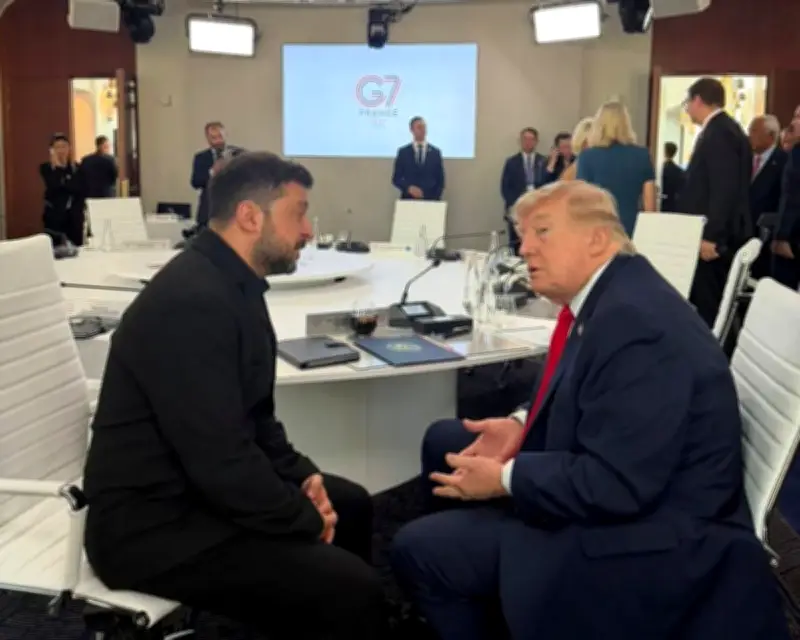
Zelenskyy – who did not initially have a bilateral meeting with Trump scheduled – eventually met the US president alongside Macron for his first face-to-face meeting in four months. Zelenskyy tried to convince Trump that Ukraine was no longer losing on the battlefield, and the US role should not be that of a messenger between the two sides but of a mediator supportive of Ukraine. The meeting delayed the start of the full summit.
Giving his readout of the meeting via video link to a Reuters conference in London, Zelenskyy said the G7 leaders unanimously agreed: "Russia is not winning and is losing a lot people; it must therefore reach an agreement as quickly as possible. They do not have the initiative in their hands."
Prospects for talks before winter
He said it was important to try to organise talks with Russia before the winter, while acknowledging that Moscow had not responded to his proposal that Putin attended the G7 meeting. Trump spoke to Zelenskyy and Putin on Sunday before travelling to the G7 and claimed both men were open to a meeting. He described the death toll in the war as "ridiculous".
Trump – who lost patience with his inability to force home a deal in which Ukraine gave up territory it had not lost on the battlefield – still seems to regard the US as neutral in the conflict, and above all eager to see economic sanctions on Russia lifted so projects such as an Alaska-Siberia tunnel can be considered.
European allies seek direct role
Zelenskyy and his main European partners – the UK prime minister, Keir Starmer, the German chancellor, Friedrich Merz, and Macron – realise talks with Russia in the short term may be unlikely, but hope Trump's engagement could make them possible in the autumn. The E3 – UK, Germany and France – also want to be directly represented at the talks, since they are providing almost all the financial and military support to Ukraine.
Putin's special representative, Kirill Dmitriev, kept up a steady flow of social media posts denigrating the Europeans during the G7 talks, including welcoming Starmer's political demise. "EU/UK warmongering 'poison pills' to derail peace discussions are too obvious and delay peace by pushing tired, unrealistic solutions," he wrote. "Hypocrisy does not work well when exposed."
Zelenskyy's military updates and long-range strikes
In his remarks at the G7, Zelenskyy told the leaders he was making changes to army pay to make frontline recruitment levels sustainable. The US vice-president, JD Vance, the most consistent critic of Ukraine in the US administration, has repeatedly claimed that Ukraine is bound to lose the war because of Russia's superior ability to recruit soldiers.

Zelenskyy also confirmed Ukrainian drones had set on fire Moscow's largest oil refinery, which is about 9 miles (15km) from the Kremlin and 300 miles (500km) from Ukraine. "Russia must be forced to end its war against our people. And Ukraine's long-range weapons are one of the important components of such pressure," he said. "This is a just response to Russian strikes – and to the dragging out of a war that must be ended."
European representation and internal debates
European leaders are pushing to be involved in any talks. "The right negotiation is one in which Ukraine and Russia are at the table, but with Europeans and Americans present as well," Macron said on Monday. German government sources said that the most realistic format would pair Ukraine and Russia with the US and Europe but the hardest question was who speaks for Europe. They argued Kyiv now negotiated from a position of strength, because Russia cannot win on the battlefield and its economy is straining.
Internal European discussions about appointing a special representative to lead Europe at the talks suffered a setback when the Finnish president, Alexander Stubb, rejected taking up the possible post. "Personally, I do not see myself as a representative in this matter," he said. "I believe this should be led by the major players, namely France, Germany and the UK." Diplomats are looking for a heavyweight figure such as a former prime minister.
But he backed the idea of talks, saying: "We are currently in a situation where Ukraine holds strong positions militarily, politically and economically. Therefore, I believe the time has come for Europe to establish contact with Russia's leadership, specifically President Putin, in order to conduct diplomatic negotiations."