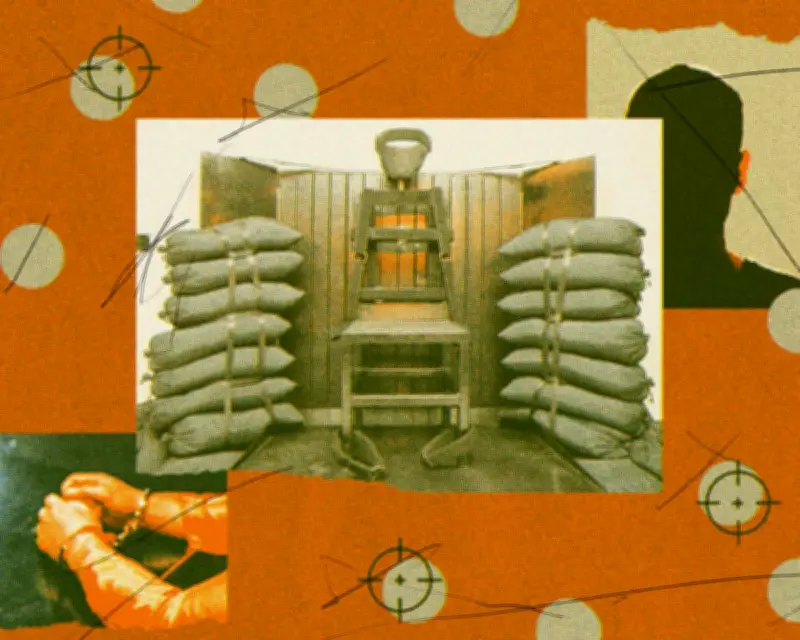
Idaho has become the first US state to adopt the firing squad as its primary form of execution, with the state's department of corrections (IDOC) confirming that its death chamber at a maximum security prison south of Boise is retrofitted and open for business as of 1 July. The state spent over $1m on the venture, including $24,000 on a rack of AR-style, .308-caliber, scoped rifles to be wielded by volunteer marksmen.
The firing squad, long considered archaic and bloody, is on the rise across the US as states seek new approaches to capital punishment. Idaho becomes the seventh state to include it among its execution methods, with more jurisdictions now allowing judicial killing by gunfire than at any time in US history.
Concerns over botched executions
Despite supporters' claims that the method is foolproof, forensic experts warn that it can go grotesquely wrong. Of the four firing squad executions carried out in the US since 2010, two appear to have been botched, with bullets veering from their intended target of the left ventricle of the heart and causing prolonged, agonising deaths. Expert forensic analysts have raised allegations in US supreme court filings that the blunders may have been intentionally inflicted as a form of retributive punishment.

Under Idaho's new death protocol, the identities of the three volunteer shooters are known only to the state prisons director and deputy. They will be responsible for carrying out court-ordered killings of Idaho's eight death row inmates, one of whom is female. IDOC stated that its procedures were designed "to ensure that any execution is conducted in a secure, orderly, and dignified manner."
Shift from lethal injection
Idaho switched procedures after lethal injection ran into difficulties. In February 2024, the state had to call off the execution of convicted murderer Thomas Creech after a medical team failed to establish an IV line. Other states have been similarly plagued by botched lethal injections, exacerbated by an international boycott of medical supplies used in the procedure. Alabama took up nitrogen gas asphyxiation, but earlier this month federal courts declared it unconstitutional.
Given the quagmire facing active death penalty states, the firing squad commands obvious appeal. There is no impediment to acquiring rifles in the US, and the five states that have firing squads among their possible protocols—Idaho, Mississippi, Oklahoma, South Carolina, and Utah (plus Florida and Tennessee, which could also theoretically access the firing squad if other methods fail)—claim it is close to flawless.
Historical botches
But such claims are belied by American history. Though the firing squad was used at the first judicial execution in the Jamestown settlement in 1608, it has been relatively sparsely used since. There have been 147 executions of civilian prisoners by gun since Jamestown, several of which fell short of foolproof. In 1879, Wallace Wilkerson took 27 minutes to die after marksmen shot him above the heart and in the left arm. "Oh, my God! My God! They have missed," he screamed as he writhed in the dirt.
Martin Gardner, a law professor writing in the Ohio State Law Journal, examined the first known case in which shooters are thought to have deliberately aimed away from the prisoner's heart. When Eliseo Mares faced a Utah firing squad in 1951, all four live bullets entered the wrong side of his body. Gardner writes: "It appears the misses were intentional. Whether the riflemen wished to torture the victim or feared to inflict the fatal shot in the heart is unknown."
Recent cases
Over the past 16 years, there have been four firing squad executions, two of which generated concerns. In 2010, Utah put to death Ronnie Lee Gardner, 49, using a team of five anonymous officers. The Salt Lake Tribune reported that after the bullets slammed into his chest, Gardner clenched his hand into a fist several times in what appeared to be an effort to fight the pain. The witness said it was an "excruciating wait for Gardner to die."

Last year, opponents of capital punishment led by Utahns Against the Death Penalty brought on board Dr Jonathan Groner, an emeritus professor of surgery at the Ohio State University, to study the autopsy findings. Groner was disturbed to find that the holes in Gardner's torso were not located over the heart but further to the left. He told a press conference: "It seems possible that there is some sort of implicit bias in the execution process."
Randy Gardner, brother of the executed inmate, said: "It's just disgusting. How from 20ft away could anybody miss a target pinned on my brother's heart?" The Utah department of corrections declined to comment.
South Carolina's experience
Most firing squad executions in America over the past century have been carried out by Utah. But last year, South Carolina convened three firing squads. The first took the life of Brad Sigmon, 67, and appeared to go as intended. But in April 2025, the execution of Mikal Mahdi, 42, a convicted murderer who killed an off-duty police officer in 2004, was anything but textbook.
An Associated Press media witness reported that Mahdi cried out as three volunteer prison employees, standing 15 feet away, emptied their rifles into him. He groaned twice over the next 45 seconds and continued breathing for about 80 seconds before making a last gasp—much longer than the 10 to 15 seconds he was supposed to have remained conscious. Autopsy results obtained by the Guardian showed only two wounds on Mahdi's body despite three members of the firing squad. The state claimed that two of the three bullets must have entered the same entry hole, but a forensic pathologist called that scenario "extraordinarily uncommon."
The pathologist, Dr Jonathan Arden, concluded that the shooters missed the intended target area, causing "excruciating conscious pain and suffering" for up to 60 seconds. Gerald King, a federal public defender involved in representing all three men killed by South Carolina's firing squad last year, said the evidence showed that the Mahdi shooters had largely missed the prisoner's heart and that the execution had been botched. "This did not go as the state said it would."
Allegations of intentional misfiring
A month after Mahdi's execution, the South Carolina supreme court ruled that the process had not been botched, but confirmed that the marksmen had failed to strike the critical left ventricle and had hit only Mahdi's pericardial sac and right ventricle. In the course of later proceedings for Stephen Stanko, 57, a convicted murderer, Stanko's legal team made an eye-popping allegation in filings to the US supreme court. Drawing on expert opinions from a ballistics forensics scientist and pathologist, Stanko's attorneys posited that "those responsible for conducting the Mahdi firing squad intended to miss the direct target," causing him to endure "the most extreme pain a human can experience until his death."
Joseph Perkovich, counsel of record in Stanko's filing, said: "They missed entirely the left ventricle, and only glancingly struck the right ventricle. For three marksmen to miss their target 15ft away is effectively impossible—so that leaves us with something very bleak, and that is the intent."
In his upcoming book The Hippocratic Paradox, Dr Jonathan Groner discusses Mahdi's execution and suggests that the firing squad aimed away from the left ventricle aware that Mahdi, a Black man, was on death row for killing a white police officer. Groner ponders whether this was a "quasi-lynching." He writes: "Would corrections officers in a southern state intentionally torture a Black man who murdered a police officer? The historical record suggests this is far from out of the question."
The South Carolina department of corrections pointed to the state supreme court ruling and said: "South Carolina categorically denies this purely speculative accusation."
Secrecy and doubt
Given the total secrecy that surrounds executions in South Carolina, as in other death penalty states, there is no way to ascertain who the volunteers were or their state of mind. Deborah Denno, an authority on execution protocols at Fordham law school, expressed unease about the sudden craze for firing squads. She used to see the protocol, with its claim to being "foolproof," as the "least inhumane readily available method." Now she's not so sure. "We tend to forget that human beings are conducting this, and human beings have emotions and feelings. Such as wanting to set things right, an eye for an eye, and revenge."