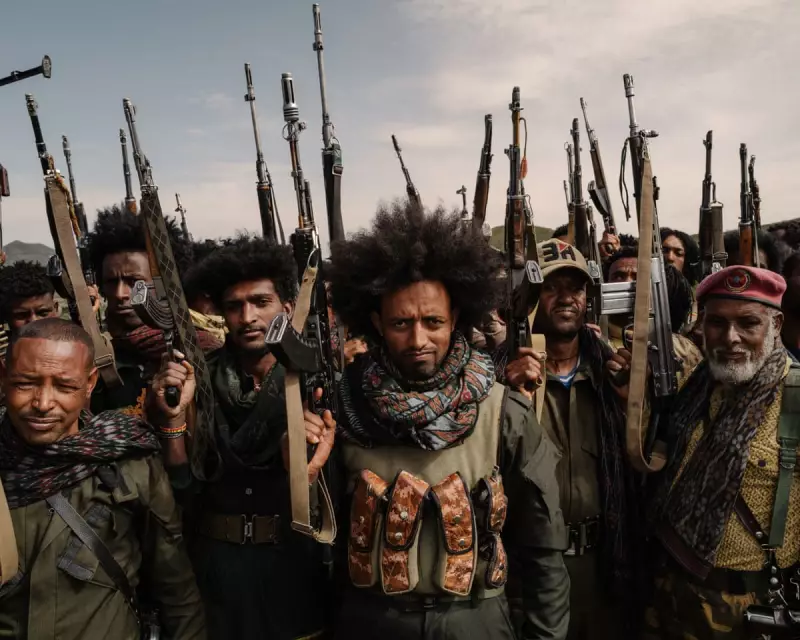
Ethiopia stands on the precipice of renewed nationwide conflict, with a violent armed insurgency already devastating its north-western highlands. A rare photographic report offers a glimpse into the remote Amhara region, where the ethno-nationalist Fano militia is locked in battle with federal forces, cutting off vast areas from the outside world.
The Rise of the Fano and a Fractured Peace
Three years after the official end of the Tigray war, which claimed over 600,000 lives, fighting has never truly ceased in northern Ethiopia. In the Amhara region, bordering Tigray and Sudan, the Fano movement has emerged as a powerful force. Composed mainly of former soldiers from the disbanded regional special forces, this militia now controls large swathes of territory, primarily rural areas.
The 2022 Pretoria Agreement, which ended the Tigray war, reshuffled alliances, turning former federal government allies into enemies. Amhara fighters felt profoundly excluded from the peace deal, fostering a deep sense of betrayal. The situation deteriorated further when Addis Ababa announced the dismantling of the regional special forces in 2023, a move perceived as a direct threat by the Amhara community.

A Region Engulfed by Violence and Abuses
The conflict has unleashed widespread violence and severe human rights abuses. Federal forces are regularly accused of kidnappings, massacres, sexual violence, and targeted attacks on civilians and humanitarian personnel, often using drones. One such strike on a health centre in Sanqa in September 2024 killed four, including a pregnant woman.
Civilians bear the brunt of the war. The report documents harrowing accounts, such as that of Gete Beyono, 23, whose five-year-old son was killed by a government mortar shell while they crossed a field. Such atrocities fuel local anger and bolster the Fano's legitimacy. However, the Fano are also accused of multiple abuses and ethnic cleansing in territories like Wolkait and Raya, which they annexed during the Tigray war.
The fighting has displaced over 670,000 people within Amhara, a region already hosting refugees from the war in Sudan. Humanitarian aid struggles to reach those in need, blocked by federal forces and the Fano's unpredictable checkpoints. By 2024, an estimated 2.3 million people in Amhara required urgent assistance.
Strategic Stalemate and Nationalist Ambitions
The Fano, reviving the name of a 1930s anti-fascist volunteer group, claim to represent and defend the Amhara ethnic group. They have recently formed a new joint political structure, the Amhara National Fano Force (ANFF), to unite their fragmented factions, which number nearly 20,000 combatants.
Their ambitions are significant, ranging from asserting full control over the Amhara region to toppling Prime Minister Abiy Ahmed's federal government. They portray their community as the cradle of "Ethiopianness," emphasising the region's historic role as the nation's political and religious heartland, home to ancient rock-hewn churches.
The conflict has created a stark stalemate. Federal forces are largely confined to major cities, while the Fano dominate the countryside, from which they launch lightning raids. The situation remains highly volatile, with frontlines shifting constantly. Meanwhile, escalating tensions between Addis Ababa and the Tigray People's Liberation Front, alongside a war of words with Eritrea over Red Sea access, threaten to ignite a larger regional conflict.
As the insurrection continues, the economy collapses and insecurity grows. Even the Fano's widespread community support is being tested by accusations of extortion at checkpoints. For now, Ethiopia's heartland remains a fractured battleground, with no clear path to peace in sight.