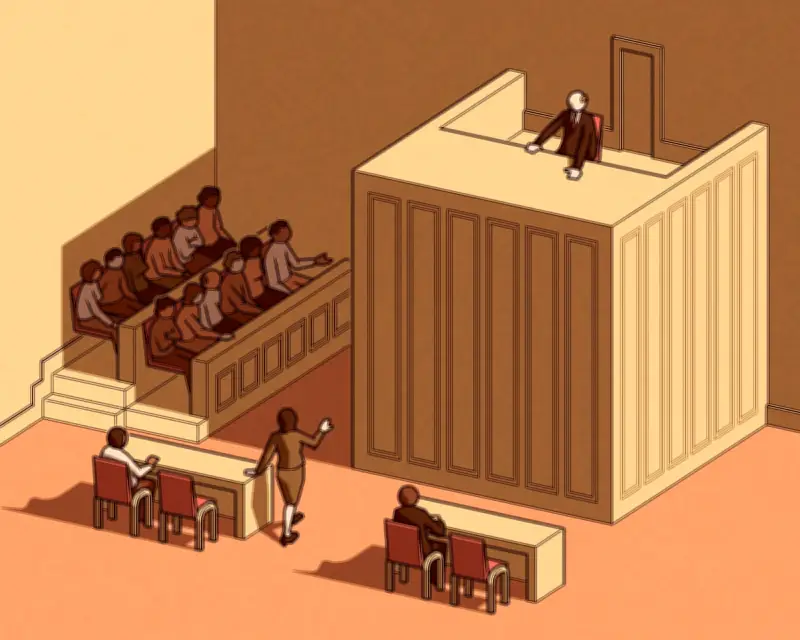
In a London court in 1670, a judge locked a jury away for two days without food, water or a chamber pot for defying his direction to convict Quaker William Penn. The foreman, Edward Bushell, refused to yield, and the chief justice of England later ruled that no juror could be punished for refusing to convict, entitling juries to decide according to conscience. A plaque honours Bushell at the Old Bailey, reminding jurors of their right to acquit.
This principle has held for 350 years. In my 50 years of practice, I have seen many juries bring back 'sympathy verdicts' – acquittals because they believe a defendant has been oppressively prosecuted. But barristers rarely remind juries of this right, fearing they should not urge juries to set aside their oath to decide on the evidence. This right is central to the case of the Elbit four, who last week were sentenced to over 22 years combined for a direct action protest.
The Elbit four and the Filton 25
Leona Kamio, 30, a nursery teacher; Samuel Corner, 23, and Fatema Rajwani, 21, both students; and Charlotte Head, 30, a domestic abuse caseworker, broke into a factory owned by Elbit Systems, an Israeli drone manufacturer. They are part of the 'Filton 25', over two dozen people being tried for breaking into an arms factory near Bristol. The first group of defendants underwent two trials. At their first trial, they faced several charges, the gravest being aggravated burglary. Their leading counsel, Rajiv Menon KC, reminded the jury of their historical right to acquit and invited them to weigh the use of the drones. The judge, Mr Justice Johnson, referred Menon to the high court for contempt for breaching an order not to mention the jury's right to acquit. The jury acquitted the defendants of aggravated burglary but could not reach a majority decision on other charges.

The prosecution demanded a retrial on the unresolved charges: criminal damage, ordinarily met with a fine or up to 18 months' sentence. By then, the four had already spent over 18 months in pretrial detention. The second jury convicted them of criminal damage. One defendant was also convicted of grievous bodily harm without intent, for accidentally injuring a female police officer with a sledgehammer while disoriented by pepper spray. He received seven years and eight months.
Secret 'terrorist connection' ruling
How does damaging property earn nearly eight years? At a secret hearing during the first trial, Mr Justice Johnson ruled that the protest carried a 'terrorist connection'. This was unprecedented for a direct action trial. His reasoning: the defendants' purpose was to 'influence' the British government – the purpose of almost every political protest. The ruling was kept secret from the jury and the public, and the UK press was barred from reporting it. There was no terrorism in any ordinary sense – no violence meant to kill or maim, only a determination to expose British complicity in killing Palestinians.
The Sentencing Act 2020, passed by the then Conservative government, widened the definition of terrorism, allowing the judge to impose far heavier sentences. As 'terrorists', the Elbit four will serve longer before parole and remain on a police list for 15 years as suspects for real terrorism crimes. They are labelled terrorists because they were convicted of a quasi-terrorist offence that was never charged, never put to the jury, and never proven by the prosecution. The jurors who found them guilty of criminal damage had no idea their verdict would be treated as a verdict on terrorism. The prosecution was not required to establish the terrorist connection beyond reasonable doubt.
Foundational principles undermined
It is a foundational principle of English law that no one should be convicted of an offence not charged and proved. Here, that principle was suspended. The secrecy compounds the injury. As Jeremy Bentham said, 'Publicity is the very soul of justice; it keeps the judge, while trying, under trial.' The court of appeal struck down Johnson's decision to have Menon tried for contempt, ruling it wrong; Johnson apologised, but that did not stop him sentencing Menon's clients after their second trial.

This returns us to Edward Bushell and what a jury is for. Juries have always had the power to temper law with mercy, among the oldest protections against an overbearing state. The difficulty is that judges seldom tell juries this power exists, leaving counsel to invoke it obliquely. Years ago, defending a woman who killed her abusive husband, the advocate Edward Marshall Hall closed with: 'Just look at her, gentlemen of the jury. God never gave her a chance. Won't you?' They did.
It would be far more transparent to bring the power into the open – let the judge remind the jury of the right where the defence claims it, and let the prosecution argue against its exercise. Instead, the only lawful way to appeal to a jury's conscience is to tell them to look at a plaque in the Old Bailey lobby. The Elbit four did not act in ignorance of the consequences. Bentham held that a citizen may disobey an unjust law, provided they accept punishment. On that view, protesters who knew they were breaking the law against criminal damage should have pleaded guilty. While on trial, they openly acknowledged participating in the break-in and damaging the drones. What no defendant should face is punishment for a terrorism crime that was never charged.