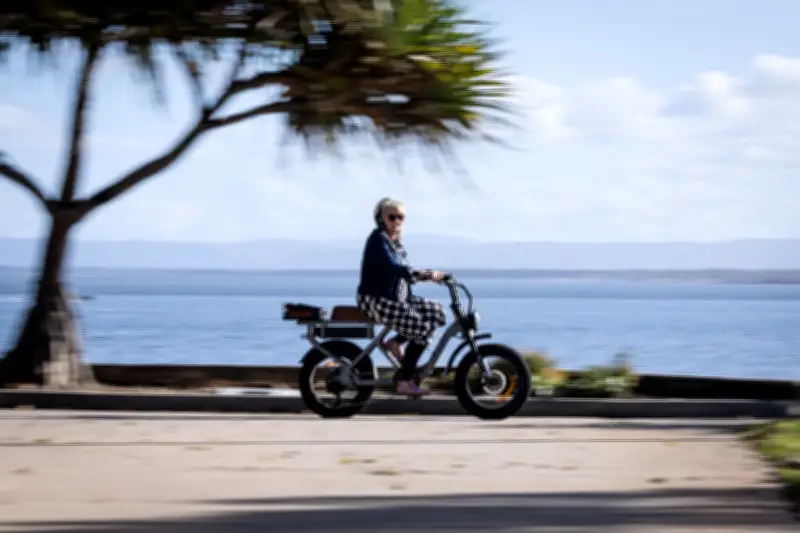
Since getting an ebike last year, Paula Sharam, 70, no longer drives on Bribie Island and says she already complies with the new 12km/h speed limit near pedestrians. Photograph: David Kelly/The Guardian
Aggrieved pedestrians and push-bike riders are pitted against those who see e-mobility as a ‘once in a generation’ chance to change the way we travel around cities. Get our breaking news email, free app or daily news podcast. The best new cycling and ebike trails in Melbourne and surrounds.
Paula Sharam had a nightmare last week: a thief stole her ebike. “I was telling my granddaughter and she said: ‘You love that bike more than us!’,” she says. Sharam laughs, but then, in earnest, says that her two-person, fat-tyred ebike has changed her life. She picks up her grandkids with it. Loads it up with groceries for the shopping run. Commutes to the fashion shop she runs. These days, Sharam says she only really takes her SUV out every few weeks, when she has to pop into Brisbane, about 65km south of her Bribie Island home. “On the island, I don’t use my car,” she says. “I just use my bike.”

Sharam’s bad dream occurred on the eve of the Queensland government’s passing of what it described as a nation-leading “crackdown” on “dangerous e-scooter and e-bike behaviours”. As it turned out, her worst fears weren’t realised. She has a driving licence. Her bike has a maximum unassisted speed of 25km/h and is compliant with European product safety standards. All of these are among the requirements for ebike riders under the new laws.
‘I avoid people on the footpath like the plague,’ Sharam says. ‘It’s common sense.’ Photograph: David Kelly/The Guardian. Sydney is awash with shared ebikes. Is Australia finally falling in love with Lime? Read more. At 70, she is comfortably above the 12–17 age bracket at which e-mobility will now require parental supervision. And Sharam says she already complies with the new 12km/h speed limit near pedestrians. “I avoid people on the footpath like the plague,” she says. “It’s common sense.” But Sharam is concerned the added regulation and “demonisation” of ebikes will preclude or discourage others from enjoying their benefits. Which makes her among the more measured critics of laws that have come under blistering attack from all sides.
Fears of ‘complete embarrassment’
The Australian Medical Association’s Queensland branch says the government’s backpedalling of its original proposal – to ban people under 16 using the devices – was a shocking “betrayal of children’s safety” that left doctors “struggling to see” the point of the government’s 10-month long e-mobility inquiry. More than 1,200 submissions were made to that inquiry, and they show just how deep divisions run on what advocates refer to as a burgeoning “revolution” in transport – but what critics say is unleashing “chaos on our streets and footpaths”.
Sign up for the Breaking News Australia email. There are many aggrieved pedestrians and push-bike riders, some of whom attested to life-altering injuries they say were caused by e-mobility devices. On the other side were the many advocates, among them Engineers Australia, who saw in the “rapid uptake” of e-mobility a “challenge” – but one that offered a “once in a generation opportunity” to embrace news ways of travelling around cities at a time when the transport network is “under enormous pressure”. Others, like the state’s tourism council, pitched a vision of Queensland as a “national leader in active transport” when it hosts the world for the Brisbane 2032 Olympic and Paralympic Games.

Instead, the Queensland University of Technology’s Dr Mark Limb tells Guardian Australia the state will now “probably have the most hostile laws for ebike usage anywhere in the world”. “I’m not aware of any other jurisdiction, in the free world at least, that has a licensing scheme to ride a bicycle, for example,” the urban planning researcher says. Dozens of young ebike riders descend on Sydney golf course in viral rideout – video. Limb says it comes at a time when active transport desperately needs to be fast-tracked in the car-centric south-east corner, where about 4 million of the state’s 5.7 million people live. That region could add the population of another Brisbane to its rapidly expanding suburbs over the next 30 years, Limb says. He says e-mobility was “meant to be the answer” to the region’s natural barriers to having more people leaving their cars at home: hills, heat and humidity. It could also showcase south-east Queensland’s natural beauty and outdoor lifestyle to international visitors, he says. He fears “complete embarrassment” at the Games, with visitors stuck in traffic on ugly main roads or fined for using a hire scooter without a licence.
However, the problem for e-mobility advocates like Limb and Sharam is that not everyone rides like a fashion-loving grandmother on a laid-back island.
‘Too afraid to ride’
Sophia Tyrrell lives at Palm Beach on the Gold Coast, on the other end of the state’s south-east region from Sharam. Her children – River, 8, and Kai, 6 – attend a primary school 2km away. When they rode their push-bikes, the school drop-off took about 10 minutes. That was until November, when River was knocked off her bicycle by an ebike rider. Between Tyrrell’s home and the primary school is a high school – to which hundreds of students ride ebikes and e-scooters. She says many of them illegally modify their rides to reach high speeds, or ride legal devices dangerously. Fortunately, River wasn’t seriously injured. But the many accidents and bad behaviour they witnessed every day upset Tyrrell’s children. “We can ride and we would ride every day to school,” Tyrrell says. “But my kids are too afraid to ride after everything they’ve seen.” Instead, she drops them off in her SUV – a journey that can take about 20 minutes in peak hour congestion.
Tyrrell runs a hair salon, and when e-devices first hit the footpaths, they were the biggest topic among her customers. One client, a 67-year-old woman, needed reconstructive surgery on her shoulder after being struck by two boys on an ebike on the footpath, Tyrrell says. Another was left with a fractured toe after being hit by an e-scooter. “We have got to a position where we are afraid to walk on our footpaths,” she says. Tyrrell says the new laws are “great” on paper. But she doubts police have the resources to enforce new e-mobility infringements – and fears the laws will amount to regulation in name alone.
‘To be out in the fresh air and just being able to have that mobility to just go anywhere is great,’ Sharam says. Photograph: David Kelly/The Guardian. “I would remove [e-mobility devices] from the footpath and put them on the roads where they belong,” she says. “Because, for me, they are motorbikes, only silent.” Limb disputes that categorisation. Most ebikes, he says, are more like push-bikes. But on other key points there is more widespread agreement. E-mobility devices with throttle acceleration that can travel at high speeds unassisted by pedalling are more like motorbikes, he says – but these were already illegal. Queensland is experiencing conflict on its footpaths – but that conflict, he says, is a “damning indictment” on the poor state or absence of footpaths and a safe and dense network of active transport routes.
Tyrrell says her problem is not with ebikes and e-scooters per se and says, if given the space and laws to be used responsibly, they could help make her life better – even if she never uses one. “The traffic here on the Gold Coast where we live is so horrendous,” she says. “We need to expand the footpath, the bike lanes, and all the infrastructure, because the population is exploding here.” Sharam agrees e-mobility devices could lead to fewer cars on the road, fewer emissions and less power consumed. Which, she says, would do more than benefit the environment. “To be out in the fresh air and just being able to have that mobility to just go anywhere is great,” she says. “I think it would just make people happier.”
The state’s transport minister, Brent Mickelberg, says Queensland’s “tough new laws” were “based on extensive community and expert consultation” and “strike the right balance between keeping Queenslanders safe from those doing the wrong thing, while backing those who do the right thing”. “We promised to deliver nation-leading laws about who can ride, what they can ride, where they can ride, and how fast – and our laws do exactly that.”