DoorDash Grandma's White House Delivery Revealed as Orchestrated Stunt
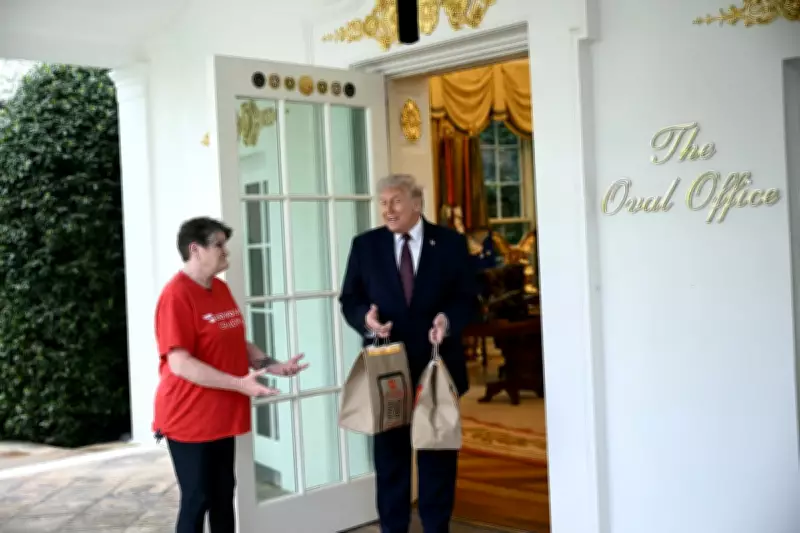
Sharon Simmons, the DoorDash delivery driver who gained national attention after being photographed delivering McDonald's to Donald Trump at the White House on Monday, had previously lobbied in favor of the president's "no tax on tips" policy. This connection has led to widespread skepticism about the authenticity of the encounter, prompting DoorDash to confirm that the delivery was indeed a staged event.
Previous Advocacy and Geographic Discrepancies
In July 2025, Simmons testified before Congress, advocating for the "no tax on tips" policy that DoorDash actively supports. During her testimony, she identified herself as a Nevada resident who turned to delivery driving due to financial strain caused by her husband's cancer treatments. However, during Monday's White House delivery, she was described as an Arkansas resident, raising immediate questions about her background and the event's legitimacy.
DoorDash later clarified that Simmons had relocated from Nevada to Arkansas in late 2025 to be closer to family. The company issued a statement acknowledging that the delivery—along with the $100 tip Trump provided—was arranged to commemorate the congressional legislation that had enshrined the "no tax on tips" policy into law a year earlier.

Corporate Response and Public Reaction
Julian Crowley, a DoorDash spokesperson, addressed accusations of deception on social media, stating, "No one is claiming it was a real delivery." Despite this clarification, many observers criticized media coverage that initially presented the delivery as authentic. The White House's rapid response team further fueled controversy by quoting Simmons—dubbed the "DoorDash grandma"—claiming she had saved over $11,000 in tips by not declaring them on her taxes.
This claim was quickly challenged by a community note on social media, highlighting that such savings would be impossible under the actual policy. When questioned by the Guardian, a DoorDash spokesperson explained that Simmons earned $11,000 in tax-exempt tips in 2025 due to Trump's policy. However, it remains unclear whether Simmons earned enough to owe federal income tax on those tips, which are still subject to Arkansas state income tax.
Policy Details and Economic Implications
The "no tax on tips" policy offers a temporary deduction of up to $25,000 annually for eligible workers, but tipped employees must still report their tips as income. According to the Tax Policy Center, only about 2% of households—representing 60% of those with tipped workers—would benefit from this tax cut, as many tipped employees already pay minimal federal income tax. The average annual savings for eligible workers is estimated at $1,800.
Labor advocates have criticized the policy for its limited impact and potential to exacerbate income inequality. Saru Jayaraman, president of One Fair Wage, condemned the publicity stunt, stating, "Corporations are paying poverty wages while policymakers offer Band-Aid solutions like 'no tax on tips' instead of raising pay."
Broader Legislative Context and Criticism
The Economic Policy Institute highlighted in a February 2026 report that the law creating the tipped income deduction also enacted significant cuts to healthcare, energy, and food assistance programs. These cuts disproportionately affect low-income households, including those with tipped workers, while financing tax reductions for the wealthiest individuals.
DoorDash's statement quoted Simmons praising the advocacy of over 40,000 drivers who ensured independent workers were included in the final legislation. However, the company declined to comment on whether Simmons receives compensation for her lobbying efforts on its behalf.
This incident underscores ongoing debates about corporate influence, worker rights, and the effectiveness of tax policies aimed at supporting low-wage earners in an increasingly precarious gig economy.