London's beloved Battersea Park Funfair, a cherished attraction for over two decades, was forced to close its doors forever after a horrific rollercoaster tragedy that killed five children and seriously injured 13 others. The incident, combined with a decline in popularity, sealed the funfair's fate, but its memories live on in the hearts of thousands.
London's Most Loved Theme Park
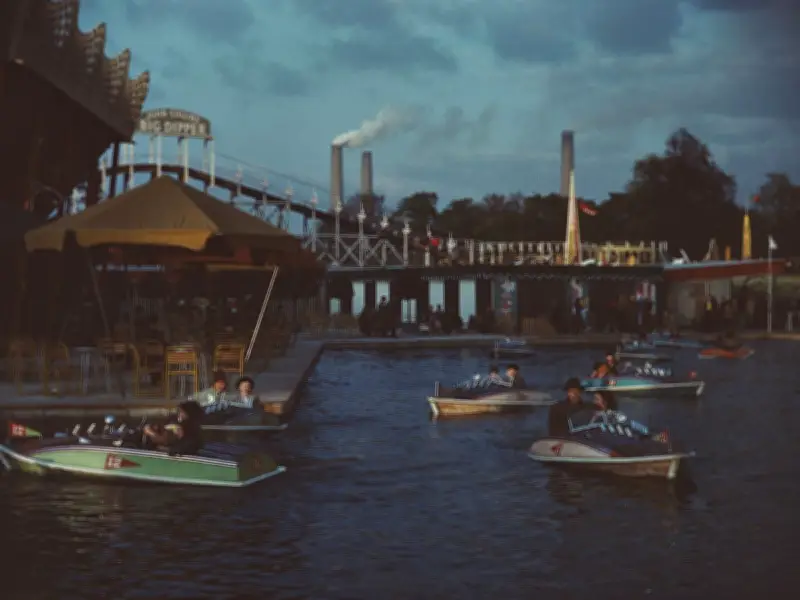
Originally conceived as a temporary post-war attraction for the Festival of Britain in 1951, the small theme park in Battersea Park was designed to showcase British creativity and achievements. However, its unexpected popularity led to the funfair operating for 23 glorious years before tragedy struck.
The Battersea Park Funfair featured thrilling rides like roller coasters, swings, and roundabouts. Some of the most beloved attractions over its history included The Boomerang, The Haunted Goldmine, The Bubble Bounce, John Crowle's Gallopers, Harry Gray's Swirl & Chairs, J. Ling's Moon Rocket, Botton's Dive Bomber, The Paratrooper, Octopus, and the pièce de résistance — the Big Dipper.

Scores of visitors walked through its doors over two decades, creating lasting memories. A Facebook group called 'Battersea Park Fun Fair 1951 to 1977' is dedicated to reminiscing about the funfair, with hundreds sharing fond memories. One person recalled, "I lived two minutes from the park went there nearly every night after school," while another shared, "Time does not erode the memory of the sounds & smells Battersea Funfair." For one individual, the funfair holds a special place: "This is where my mum and dad first met. My dad had just come over from Ireland, and was working at the fair. My dad was 16 and my mum was 15 and they are still together now 57 years later." Another visitor said, "Just thinking about the place always cheers me up." One Facebook user noted, "Lovely days wish I could go back to those days," while another reminisced, "Spent young teenage days there, and always something to do. Great memories."
World's Deadliest Rollercoaster Accident
On Tuesday afternoon, May 30, 1972, the Battersea Park Funfair became the site of the world's deadliest rollercoaster accident to date. The funfair's biggest attraction, a wooden rollercoaster train called the Big Dipper, came off its tracks, killing five children and grievously injuring 13 others. The John Collins Big Dipper had been operating since the funfair opened in 1951.
A train being hoisted to the start of the ride reportedly broke loose from its haulage rope, and the emergency rollback brake also failed. The carriages rolled backwards towards the station. Despite the brakeman's efforts, the train gathered speed, and the back carriage jumped the rails, crashing through a barrier. Two other carriages crashed on top of it.
One child, whose sister died in the accident, suffered life-changing injuries. A fire had damaged the Big Dipper in 1970, and the funfair replaced parts with second-hand stock over 50 years old. The entire structure, including the emergency pedestrian walkway, was in an unsafe and rotting condition. One victim, who survived the initial impact, fell through the handrail to her death. A report found 51 faults in the ride, and the engineer and ride manager were tried for, and acquitted of, manslaughter in 1973.
Carolyn Adamczyk, a survivor, told The Independent: "As soon as we started shooting backwards everything went into slow motion. I turned around and saw the brake man desperately trying to put the brake on but it wasn't working. Most of the carriages didn't go around the bend, one detached and went off the side through a wooden hoarding. People were groaning and hanging over the edge. It was awful."
The Big Dipper was eventually replaced with a modern steel rollercoaster called The Cyclone, but the theme park's popularity saw a massive dip after the fatal incident.
Closure and Current Status
The horrific accident, coupled with a decline in popularity, led to the closure of the Battersea Park Funfair on September 22, 1974. Plans for a European Disneyland in Battersea Park also contributed to the decision. The site was levelled and became a spot for exhibitions and travelling fairs, eventually becoming Evolution London, a popular purpose-built event venue.