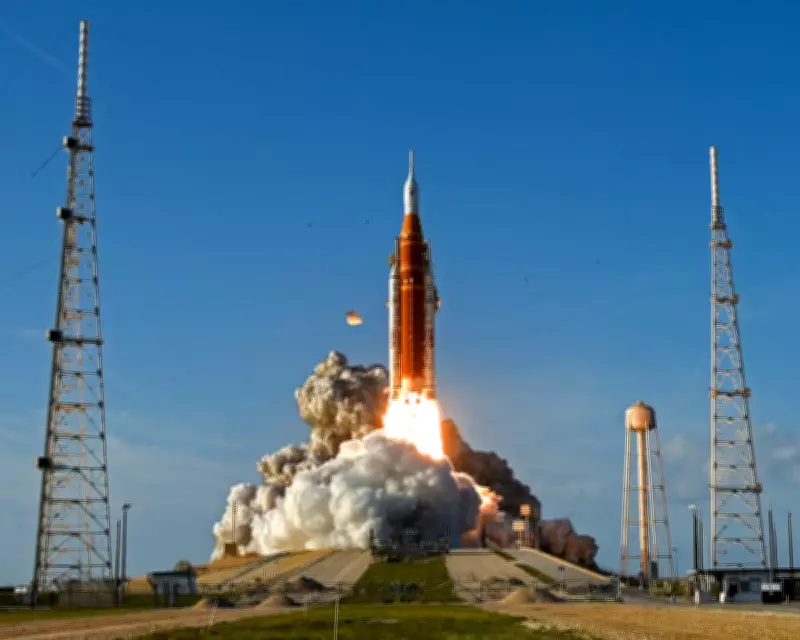
Artemis II Launch Ignites Controversy Over Space Exploration's Purpose
As NASA prepares to launch the Artemis II mission from Cape Canaveral on April 1, a growing debate has emerged about the fundamental value of space exploration. Columnist Zoe Williams has voiced a controversial perspective that challenges the entire premise of sending humans beyond Earth's atmosphere.
The Core Argument Against Space Missions
Williams acknowledges having no personal animosity toward astronauts or scientific innovation, but questions the specific purpose of the Artemis II mission. She argues that space exploration has become increasingly pointless as Earth faces urgent environmental, social, and economic crises. The columnist suggests that resources allocated to space ventures could be better directed toward solving problems on our home planet.
The Fermi Paradox plays a central role in Williams' reasoning. She references physicist Enrico Fermi's famous 1950 question "Where is everybody?" to support her position that intelligent extraterrestrial life likely doesn't exist. If such life existed, Williams contends, it would have made contact by now. She describes other planets as "infinitely less beautiful than this one we live on," questioning why humanity would seek to explore them.

Public Reaction and Counterarguments
Williams notes that her position on space exploration generates unusually strong reactions compared to her other opinions. Critics accuse her of attempting to ruin celebratory moments, opposing innovation and modernity, or lacking appreciation for scientific discovery. Some defenders of space exploration point to technological advancements that have emerged from space programs, though Williams counters that many such discoveries have primarily improved military capabilities.
The columnist clarifies several misconceptions about her position:
- She does not dislike astronauts personally, acknowledging they seem "wholesome" and "great"
- She is not opposed to innovation or modernity in principle
- Her concern is not primarily about financial costs but about opportunity costs
"It's a paradox, and not a delicious one, that moaning about the waste of energy that is space travel has turned into quite a significant waste of my own energy," Williams observes, highlighting the irony of her position.
The Broader Context and Final Appeal
Williams questions why the United States, with its numerous domestic challenges, continues to prioritize space exploration. She specifically addresses NASA with a direct appeal: "Seriously, NASA, can you not just knock it off? Hasn't the US, of all nations, got bigger things to worry about?"
The Artemis II mission represents NASA's first crewed lunar mission since the Apollo program ended in 1972. Scheduled to launch on April 1 from Cape Canaveral, the mission aims to test spacecraft systems in preparation for future lunar landings. Williams' critique arrives as space agencies worldwide increase their exploration ambitions while Earth faces unprecedented environmental and social challenges.
This debate touches on fundamental questions about resource allocation, scientific priorities, and humanity's relationship with the cosmos. As space exploration advances, discussions about its purpose and value will likely intensify, particularly as governments balance extraterrestrial ambitions with terrestrial needs.