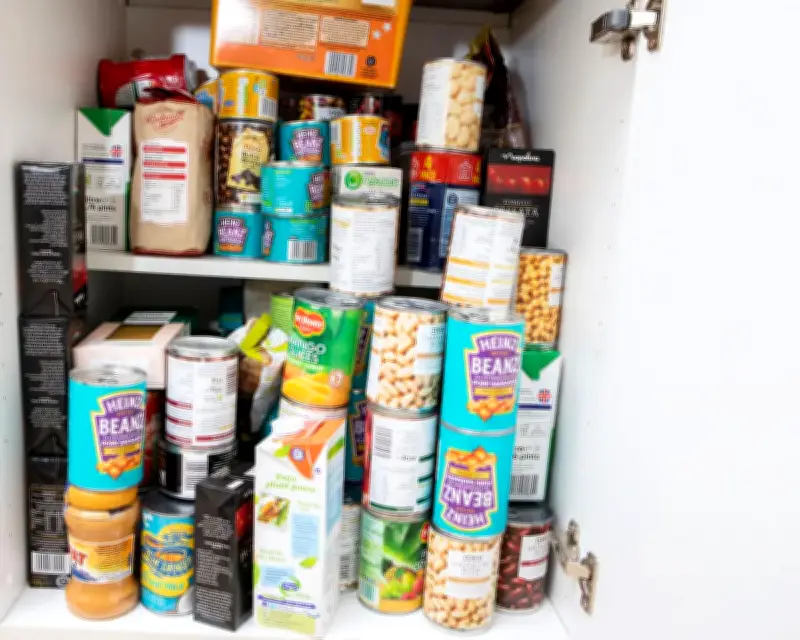
Three weeks after the UK government launched its Prepare campaign urging citizens to stockpile emergency supplies, columnist Emma Brockes has taken stock of her own efforts—and found them severely lacking. Her inventory includes two cans of tuna, two litres of sparkling water, an uncharged mega-torch, and three OxyContin tablets saved from a caesarean section nearly 12 years ago.
Government Recommendations and Personal Reality
The Prepare campaign, backed by Health Secretary Wes Streeting, lists nine essential items including wet wipes, first-aid kits, and batteries. The World Health Organization advises budgeting for 15 litres of water per person per day, meaning a family of four would need to store upwards of 180 litres to cover a three-day period. Brockes notes that the likelihood of such a scenario seems intuitively lower than the disasters the campaign aims to forestall.
Brockes's stocktaking reveals a pattern of incomplete preparation. The mega-torch, purchased after the 2019 New York blackout that left her unable to charge her phone for about an hour, remains uncharged. The first-aid kit contains mostly oversized plasters, with normal sizes long used up. The sparkling water would provide bubbles for the first hour after a nuclear strike—if it happened that afternoon. The OxyContin, she admits, is probably less powerful than homeopathy at this point, though she retains a vague hope of using it for barter when money breaks down.

A Collective Attitude Problem
Brockes identifies her main deficit as attitude. This, she argues, is a widely shared problem, evidenced by the collective shrug when informed of threats posed by AI. It's not that people don't care, but that it's hard to know what to do without sacrificing closet space to 40 two-litre bottles of water or disrupting thought patterns to accommodate uncomfortable truths.
She suggests that what's needed is rigorous thought experiments to address the collective failure of imagination. This feels necessary even six years after a global pandemic, but humankind's ability to move on from recent trauma—what she calls resilience—proves unhelpful in this context. The government calls this building "household resilience," which in her house means learning not to melt down when someone can't find their favourite hoodie or the Nutella runs out.
Local Resilience Forums and Fiction as Preparation
Brockes recommends browsing local resilience forums, which list regional threats ranging from "nuclear attack by a state on the UK mainland" down through pandemics, biblical droughts, floods, and National Grid collapse, to "space weather." She finds the lists reminiscent of the film When the Wind Blows, but notes that local government language and tables drain any sense of threat under the weight of boredom.
For real imaginative engagement, she turns to fiction. The opening pages of Emily St John Mandel's Station Eleven feature a character named Jeevan who, tipped off by a doctor friend about a coming pandemic that will kill 99% of the world's population, shackles seven shopping carts together and buys enough food and water to barricade himself in his apartment for 58 days.
Brockes concludes with a pragmatic if sardonic plan: walnuts at the back of the cupboard, batteries from the remote for the torch, books for firewood per The Day After Tomorrow, and the cats for extra warmth. She recalls a couple who survived 118 days in a tiny boat in the Pacific and imagines figuring out water collection from defrosting freezers and aloe vera gel. "See? Already thinking like a survivor. We've got this!"