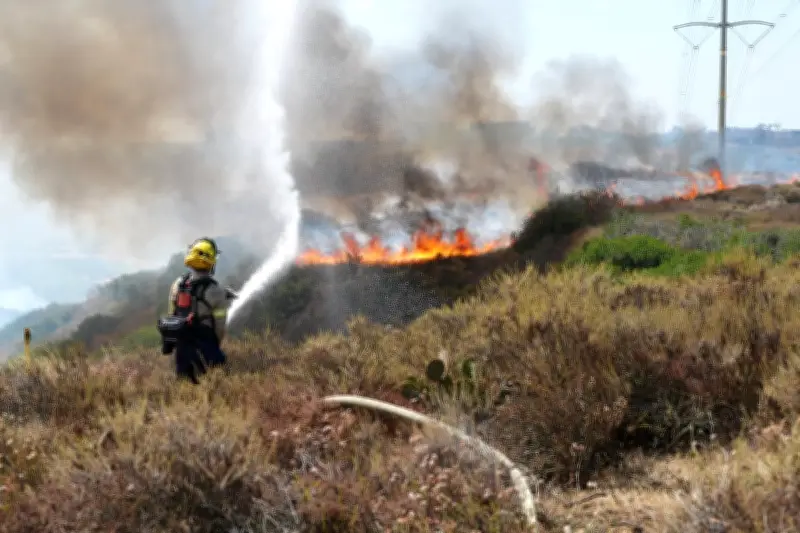
Smoke billows over Sorrento Valley as firefighters battle the fast-moving Sorrento fire near a highway interchange in San Diego, California, on 8 June 2026.
The US public still favors action on climate change despite President Donald Trump's aggressive push for fossil fuels, according to experts and polling. Two-thirds of Americans say they are worried about the climate crisis, a proportion that has remained consistent even as other issues dominate news cycles.
Elite Attention Wanes, Public Concern Steady
US political and media discourse has drifted away from the climate crisis amid Trump's frontal assault on policies to limit global heating and his demands to "drill, baby, drill" for more oil and gas. However, the American public remains concerned and continues to support action, said Anthony Leiserowitz, director of the Yale Program on Climate Change Communication.

"The 2024 election was not a referendum on climate change – Americans believe in climate change, worry about climate change and support action on climate change," Leiserowitz said. "That didn't change before, during or after the election."
Media Coverage Declines
Despite mounting heatwaves, droughts, and other impacts, US media coverage of climate change has shrunk. Outlets including the Washington Post, NPR, and CBS have cut climate journalist positions. This lack of coverage contributes to a "spiral of climate silence," Leiserowitz noted, where even some climate group leaders avoid mentioning the issue.
"There is this spiral of climate silence. I've even heard some leaders of climate groups say, 'don't mention climate change.' I don't know why they'd make that decision, there's absolutely no evidence that people care about this less than they did," he said.
Public Support for Renewables
Yale polling shows that a majority of US voters link rising costs to the climate crisis, and Trump's attempts to halt renewable energy projects are broadly unpopular. Only 7% of voters support a candidate who advocates decreasing renewable energy use, while just 14% want a candidate who pushes for more fossil fuels.
"The president's viewpoint is not shared by most Americans or even most conservative Republicans," Leiserowitz said. "This war on renewables isn't even shared by his own base."
Economic and Health Impacts
Rising temperatures are taking a toll on Americans' health and finances through heat, wildfire smoke, and storms. Research found that US households pay between $400 and $900 more each year due to climate impacts, with costs exceeding $1,300 in some counties in California, Louisiana, and Florida.
"The status quo has a lot of real negative consequences for American households," said Kimberly Clausing, an economist at UCLA School of Law and co-author of the study. Home insurance rates and health costs are being accelerated by the climate crisis.
Political Challenges
Despite polling, the political wisdom that Biden's climate policies were unpopular may deter politicians from embracing climate action. "People on the left know this is a problem and worry about it but think 'why talk about this if I want to win elections?'" Clausing said. "The last guy did, he did something about it and then this happened [election defeat]. It's hard for politicians to get excited about it at the moment."