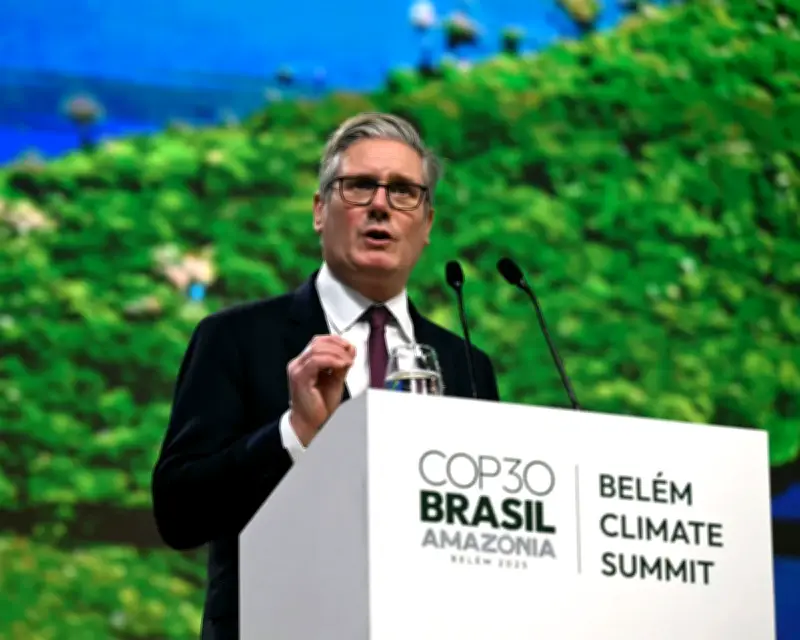
Keir Starmer faced a problem no Labour government has needed to deal with before: his energy and climate policies, core to solving the cost of living crisis, came under attack from opposition parties that made dismantling the agenda one of their top priorities, second only to immigration, in their pitch to voters.
Breakdown of cross-party consensus
This is new in British politics, where a cross-party consensus on climate and environment has held at least since Margaret Thatcher warned the UN of the climate crisis in 1988. David Cameron urged voters to “vote blue, go green” in 2006; Theresa May enshrined net zero by 2050 in law; Boris Johnson championed the Cop26 summit in 2021; even Rishi Sunak only attempted a partial rollback as a last desperate throw before calling an election.
But Kemi Badenoch weaponised the climate and energy agenda, with Ed Miliband, the energy secretary, her most frequent named target in the cabinet. She vowed to abandon the net zero target, boost North Sea drilling, scrap the windfall tax on oil and gas profits, and repeal the 2008 Climate Change Act. Nigel Farage’s Reform party went further, openly denying climate science and threatening to withdraw from the 2015 Paris agreement.

Internal disarray and rollbacks
This tearing apart of the longstanding consensus threw Labour into disarray. Some within Starmer’s inner circle whispered that his eye-catching pledge to decarbonise the UK’s electricity by 2030 was a liability and should be dropped. They briefed against Miliband to key media and forced a halving of the target of a pledged £28bn investment in the green economy.
Ed Matthew, UK director of the E3G thinktank, called that advice out of step with voters and deeply flawed. Polls continue to show voters still support climate action: polling for More in Common, for the Energy & Climate Intelligence Unit on the eve of the local elections in May, showed two-thirds of the public wanted the country to meet the net zero target. “Starmer made the bold move to set a whole of government mission to make the UK a clean energy superpower,” said Matthew. “This was visionary. But he was constrained by his former adviser Morgan McSweeney, who was concerned this mission would lead Labour voters to defect to Reform. That was a misreading of these voters, with polls showing the majority want to take back control of their energy and support more renewables.”
Green party resurgence
Rowing back on climate helped the resurgence of the Green party. “By tempering his ambition on the clean energy front, [Starmer] left his left flank open, which the Green party is now pouring through, with their pledge to speed up the transition and take on the fossil fuel industry profiting from the war,” said Matthew. Labour lost large numbers of voters to the Greens in the recent local elections, and to the Liberal Democrats who held firm on climate and environmental policies under Ed Davey.
Yet Starmer has a good story to tell on the government’s green achievements. “Starmer’s record of supporting Miliband’s climate action is strong,” said Mike Childs, head of science at Friends of the Earth. “He intervened in the spending review to ensure the warm homes plan for insulating houses was not cut further by the Treasury, insisted that the government’s revised climate plan must be legally compliant, and has voiced support for green energy and jobs.”
Cost of living and renewable investments
While the cost of living bites, investments in renewable energy reduced wholesale electricity prices by about a third last year, according to the ECIU thinktank. Households have seen little upside so far because bills were sent soaring again by two consecutive fossil fuel crises: Russia’s invasion of Ukraine and the Iran war. Labour hopes to change that by breaking outdated mechanisms that shackle electricity prices to the cost of gas. Record numbers of people are opting for solar panels and heat pumps, made easier by Labour’s changes to regulations and more generous grants, and electric car sales leapt 60% in April, helped by investments in charging infrastructure.

The government’s stance on the North Sea, vociferously attacked by the Tories and Reform, has been endorsed by the world’s leading energy economist. Fatih Birol, chief of the International Energy Agency, said in April the moratorium on new licensing made sense as it would not come onstream for years, and any green light for projects already in the licensing system – such as the controversial Rosebank and Jackdaw fields – would make little difference to the UK’s energy security, nor ease prices.
Pippa Heylings, vice-chair of parliament’s all-party climate group, said: “Birol is right that new exploration for oil and gas will not help lower people’s energy bills. We need to take back control of our energy security and strengthen clean energy cooperation with our European neighbours. To truly free ourselves from our dependence on fossil fuels and Trump’s America, our focus needs to be on a clean shift away from fossil fuels to homegrown renewable energy, with prices we can control.”
Starmer's public support for green policy
While some within Downing Street sought to row back on green policy, Starmer in public has always shown clear support. Last year, he hosted 60 governments at an energy security conference in Westminster where he declared that the UK was “going all out” for renewables and would “accelerate” the transition to a low-carbon economy, because it was “in the DNA of my government”.
He appeared less enthusiastic over nature policy. Rachel Reeves, chancellor, dismayed conservationists when she opened up a war of words over planning regulations and development, lambasting rules that protect “bats and newts”, which she claimed acted as a brake on growth. Craig Bennett, chief executive of The Wildlife Trusts, argued her target should instead have been housebuilders who have planning permission for more than 1m homes but fail to build them. He called the attacks on nature protections “performative”, as “they decided to pick a fight with nature because they thought it would make them look big and strong”, rather than reflecting economic realities. “I don’t think they even really believed it.” This fight “just demonstrates them to be unbelievably out of touch with where the British public is”, because polls show roughly 80% of people want stronger nature protection, not less, according to Bennett.
Legacy and lessons
Starmer leaves a legacy of strong action on net zero, undermined by anti-nature rhetoric and squabbling among his own advisers over how green to paint this government. Andy Burnham, his likely successor, shows signs of the same struggle – equivocating on North Sea drilling, perhaps to placate the unions. The lesson from Starmer’s time in office is that voters are greener than the Tories and Reform would have the public believe, and Labour has much more to lose to the left than the right on these issues. Ami McCarthy, head of politics at Greenpeace UK, said the government cannot afford more mistakes: “Despite all the noise around Reform’s gains, Labour risks alienating even more voters by abandoning its policies on climate and nature.”