An Italian MEP has accused the Italian government of potentially attempting to conceal the reality of conditions at an offshore migrant detention facility in Albania after a delegation she led was reportedly barred from carrying out a comprehensive inspection.
MEP delegation blocked from full inspection
Cristina Guarda, a member of Italy's Greens and Left Alliance (AVS), stated that personnel at the Italian-operated centre in Gjadër declined to provide essential information to MEPs from the Greens/EFA group, including the number of individuals detained, and refused them access to the cells.
Guarda noted that testimonies collected from detainees they were able to speak with depicted a daily life characterised by “limbo and alienation.” She referenced an official log of “critical events” indicating that there have been six suicide attempts at the facility since mid-May, along with additional instances of self-harm.

“Whether they want to hide the truth about the conditions of life inside the detention centre, something is not clear,” Guarda said, also describing “sweltering” heat at the facility.
Background of the Albania centres
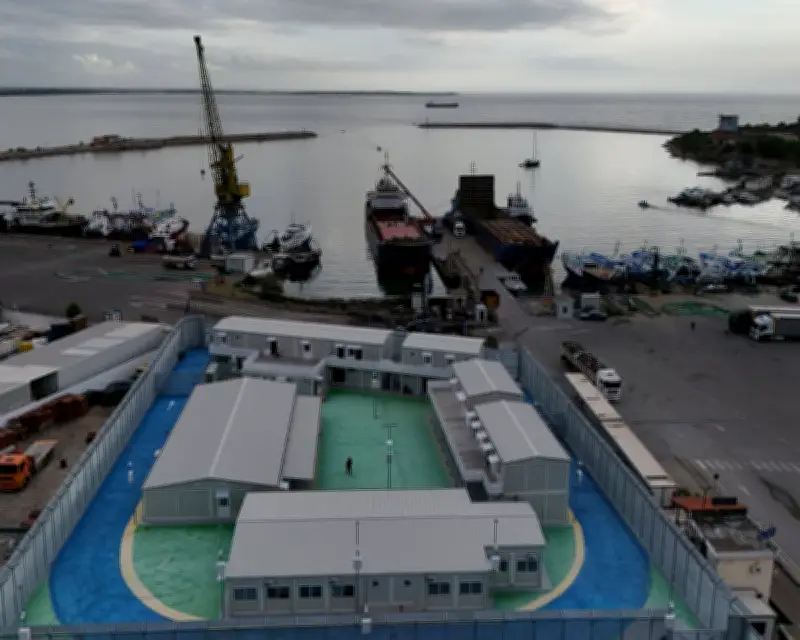
Italy inaugurated two centres in Albania—in Gjadër and Shëngjin—in 2024 as part of a contentious agreement to process asylum applications from adult men intercepted at sea by Italian government vessels and to detain rejected asylum seekers pending deportation. The five-year deal costs Italy an estimated €130-140 million (£112-120 million) annually and has encountered repeated legal hurdles. Citing European Union law, Italian judges have blocked numerous transfers, arguing that migrants' home countries are unsafe for repatriation if their asylum claims are rejected.
Several individuals are believed to have arrived at the facilities following the European Parliament's adoption of a plan this month that permits the establishment of offshore “return hubs”—centres outside the EU where undocumented individuals can be held indefinitely while awaiting return to their home countries.
Conditions and allegations
Although no official figures exist, the Gjadër facility, primarily used for detention before expulsion, is estimated to hold 70-80 people. The combined capacity of the Albanian centres is designed for roughly 1,000 individuals, with the original agreement allowing a cap of 3,000 at any one time. Guarda alleged that the use of psychotropic drugs was “a constant” and that detainees filled their time by sleeping because “essentially they have nothing to do.”
“One person said he was living his days in pursuit of his freedom,” she added. “This situation is alienating – it amplifies difficulties of a psychiatric nature and must be taken seriously.”
Official responses and reactions
Rome’s prefect office, which oversees Italy’s offshore migrant processing centres in Albania, did not immediately respond to a request for comment. Neither did Medihospes, the Italian cooperative managing the facilities.
Italy’s Prime Minister, Giorgia Meloni, has repeatedly expressed determination to make the initiative work, despite the government failing so far to achieve its original goal of sending 36,000 people per year to the centres. In April, a group of senators from her Brothers of Italy party visited Gjadër and described a “modern, efficient facility in excellent condition and designed to ensure proper reception, safety and compliance with standards.”
Tineke Strik, a Dutch MEP who was part of the European Parliament delegation, called the visit “very disappointing and disgraceful.” She added: “The staff really created a lot of obstacles for us. We didn’t get any data, they didn’t answer any questions, and we were not allowed to really go into the cells, and see what the situation is like. For the people we did manage to speak to here, it’s clear they have problems asking for asylum, and many of them don’t see any way out of a failed system.”

Cecilia Strada, a politician with Italy’s centre-left Democratic party, called on the Italian government and European Commission to explain why the MEPs faced obstacles. “They keep telling us that human rights are and will be guaranteed in centres located in third countries,” she said. “But European parliament representatives, who have the authority to enter, were ultimately unable to genuinely verify respect for those rights.”