Louisiana Appeals Court Clears Path for Ten Commandments in Public Schools
A federal appeals court has made a significant ruling that permits Louisiana to enforce a controversial law mandating the display of the Ten Commandments in every public school classroom. The US Fifth Circuit Court of Appeals voted 12-6 on Friday to lift a preliminary injunction that had previously blocked the law, which was initially found to be unconstitutional.
Court Decision and Legal Reasoning
The majority opinion from the court stated that it was premature to decide on the constitutionality of the law, as it had not yet gone into effect. The judges argued that there were insufficient facts available to make a judicial judgment, rather than speculation. Key uncertainties include how prominently schools will display the religious text, whether teachers will reference the Ten Commandments during classes, and if other historical documents like the Mayflower Compact or the Declaration of Independence will also be exhibited.
This decision came after the court decided to reconsider the case with all judges present, following a ruling by three judges in June that deemed the law unconstitutional. Louisiana became the first state in 2024 to require such displays, igniting intense debate over religious freedoms in educational settings and the separation of church and state.

Legal Challenges and Arguments
A lawsuit was filed in 2024 by parents of Louisiana schoolchildren from diverse faith backgrounds, who contended that the law violates the First Amendment of the US Constitution. This amendment guarantees religious liberty and prohibits the government from establishing a religion. Proponents of the law, however, argue that the Ten Commandments are historical documents that form part of the foundation of US law.
In a concurring opinion, Circuit Judge James Ho, appointed by former President Trump, wrote that the law "is not just constitutional – it affirms our nation's highest and most noble traditions." Conversely, among the six dissenting judges, some argued that the law imposes a clear constitutional burden by exposing children to government-endorsed religion in a mandatory setting.
Circuit Judge James L. Dennis, a Clinton appointee, stated that this "is precisely the kind of establishment the Framers anticipated and sought to prevent." The Fifth Circuit, covering Louisiana, Mississippi, and Texas, is known as one of the most conservative federal appellate courts in the country, often advancing Republican policies to the similarly conservative US Supreme Court.
Political Reactions and Implementation
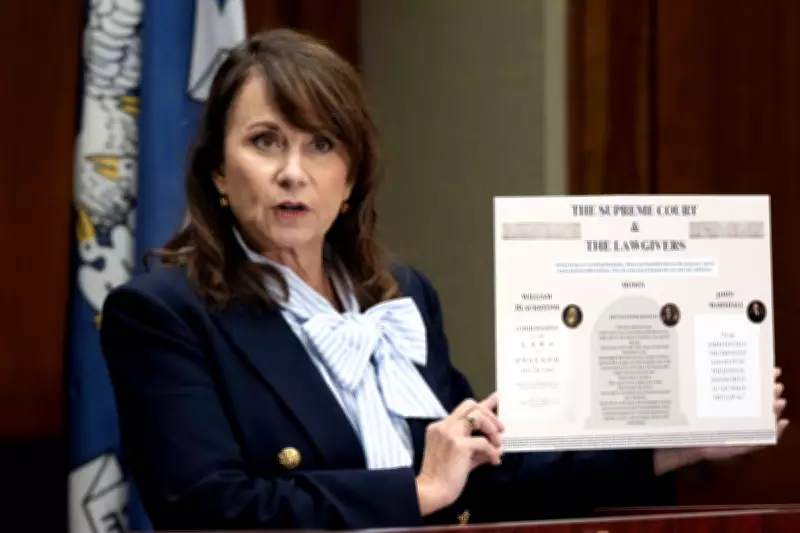
Louisiana's Republican Governor, Jeff Landry, a staunch ally of Trump, praised the court's decision, posting on Facebook: "Common sense is making a comeback!" The state's Attorney General, Liz Murrill, emphasized that Louisiana schools should "follow the law" and noted that she had distributed correct examples of the required poster.
Under the law, the Ten Commandments must be displayed on a poster or framed document that is at least eleven inches by fourteen inches in each classroom of public elementary, middle, and high schools, as well as public college and university classrooms. The text must be the "central focus" and printed in a large, easily readable font.
Criticism and Further Legal Action
The Freedom From Religion Foundation, involved in the legal challenge, called the ruling "extremely disappointing" and warned that it would force families into a "game of constitutional whack-a-mole," requiring separate challenges for each school district's displays. The ACLU of Louisiana described the decision as "disgraceful and deeply harmful" and vowed to continue legal efforts to block the law.
Alanah Odoms, executive director of the ACLU of Louisiana, stated, "This decision is wrong. It is cowardly. And it carries real consequences for our children. By forcing a singular religious text onto the walls of our public schools, the Fifth Circuit has flung open the door to the religious coercion of Louisiana's children." She added, "Louisiana schools are not Sunday schools. Teachers are not pastors. And the state has no business inserting itself between parents, their children, and matters of faith and conscience."

Broader Context and Historical Precedents
Similar laws have faced legal challenges in other states. For instance, a group of Arkansas families filed a federal lawsuit last year against a near-identical law, and Texas lawmakers passed a similar requirement for classroom displays. The Fifth Circuit heard arguments on both the Texas and Louisiana laws last month, though Friday's decision does not apply to Texas, where posters have already been installed in many classrooms.
Historically, the US Supreme Court has ruled on related issues. In 1980, it found that a similar Kentucky law violated the establishment clause of the Constitution, stating it had "no secular purpose" and was "plainly religious in nature." In 2005, the court upheld a Ten Commandments marker at the Texas state capitol while striking down displays in Kentucky courthouses, highlighting the nuanced legal landscape surrounding religious symbols in public spaces.