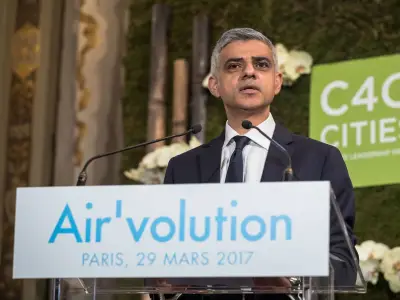
Andy Burnham's ambitious devolution agenda, a cornerstone of his journey to Downing Street, is now facing the stark realities of implementation. After just two weeks in office, the prime minister has set the autumn budget as the deadline to flesh out his proposal to give England's regional mayors a share of income tax revenues, a move aimed at boosting local economic development.
Fiscal centralisation: a deep-rooted problem
The UK remains one of the most fiscally centralised countries in the developed world. According to the Centre for Cities, only about 5% of tax revenue currently stays with mayors and local authorities, with the rest flowing directly to Whitehall. In contrast, France retains 14% locally, and Japan 22%. This centralisation has historically been a source of tension, with Westminster acting as the ringmaster, as evidenced by independence movements in Scotland, Wales, and Northern Ireland.
England's devolution system, however, is the most fragmented. Successive Conservative governments created dozens of ringfenced funding pots, fostering a 'begging-bowl' culture that failed to compensate for billions in central grant cuts during austerity.

The income tax proposal: a good idea with practical wrinkles
Burnham's proposal to allow mayors to retain a share of locally generated income tax is widely seen as a positive step. Economists argue it could address Britain's severe regional inequalities. The Institute for Fiscal Studies estimates that between 6% and 9% of local income tax revenues would be sufficient to fully replace the integrated settlements currently provided by central government.
However, the plan faces significant implementation challenges. One major concern is that the fastest-growing mayoral authorities are often the wealthiest, such as London and Greater Manchester. If these areas retain a rising share of income tax, weaker regions like the West Midlands and South Yorkshire risk falling into a cycle of weak growth, limited investment, and further decline.
Timeline and capacity constraints
The income tax plan will not come into full effect until 2028, a long wait for a prime minister in a hurry. Additionally, dozens of new mayoralties are being created, with a deadline to extend similar powers to places like Essex, Stoke-on-Trent, and Warrington by the end of that year.
The OECD recently endorsed devolution but warned that Britain's starting point makes it challenging. Key building blocks are missing. English local government has been severely weakened since 2010, with the workforce plunging from 2.2 million in 2009 to about 1.1 million today. While Greater Manchester and the West Midlands have developed sophisticated analytical and delivery teams, many authorities lack the staff and expertise to manage new money and powers effectively, even struggling with basics like bin collection and pothole repairs.
Financial risks and oversight gaps
The risk of poor spending decisions is high. Recent scandals in Tees Valley, Birmingham, and the multibillion-pound debts in Woking, Warrington, and Thurrock highlight the dangers. Labour inherited a broken local audit system, with only 1% of places publishing audited accounts for 2022-23 by the original deadline. The abolition of the Audit Commission and the decline of local journalism have removed crucial checks and balances.
Labour plans to strengthen the role of the new Local Audit Office, which has taken over some functions, and may also involve the National Audit Office. Public trust in local government is low, with only about 35% of people reporting high or moderately high trust, below the OECD average of around 45%.
Potential economic benefits
Despite these challenges, devolution could be transformative. Local leaders are often best positioned to understand their area's growth needs. The Centre for Cities estimates that integrating bus, tram, and train networks in the six largest English cities outside London would connect 1.2 million more people to their nearest city centre, generating productivity gains worth £17bn. The OECD finds that countries with higher levels of tax and spending devolution tend to have higher wages.

Currently, the UK's second-tier cities significantly underperform their G7 peers. Among the bottom 20 big cities in the G7 for productivity, seven are British. Empowering regions could make a substantial difference.
On the road to transferring power from Westminster, Burnham will inevitably encounter potholes, but the path is worth pursuing for the potential economic and social gains.