
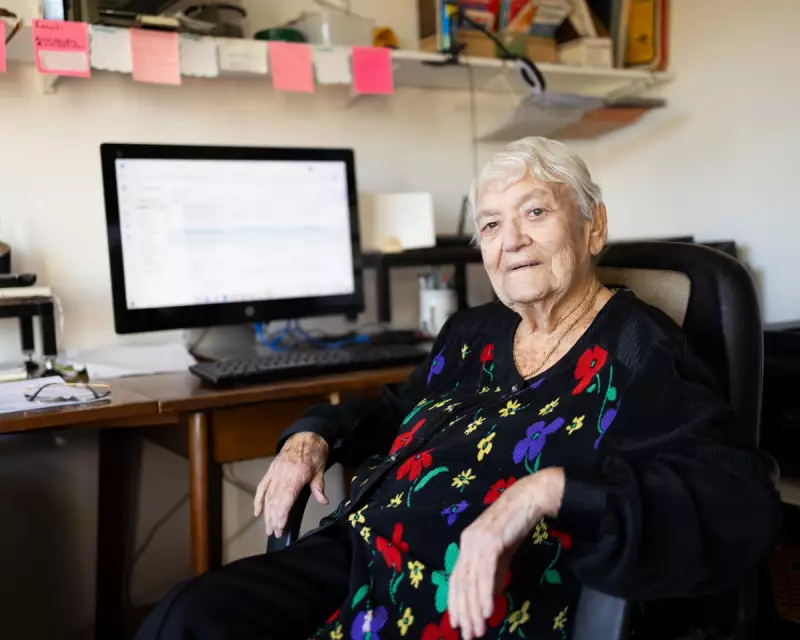
At 94 years old, Diane Munday remains a formidable force in the fight for women's reproductive rights. As a key architect of the landmark 1967 Abortion Act, she celebrated a partial victory on the terrace of the House of Commons over half a century ago. Yet, with a half-glass of champagne, she declared the work only half finished. Today, her prediction rings true as she continues her campaign for the full decriminalisation of abortion in the United Kingdom.
The Unfinished Legacy of the 1967 Act
Munday, a co-founder of the British Pregnancy Advice Service and former leading member of the Abortion Law Reform Association, reflects on a lifetime of activism from her home office. The space is a testament to her dedication, lined with books on abortion history, filed press cuttings, and decades of correspondence, including vitriolic "crank letters" labelling her a murderer. Her drive is deeply personal, stemming from a traumatic event in 1961.
After already having three young sons, Munday sought an abortion. A neighbour, a dressmaker also with three children, had recently died from a backstreet procedure. "We raised £90, I went to Harley Street and I was alive," Munday recalls. "The unfairness, the injustice of that, is I think what drove me all those years. I've never forgotten her." This injustice fuelled her campaign throughout the 1960s to build public support for legal reform, a necessity pointed out by then-Prime Minister Harold Wilson, who dismissed abortion as a "petty middle-class reform."
Breaking the Silence: A Nation's Secret
Munday's strategy involved addressing respectable women's groups like the Women's Institute. "I stood up and I said 'I have had an abortion'," she recounts. The response was a revelation. Woman after woman confided their own hidden experiences, stories of terminations during the Depression or periods of unemployment. "It became obvious that this was common, that it was a thing that women did, but didn't talk about," she says. This nationwide silence, broken in whispers, solidified her resolve to change the law.
While the 1967 Act was a watershed moment, it did not decriminalise abortion. Instead, it created a legal defence for doctors under specific conditions. This legal framework has continued to allow for the prosecution of women, a reality highlighted by a series of high-profile cases that brought women before the courts for ending pregnancies outside the strict legal terms.
A Landmark Vote and the Road Ahead
Early this summer, a significant parliamentary vote offered a new step forward. An amendment to the crime and policing bill, tabled by Labour MP Tonia Antoniazzi and passed by Parliament, aims to end the criminal investigation and prosecution of women who terminate their own pregnancies. Hailed as the most significant advance since 1967, this change is a direct response to those distressing prosecutions.
Yet, for Munday, this is still not the full glass of champagne. She demands complete decriminalisation and the removal of remaining restrictions, such as the requirement for two doctors to sign off on the procedure. "Parliamentarians need to get rid of the restrictions... make it readily available," she insists.
Monitoring developments via internet alerts, Munday expresses profound concern over the rollback of rights in the United States, following the Supreme Court's overturning of Roe v Wade. "I always saw America as being a sort of 'modern society' and it's going backwards," she states, adding a rallying cry: "American women have got to get up and fight for what they want."
Closer to home, she views comments from Reform UK leader Nigel Farage, who has called for a reduction in abortion time limits, as a serious threat. "He could be the next prime minister the way things are going," she warns. However, she finds hope in the younger demographic of Parliament, who she believes are unlikely to support restricting rights they have always known as legal.
She also welcomes recent progress such as making emergency contraception more readily available from pharmacists, calling it a "huge advance."
Six decades on from that half-glass on the parliamentary terrace, Munday admits she never expected the battle to remain unfinished. While some MPs advocate for a new, modern abortion act fit for the 21st century—a prospect she calls "amazing"—she is "not very optimistic" it will happen in her lifetime. Her fundamental aim, unchanged since the 1960s, is for safe, legal, and accessible abortion to be a guaranteed right for all women. The fight she started continues.




