
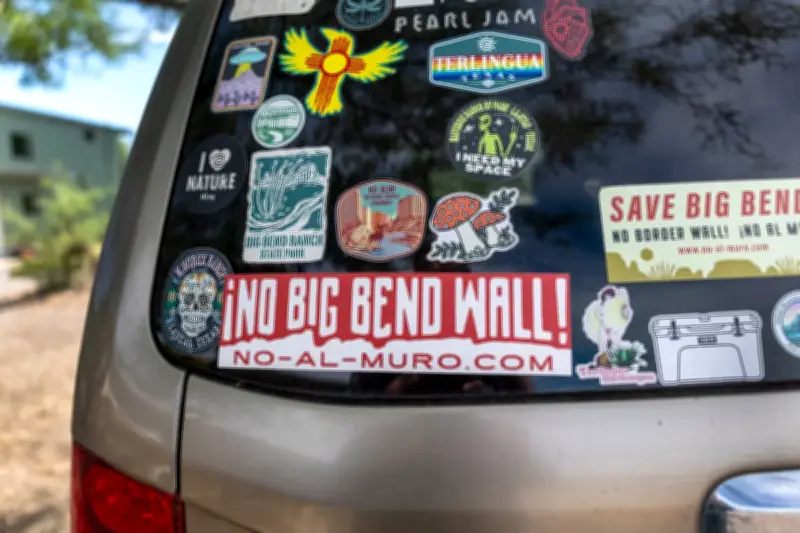
Last February, 41-year-old Molly Walker posted an Instagram story: a photo of herself standing in the desert, holding a protest sign fashioned from a pizza box with 'NO WALL' scrawled beneath. The call to action—'if you want to organize, DM me'—sparked one of the most surprising bipartisan grassroots campaigns in recent US history.
Grassroots Movement Forms
Born and raised in the Big Bend region of far-west Texas, Walker had no idea that a single social media post would ignite the No Big Bend Wall (NBBW) campaign. 'The five people who responded to that photo,' Walker says, 'with their various skill sets, I thought, Wait … we can actually do something. Let's try to do something!'
Walker and a handful of other committed residents have since paused their careers, dedicating themselves full-time to NBBW. The proposed border wall, they argue, threatens their home, livelihoods, and the wilderness along the Rio Grande corridor. 'I've walked away from all of my sources of income,' Walker says. 'At first, I wasn't even eating or sleeping. I didn't expect my Instagram post to become the foundational block. I felt responsible.'
Legislation and Impact
The previous summer, Congress passed the One Big Beautiful Bill Act, giving the Department of Homeland Security $46.5bn to expand the border wall. In the Big Bend region, including the national park where illegal crossings are rare, a concrete and steel wall is difficult to justify. According to experts, a wall would cause irreparable damage to wildlife, limit paddlers' and fishers' access to the Rio Grande, and likely strip the Big Bend of its international dark sky status—a mainstay of its tourism industry.
'We live in a desert and they're building a wall that cuts us off from our river. It makes no sense,' says Clara Bensen, one of the five respondents to Walker's Instagram story. 'First it was shock. Then anger. Now I think we've internalized the reality of a long-term fight.'
Bipartisan Resistance
Since February, concerned citizens have been glued to the smart wall map on the US Customs and Border Protection website, where construction plans keep changing. Currently, the map suggests a wall through the region, but only surveillance technology and patrol roads in the national park. Because CBP has offered little transparency, many remain skeptical. Media attention has focused on the unlikely bipartisanship. 'I've never worked with so many conservatives,' says Bensen. Border agents, sheriffs, progressive activists, and politicians have coalesced—drawing up lawsuits, mobilizing local landowners, and traveling to Washington to deliver a petition with over 150,000 signatures to Texas senators John Cornyn and Ted Cruz.
Challenges and Capitulations
The full picture is more fraught, as key community members capitulate. In April, a local pecan farmer tried to sell well water to a 500-person man camp of border wall construction workers. In May, a local landowner leased space in his RV park to wall contractors. Most dishearteningly, the 5,200-acre Moody Bennett Ranch, partly owned by Yeti co-founder Ryan Seiders, succumbed, according to a report by Marfa Public Radio. Barnard Construction, awarded a $960m wall contract, has been buying materials from Moody Bennett. Seiders did not respond to requests for comment; a Yeti spokesperson said the company has no involvement in the ranch.
'The only reason there's any work getting done is those people,' says Yolanda Alvarado, landowner coordinator for NBBW, about cooperating landowners. 'And they stand to make a lot of money.' Alvarado's family owns two ranches; the wall would cut one in two, separating their well and ancestral cemetery. 'A lot of people say, This is the federal government and they'll do what they want,' Alvarado says. 'That's not how this works. We have a brilliant team. There's not going to be a wall.'
Local Commitment
'We're fighting like hell,' says NBBW board member David Keller, an archaeologist and co-owner of a local bar. 'I've pinned my entire life on this place. So what does it mean to lose it? Some might say, Well, you're not losing it. They're just building a wall through it. But to me, it's a total loss.' Anna Claire Beasley, another local, adds: 'I have family from Presidio that goes way back. As a little girl we'd travel here and I dreamed of living here. It took effort, time and dedication to make the move and I didn't do all that for nothing. I'm not going to roll over.'
Most Americans don't care much about far-west Texas, or care in the abstract. The fight remains in the hands of residents like Walker and Keller. 'The American understanding is built off worst-case scenarios and manufactured fear rhetoric,' Walker says. 'It completely disregards that there are American lives and thriving communities rooted to the border.'




