
Japan's Youth Mobilize to Defend Pacifist Constitution Amid Rising Tensions
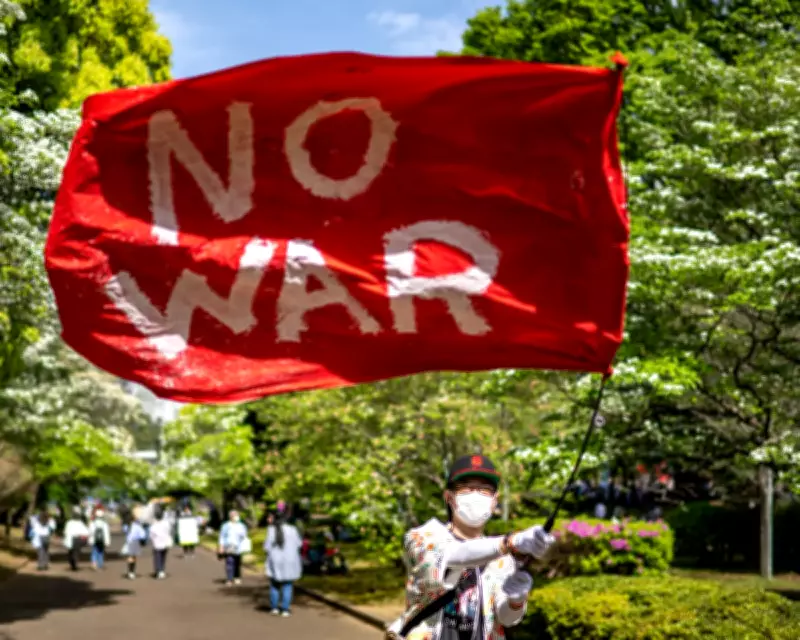
In Tokyo, a growing movement of young Japanese citizens is taking to the streets to protect their country's pacifist constitution, a document drafted by the United States after World War II that has remained unchanged for nearly eight decades. The protests have gained momentum following recent government actions that challenge Japan's postwar commitment to peace.
The Lightsaber Symbolism
Gohta Hashimoto, a 22-year-old university student, brandishes a toy lightsaber at rallies, representing the battle he and fellow protesters face against constitutional revision. "I've been interested in the constitution for about a year, ever since the rise of far-right parties in Japan," Hashimoto explains. "I wanted to be part of a movement that keeps my country peaceful and protects the constitution."
Hashimoto's realization came gradually. "I always thought of politics as something for older people, but that feels like turning over my future to someone else," he says. "Until now I'd never thought of the constitution as something young people needed to fight for."
Growing Protest Movement
The movement gained urgency on Tuesday when Japan's government lifted a ban on exports of lethal weapons, a direct challenge to the country's postwar pacifism. This follows Prime Minister Sanae Takaichi's long-standing advocacy for constitutional reform, a goal shared with her mentor, the late Shinzo Abe.
Recent demonstrations have seen remarkable growth:
- Late February: Approximately 3,600 protesters
- Late March: Swelled to 24,000 participants
- Mid-April: Estimated 36,000 people gathered outside the National Diet
The largest protests have occurred in Nagatacho, Japan's political nerve center near where the constitution was originally drafted by U.S. officials under General Douglas MacArthur's supervision.
Multigenerational Participation
The movement has united Japanese citizens across generations. Seasoned left-leaning pacifists join families with children and young professionals, all chanting against constitutional changes. Popular slogans include "Hands off the constitution" and calls for the government to "stop sucking up to America."
Yuri Hioki, a 28-year-old programmer attending Tokyo rallies, expresses the collective anxiety: "The constitution enables us to stay out of America's wars, including in this region. The thought that might change makes me really angry."
According to a Kyodo news agency analysis of smartphone location data from an April 8 rally:
- People in their 30s comprised the largest single demographic
- More than 20% were in their 20s
- 60% of all protesters were women
Article 9: The Anti-War Clause
At the heart of the controversy lies Article 9, which states that "the Japanese people forever renounce war as a sovereign right of the nation and the threat or use of force as means of settling international disputes." Protesters often carry balloons shaped like the numeral nine to symbolize this crucial provision.
Koichi Nakano, a political science professor at Sophia University in Tokyo, explains the renewed urgency: "The war has brought home the risk that Japan could get involved in an illegal war under Takaichi... so many more people feel they need to show their support for Article 9 as the last bulwark against war."
Conservative Perspective
For Prime Minister Takaichi and other conservatives, Article 9 represents defeat and decades of self-flagellation over Japan's wartime conduct. They argue that postwar pacifism imposes unfair restrictions on Japan's ability to defend itself against nuclear-armed North Korea and an increasingly assertive China.
The Iran conflict has highlighted both Japan's dependence on Middle Eastern oil and the constitutional restraints that reportedly forced Takaichi to decline former President Donald Trump's request to send Japanese maritime self-defense forces to the Strait of Hormuz.
Constitutional Amendment Process
Amending Japan's constitution requires significant political consensus:
- Two-thirds majority in both houses of parliament
- Simple majority in a nationwide referendum
Despite these high hurdles, the ruling Liberal Democratic Party's landslide victory in February's lower house elections—giving them a two-thirds "supermajority"—has strengthened Takaichi's determination. "The time has come for constitutional reform," she declared this month at an LDP convention.
Previous Constitutional Stretching
Faced with legislative obstacles, former Prime Minister Abe previously stretched Article 9's interpretation, pushing through 2015 legislation allowing Japan to exercise collective self-defense. More recently, Japan has acquired the ability to conduct pre-emptive strikes against potential threats like North Korean missile bases.
Nakano warns that pro-revisionists "want to put the final nail in the coffin of the peace constitution" by making the Self-Defense Forces constitutional, thereby legitimizing expanded military capabilities.
Public Opinion and Future Prospects
While media polls have shown support for constitutional change at or above 50% in recent years, the Iran conflict could shift public opinion if voters believe amendments would increase Japan's risk of entanglement in overseas wars.
The road to reform remains uncertain. Even with LDP support in the lower house, the party would need opposition cooperation in the upper house and cannot count on majority public support in a deeply divided nation.
As Hioki holds her bright yellow light stick at protests, she reflects on its symbolic power: "When you have one of these it makes you realize you're not alone. It gives you the courage to come along and protest." This simple accessory has become a unifying symbol for a generation determined to protect their constitutional right to peace.




