
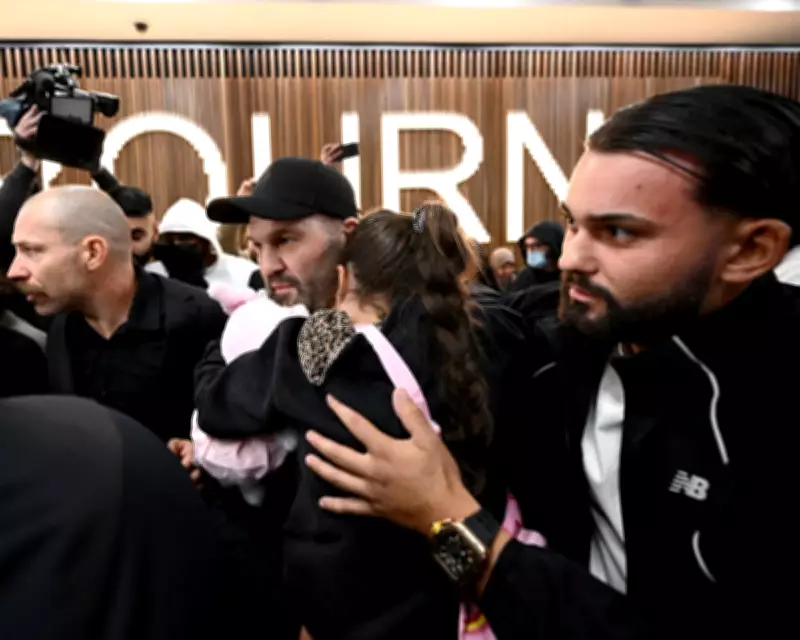
The return of Australian women and children from Syrian detention camps this week has reignited a familiar public debate – fear, anger, outrage and politics. Three women were arrested on arrival and face serious allegations linked to terrorism and slavery offences.
But beneath the headlines and the language of “Isis brides” sits a more uncomfortable reality: many of the children stepping on to Australian soil this week have spent much of their lives in camps shaped by war, deprivation, ideological extremism and chronic instability.
And, whether people like it or not, their future is now tied to ours.
There is understandable public concern. Islamic State was responsible for extraordinary brutality. Some of the adults returning may have actively supported the caliphate and, where criminal offences are alleged, they must move through the process of justice, one that ensures accountability, due process and the rule of law.
But accountability and reintegration are not mutually exclusive. In fact, one depends on the other.
The challenge is that Australia still struggles to talk about these cases with nuance. We tend to collapse everyone into a single category: terrorist, victim, sympathiser, threat. Reality is far messier.
Some women may have travelled willingly and remained ideologically committed. Others may have entered under coercion, dependence or manipulation. Many of the children had no agency at all. Yet public discourse often treats them as extensions of their parents’ choices rather than individuals shaped by years of trauma, instability and exposure to violence.
That distinction matters because children raised in these environments face layered challenges that extend far beyond ideology.
Many will have experienced disrupted attachment, chronic insecurity, exposure to violence, inconsistent education and deep social isolation. Some will have been raised in environments where hypervigilance, fear and rigid worldviews became normal survival mechanisms. Others may carry fragmented identities; Australian by citizenship but with little understanding of Australia beyond what they have been told.
The question is not whether these experiences will affect them. The question is how Australia chooses to respond to those effects.
If we approach these children solely through a national security lens, we risk creating the very conditions that sustain alienation and grievance. Constant public hostility, social exclusion and lifelong suspicion do not create safety. They create identity foreclosure, where a child becomes permanently trapped by the label imposed upon them.
Reintegration therefore cannot simply mean arrival. It must mean the deliberate creation of pathways into ordinary life.
That requires far more than surveillance and monitoring.
It requires long-term trauma-informed support. Medical needs attended to. Stable housing. Education systems capable of responding to complex developmental and behavioural needs. Mental health interventions that understand the impact of prolonged exposure to conflict and ideological control. It requires practitioners who understand that identity reconstruction takes time and that disengagement from extremism is rarely linear.
Most importantly, it requires Australia to decide whether we believe children can become more than the circumstances they were born into.
Because their futures could look very different depending on that answer.
Handled poorly, these children may grow up carrying permanent stigma, disconnected from peers, distrusting institutions and defined publicly by decisions made long before they had agency. In that environment, the risk is not only psychological harm but the reinforcement of the very narratives extremist groups rely upon, that they will never truly belong.
Handled properly, however, the trajectory can change.
Children are remarkably adaptive. With stability, safety, belonging and meaningful opportunity, identities can be rebuilt. Young people can develop critical thinking, healthy relationships and social connection outside the ideological environments they once inhabited. They can become engaged students, parents, workers and members of the community rather than permanent objects of fear.
That outcome is not guaranteed. But neither is failure.
What happens next will depend on whether Australia responds with strategy instead of symbolism.
The reality is that these children are now home. The camps did not disappear the problem. Leaving them there indefinitely would not have erased the risk. It would simply have outsourced it.
Now comes the harder part: deciding whether reintegration is something we genuinely believe in, or whether it is a concept we only support when it is politically comfortable.




