
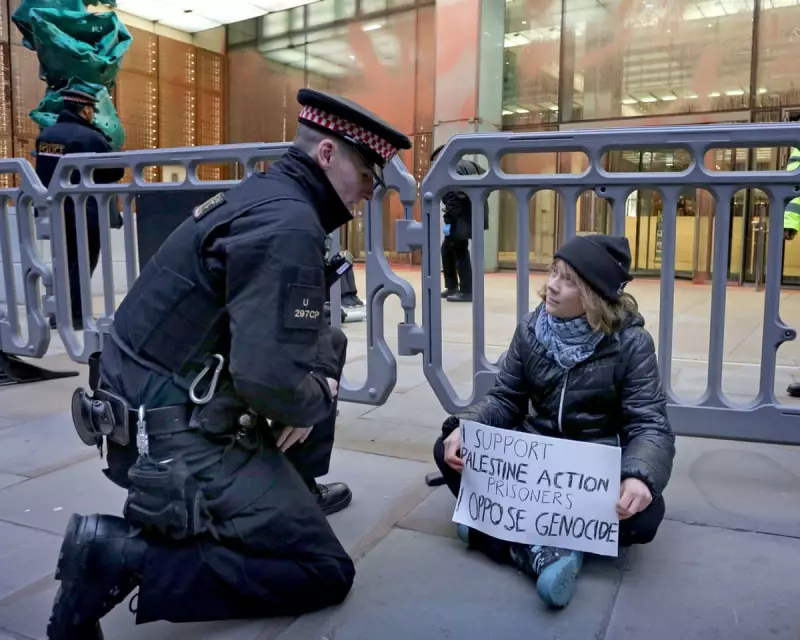
In a stark illustration of Britain's escalating crackdown on dissent, climate activist Greta Thunberg was arrested in London for the simple act of holding a protest sign. The incident, which unfolded just before Christmas, has ignited fresh debate about the state of free speech and peaceful protest in the UK under a government led by a former human rights lawyer.
A Crayon, a Guest, and an Unlikely Connection
The story begins not at a protest, but in a family home at 6am. Arwa Mahdawi recounts how her four-year-old daughter, known as O, was tasked with finding the perfect crayon for a famous houseguest: Greta Thunberg. The Swedish activist was in London to support hunger strikers linked to the group Palestine Action and needed a place to stay. Mahdawi's father, a Palestinian refugee, often opens his home to activists.
The child, unaware of Thunberg's global fame, was more concerned with whether "famous" meant "beautiful." The visit was nearly upended by the toddler's favourite catchphrase—"How dare you!"—unwittingly echoing Thunberg's own iconic line to world leaders. Despite parental pleas, the phrase was gleefully shouted, much to Thunberg's amusement.
From Crumpets to Custody: The Arrest That Confused a Child
Equipped with the child's crayon and a piece of paper, Thunberg created a sign reading "I support Palestine Action prisoners." Shortly after, she was arrested. Video evidence shows her sitting quietly, holding only the sign. For Mahdawi's daughter, a fan of the police-glorifying cartoon Paw Patrol, this was incomprehensible. The "good guys" had arrested the woman who ate crumpets with her that morning.
"Did the police not like the crayon she used?" the four-year-old asked. The question, while innocent, cuts to a disturbing core. Mahdawi found herself questioning whether supplying the crayon could itself be construed as an offence in today's Britain.
The Context: Hunger Strikes and a 'Terrorist' Designation
Thunberg's arrest was connected to her support for eight activists who have been on hunger strike since 2 November, the anniversary of the Balfour Declaration. These individuals are awaiting trial for alleged offences relating to Palestine Action.
The backdrop to this is the British government's controversial move in July to designate Palestine Action as a terrorist organisation, placing it on the same level as the Islamic State. This is despite the group's focus on non-lethal direct action against weapons manufacturers and a declassified intelligence assessment, obtained by the New York Times, which found most of its activities "would not be classified as terrorism" under UK law.
The hunger strikers are now on the brink of irreversible health damage or death. They protest both their punitive prison conditions and seek to highlight the activities of Elbit Systems, an Israel-based weapons manufacturer with several UK factories.
A Chilling Climate for Protest
Mahdawi, now back in the US, expresses her horror at the transformation of the UK. She describes a nation where thousands, including elderly activists, have been arrested for peacefully holding signs, and where the government prioritises prosecuting protesters over addressing warnings of complicity in genocide.
"I can't quite fathom what Britain, under the leadership of a former human rights lawyer, has become," she writes. It is a place, she argues, where fundamental freedoms are under sustained attack, and where a protester starving to death may soon make "absolutely no difference to the ghouls in charge."
Directing her anger at Labour leader Sir Keir Starmer, she concludes with the phrase her daughter and Thunberg share: "How dare you." The arrest over a crayon-drawn sign has become a potent symbol of a deepening crisis for civil liberties in Britain.




