
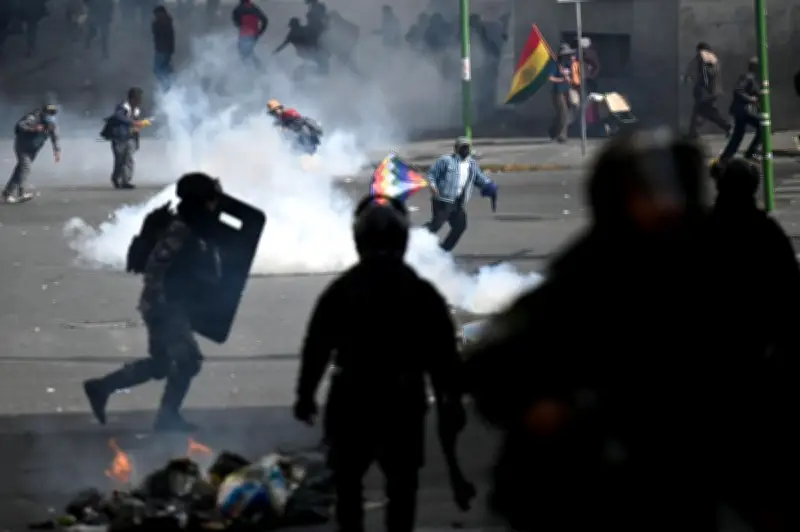
Vivian Palomequi, a leader of a peasant farmers' union, walked over 560 miles (900km) from her home in the Bolivian Amazon to La Paz in late April to protest a law she fears will accelerate deforestation and land privatization. “We declared a state of emergency and started marching,” she says. “We had no other choice.”
Mass protests against environmental deregulation
The march was part of a wave of pushbacks against the environmental policies of Bolivia's new government under President Rodrigo Paz, who took office in November. His administration has staffed ministries with former agroindustry leaders, struck deals to open protected areas to mining, and criminalized environmental defenders.
Mass Indigenous and peasant mobilizations are not new to Bolivia. In the 1990s and early 2000s, large marches followed a similar route from the Amazonian lowlands to La Paz. Resistance to extractive projects continued under leftist administrations, including that of Evo Morales, who faced criticism for ecologically destructive policies despite pro-environmental rhetoric.
Paz's policies: a continuation of extractivism
President Paz ran as a centrist with few environmental proposals beyond domestic carbon markets. Eight months into his term, activists argue his policies have worsened extractive agendas. “It’s the same old policy,” says Ruth Alipaz, an Uchupiamona Indigenous leader. “When a crisis hits, the response is to ramp up resource extraction – and that takes place right inside our territories and protected areas.”
Stasiek Czaplicki Cabezas, a Bolivian environmental economist, says the government promised “to change the model” but has instead doubled down on extractivism.
Land law change sparks outrage
One of the most controversial moves was a change in land law passed in early April. It allowed small family-owned plots – constitutionally protected from being sold, divided, or seized – to be converted to medium-sized holdings, exposing them to foreclosures and corporate buyouts. Proponents argued it would help smallholders access formal credit, but Indigenous and peasant farmers feared land dispossession and accelerated agroindustry expansion.
“When a small property enters a free commercial land market, it turns into a financial asset,” says Alcides Vadillo of Fundación Tierra. “From that moment on, it can be traded, sold, divided up or foreclosed on.”
Protests forced the government to repeal the law in May, but Czaplicki Cabezas warns: “In 10 years, you will see that the small properties that have been converted to medium properties have had higher rates of deforestation.”
Agroindustry influence in government
The marches came amid unprecedented agroindustry influence in the new government. The former president of Anapo, a powerful soya and wheat producers' association, now leads the development planning and environment ministry. The former president of the CAO, another agribusiness lobby, was appointed minister of productive, rural and water development. “They are the government,” says Czaplicki Cabezas.
Mining deregulation and conflicts
Activists are also alarmed by mining sector deregulation. In May, the Paz administration signed an agreement with mining cooperatives, lifting barriers to operating in protected areas and Indigenous lands. In April, a ministerial resolution reduced legal requirements for nearly 4,000 non-compliant mining operations. Gold mining, fueled by lax regulations and record prices, is expanding across Bolivia's tropical lowlands, contaminating Indigenous territories with mercury.
“The recent deals will create a complete lack of control when it comes to mining in Indigenous territories, the Amazon and protected areas,” says Alipaz.
Environmental defenders criminalized
Nelly Coca, a community leader from the Tariquía national reserve, spent Christmas and New Year blocking a Brazilian hydrocarbons company, Petrobras, from entering the reserve. After police dismantled the blockade, Petrobras initiated legal proceedings against Coca and 16 other activists. “If we are defending the environment, I think we should be applauded – not persecuted,” she says.
Thomas Becker, a human rights lawyer, says Coca's case exemplifies “Bolivia’s failure to secure the free, prior and informed consent required under both its constitution and international law.”
Betrayal felt by supporters
Edgar Carpio Chávez, a peasant union leader who marched with Palomequi, feels betrayed by President Paz. “We voted for him, and he invited us to his inauguration, and even paid for our travel,” he says. “Now look how things have changed – he left us with no choice but to walk more than 1,200km just to get him to listen.”
In just eight months, the Paz administration has also authorized genetically modified HB4 soy, considered controversial hydroelectric projects, and supported initiatives to open the country to carbon credits. Czaplicki Cabezas warns that a lack of work to remove dry combustion material could leave Bolivia vulnerable to intensified fire seasons.
For Palomequi, the administration's priorities are clear: “We marched for our dignity and our rights, and the government refused to meet with us. But when the agribusiness lobby arrives, they get meetings immediately. What’s clear now is that we have to remain vigilant. We are on high alert.”




