
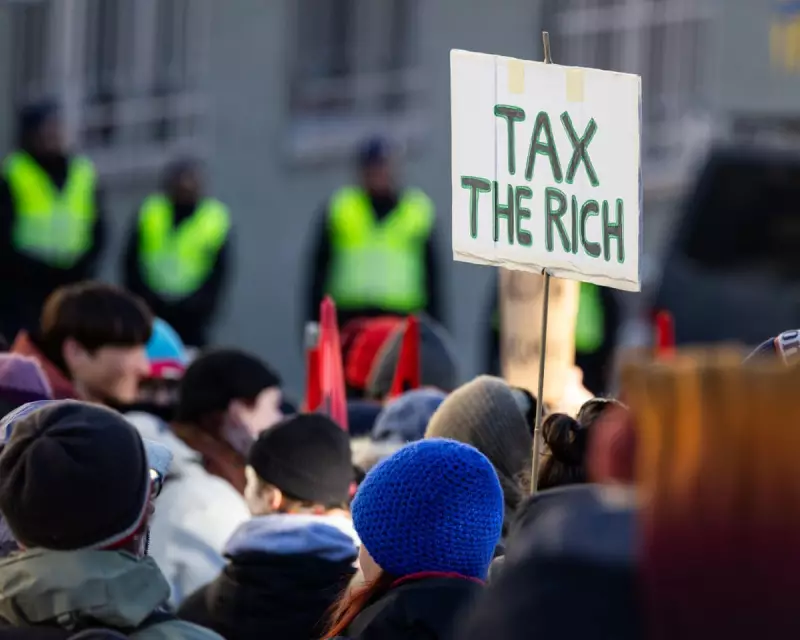
A stark new report from Oxfam has laid bare the escalating grip of extreme wealth on global politics, as the collective fortune of the world's billionaires swelled to a staggering $18.3 trillion (£13.7tn) in 2025. The charity's annual inequality survey, released amid climate justice protests at the World Economic Forum in Davos, accuses participating corporations of both fuelling crises and profiting from them.
The Soaring Fortunes of the Few
Oxfam's data reveals a record-breaking year, with the global billionaire count exceeding 3,000 for the first time. Since 2020, their combined wealth has skyrocketed by 81%, an increase of $8.2tn. The charity states this sum alone would be sufficient to eradicate global poverty 26 times over, highlighting a grotesque disparity as efforts to combat hunger and poverty stall worldwide.
"Governments worldwide are making the wrong choice; choosing to defend wealth, not freedom. Choosing the rule of the rich," said Max Lawson, co-author of the report. He accused states of brutally repressing youth-led uprisings over austerity, unemployment, and corruption across Africa, Asia, and Latin America, rather than addressing public anger.
A 'Brazen' Marriage of Money and Politics
The report's authors, Lawson and Harry Bignell, argue that the politically influential are becoming more overt in wielding their economic power. "In the past, rich people were perhaps more coy about pulling the levers of power, but it’s becoming more and more brazen, this kind of marriage between money and politics," Lawson stated.
Their research quantifies this influence starkly:
- Billionaires are an estimated 4,000 times more likely than an ordinary citizen to hold political office.
- More than half of the world’s media companies and nine of the top ten social media platforms are billionaire-owned.
- US research cited by Oxfam indicates a policy favoured by the wealthy has a 45% chance of adoption, versus just 18% if they oppose it.
Grassroots Anger and the Spark of Rebellion
The human cost of this inequality is vividly illustrated by activists on the ground. In Nairobi's Mathare slum, social justice campaigner Wanjira Wanjiru described the contrast between communities lacking clean water and a neighbouring golf club with constantly running sprinklers. She said the Kenyan government had imposed austerity on public services while granting businesses tax exemptions.
Yet, from this injustice springs hope. Wanjiru points to successful youth-led movements, like the 2024 and 2025 protests in Kenya, as a sign of a growing backlash. "When people are oppressed, they always rebel," she said.
This sentiment echoed in Nepal in September 2025, where days of protests over corruption unseated the government. Anger targeted figures like Binod Chaudhary, Nepal’s sole billionaire and an MP, whose properties were attacked. Protestor Pradip Gyawali called it part of a "new revolution" where the global youth demand a political say.
Oxfam's report serves as a dire warning: as billionaire wealth consolidates unprecedented political power, governments are increasingly opting for oligarchy, choosing to repress their people's anger rather than redistribute wealth and opportunity.




