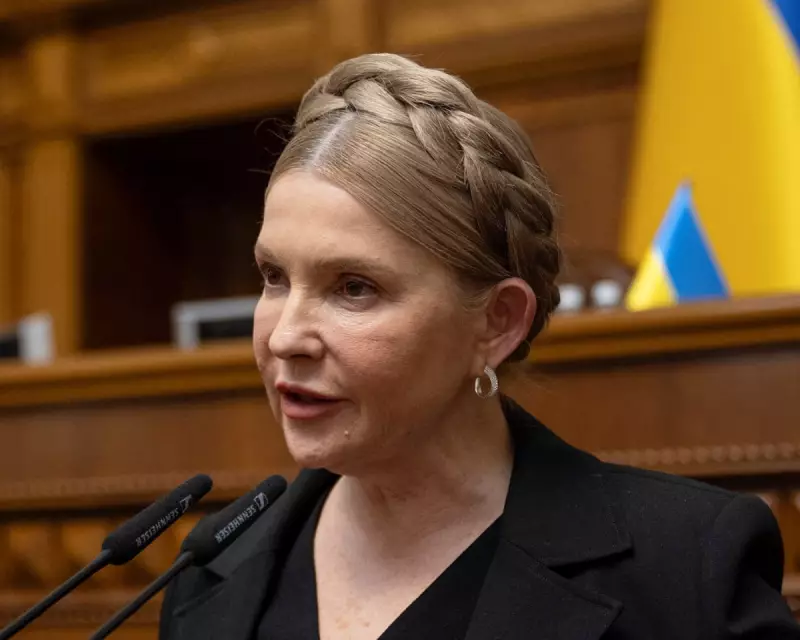
Ukrainian opposition figure and former prime minister Yulia Tymoshenko has been accused by anti-corruption investigators of orchestrating a scheme to bribe members of parliament, including some from President Volodymyr Zelenskyy's own party, in an alleged plot to undermine his authority.
Raids and Allegations
The dramatic allegations emerged after officers from Ukraine's Specialised Anti-Corruption Prosecutor's Office (Sapo) and the National Anti-Corruption Bureau (Nabu) raided the offices of Tymoshenko's Fatherland party late on Tuesday night. A spokesperson for Sapo confirmed on Wednesday that charges had been filed, though Tymoshenko has not been formally named.
Investigators briefed media that the case involves the alleged payment of bribes to politicians to vote in line with her party's interests. These votes reportedly included motions to dismiss the head of the country's security service and the defence minister, as well as to approve figures she nominated.

A video released by the anti-corruption agencies appeared to show large quantities of US dollar cash being seized during the searches.
Tymoshenko's Forceful Denial
Tymoshenko swiftly issued a statement on Facebook, categorically denying all accusations. She confirmed the raids on her office and suggested they were a politically motivated act, unrelated to law or legality.
"It seems the elections are much closer than they appeared and someone has decided to start clearing out the competition," Tymoshenko wrote. She claimed investigators found nothing illegal and only took her work phones, parliamentary documents, and fully declared personal savings.
The case reportedly hinges on an intercepted conversation, released by investigators, in which a voice alleged to be Tymoshenko's discusses using the encrypted Signal app to relay voting instructions to an unnamed MP, with the aim to "break the majority" held by Zelenskyy's party in the 450-seat Verkhovna Rada. Tymoshenko's Fatherland party currently holds 25 seats.
"I officially declare that the published audio recordings have nothing to do with me. I reject all accusations and I will prove they are groundless in court," she stated.
Political Turmoil and Historical Context
This high-profile investigation unfolds against a backdrop of intense political speculation in Ukraine. Expectations are growing that national elections could be called if a ceasefire with Russia is reached, an idea President Zelenskyy has encouraged.
The allegations also follow a recent series of corruption scandals involving figures in Zelenskyy's inner circle, prompting an ongoing political reshuffle even as Ukraine faces relentless Russian attacks on its energy infrastructure.
According to Nabu, Tymoshenko is alleged to have sought a "regular mechanism of cooperation" with MPs involving advance payments for their votes over a long-term period.
Tymoshenko is a veteran of Ukraine's turbulent post-Soviet politics. She rose to international prominence during the 2004 Orange Revolution and was later imprisoned in 2011 on charges widely seen as politically motivated under pro-Kremlin President Viktor Yanukovych. She was released after the 2014 EuroMaidan protests that ousted Yanukovych.
Intriguingly, Tymoshenko was a vocal supporter last year of a controversial, since-withdrawn, bill that would have dismantled the very anti-corruption agencies—Sapo and Nabu—that are now investigating her.
The announcement comes just two weeks after Nabu said it had uncovered a separate criminal conspiracy involving MPs receiving cash for parliamentary votes.