The Trump administration has quietly redirected $352 million in federal funds originally designated for the Secret Service to the president's controversial White House ballroom project, despite repeated assurances that construction would be financed through private donations.
Funds Diverted from Secret Service
The money was taken from the One Big Beautiful Bill Act, Trump's signature tax legislation passed last summer with Republican-only support. The law specifies that these funds must be used exclusively for Secret Service personnel, training facilities, technology, and related costs—not for construction projects.
According to the Office of Management and Budget (OMB) database, approximately $340.8 million was placed into an account labeled "Procurement, Construction, and Improvements" on June 12. An additional $10.75 million was approved the same day for an account called "Operations and Support."

Congressional Refusal and Administration Justification
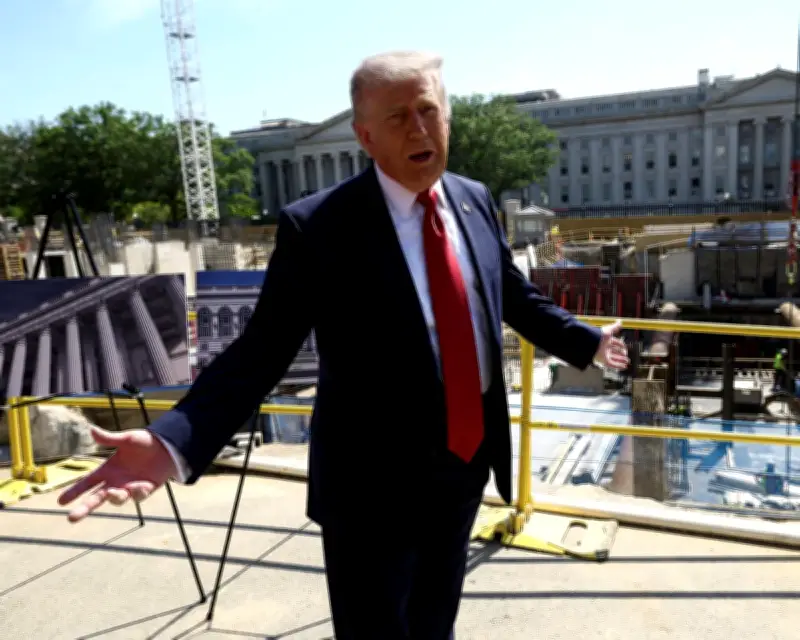
This move follows Congress's explicit refusal to allocate $1 billion for the "East Wing Modernization Project," the official name for a 90,000-square-foot ballroom being built on the site of the demolished White House East Wing.
The administration argues that the funds are necessary for legitimate security upgrades, citing recent threats against Trump, including an alleged plot to attack the UFC Freedom 250 event held on the White House south lawn.
White House spokesperson Davis Ingle stated, "The East Wing Modernization Project is inextricably tied to the security of the president, the White House grounds, and certain security infrastructure assets. President Trump and generous American patriots are funding the ballroom to the tune of approximately $400 million, which will be a secure and appropriate venue for presidents for generations to come."
Ingle added that the disrupted attacks "proves exactly why" the project is needed, citing features such as "drone-proof structures and drone ports among other critical security enhancements."
Legislators Express Concerns
Senior lawmakers have expressed skepticism. Senator Thom Tillis, a retiring Republican from North Carolina, told Notus, "That's a big problem. That sounds like a different way to fund the East Wing project. On its face it doesn't sound right."
Democratic Senator Brian Schatz of Hawaii, a member of the appropriations committee, also told the outlet, "I don't know whether it's the ballroom, but it sounds like the ballroom."
Widening Controversy Over Funding
The dispute is the latest chapter in an expanding controversy over who is actually paying for the project. When the ballroom was announced in July 2025 at an estimated cost of $200 million, Trump described it as "a private thing." The East Wing was demolished in October of that year.
In late March, with costs doubling to $400 million, Trump insisted, "This is taxpayer-free. We have no taxpayer putting up 10 cents." However, those assurances have since eroded.
Internal records obtained by the Washington Post from Clark Construction, the firm leading the project, reveal plans calling for $155 million from Secret Service funds, $149 million from the White House military office, and $3 million from the executive residence—all public money—alongside private contributions. The Washington Post reports that total costs could reach $600 million.
Scrutiny of Private Fundraising
The private fundraising aspect has drawn its own scrutiny. Watchdogs, including the Campaign Legal Center, have warned that donations from major corporations such as Meta, Coinbase, and Lockheed Martin—all of which have significant interests before the U.S. federal government—create a substantial risk of corruption.
Construction remains subject to ongoing legal challenges. In March, a federal judge ruled that the administration likely exceeded its authority by demolishing the East Wing without congressional approval.