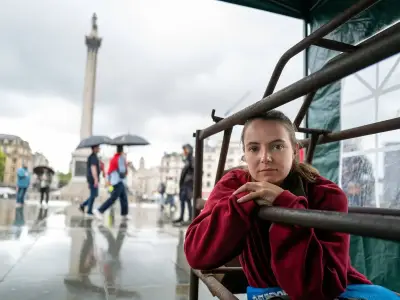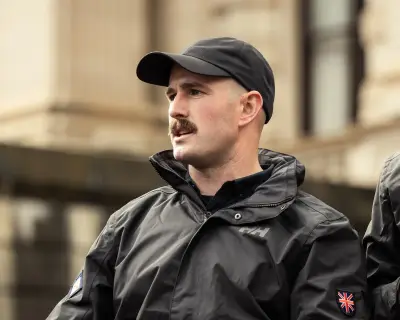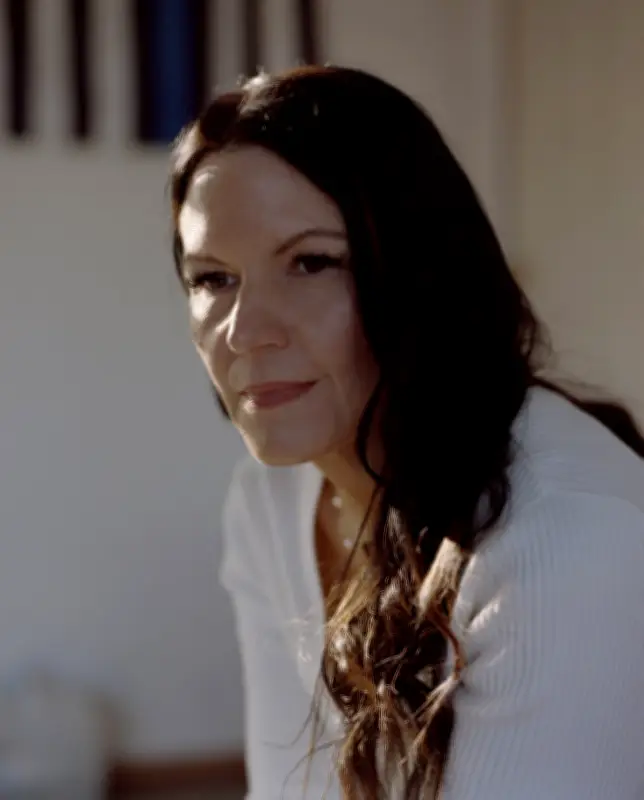
Traci Carr sits in her garage, where she keeps a box containing items left behind by her foster brother, Steven Judy, in Plainfield, Indiana. 'People treated us like we had raised a murderer.'
A Childhood Interrupted
Childhood returns to Traci Carr in fragments. Night-time. She is five. She wakes to shadows on the wall, her room strange in the dark. Her footie pyjamas slip against the wood as she pads downstairs and climbs into bed next to her foster brother, Steven Judy. He scoots over, and the monsters recede. She burrows under the covers, feeling safe. Morning. Traci and Steve share Froot Loops, their favorite cereal, the milk turning pink. He teases her, tells funny stories, acts extra goofy to make her laugh. Later, they play hide and seek. He's all theater, snapping a belt in the air as he searches for Traci and her three older siblings. They collapse in giggles when he finds them. Then one day, Steve disappears. No one explains where he went. Her parents are away for long stretches, too. When they are home, conversations drop into whispers. Doors click shut. The television is switched off when she enters the room.
The Funeral Home Revelation
The year Traci turns seven, her parents take her on a car ride. At Conkle funeral home just outside Indianapolis, the room smells of carnations and furniture polish. She is led to the coffin at the end of the room. She peers over the edge. It's Steve. His eyes are closed, his face composed. His hair isn't right – a wig, she'll learn later. But otherwise, he looks like himself. Her mother, Mary, leans close. Touch him, she urges. I don't want to. Her mother insists. Don't be afraid. Just touch him. Traci extends a single finger. It leaves a dent in his cold skin. Three days earlier, on 9 March 1981, the state of Indiana had executed Steven Judy. Traci would not fully grasp this for years.

The Crime and Execution
On the morning of 28 April 1979, around 6.30am, Judy, 22, raped and murdered Terry Lee Chasteen, 21, along the banks of White Lick Creek outside Indianapolis. When her three children – ages two, four and five – cried, he threw them into the creek to drown. It wasn't his first violent crime, but it was the one for which he would be executed. The four bodies were discovered later that morning by mushroom hunters. Residents called it the worst crime Morgan county had ever seen. A distinctive red and silver truck seen near the site of the killings was traced back to Bob Carr. He told police his foster son had borrowed it the night before. Judy was arrested the next day.
The Carr Family's Ordeal
Steve entered the Carr family through a friendship with Randy's Uncle Tony. On the day of the Chasteen murders, Randy, who was nine, and his brother Bobby, who was 11, helped Steve clean out the garage. They drove trash to the dump. They swept out their father's pickup truck, the one Steve had been driving earlier that morning. Then they went for ice-cream. The next day, the police came. Steve was out with a friend, but they questioned the boys. They drove them back to the dump and asked where the trash had been thrown. 'I wasn't going to tell them,' Randy says. 'I pointed everywhere except where we dumped.'
Hidden Victims of Capital Punishment
Scholars who study capital punishment have identified those families as a distinct and largely invisible group. Sociologist Susan Sharp began studying them in 1996. In her book Hidden Victims, she describes them as living in a kind of moral exile. 'They are tainted by association,' Sharp told me. 'We assume they must have done something wrong.' Sharp estimates that roughly 30% of death row prisoners have no family contact, either because of long estrangement or because relatives cut ties after the crime. For the other 70%, she said, the family's punishment can continue long after the condemned person is executed.

Life After the Execution
After the execution, threatening and abusive calls flooded the Carr home. They took the phone off the hook for days, but the noise did not stop. Inside the house, Mary and Bob fought constantly, often about Steve, and Bob moved out. Traci found her mom's house chaotic and undisciplined so she went with her father; Randy and his brother stayed with Mary, who seemed unreachable, crying often, sunk in a sorrow with no clear edges. Isolation hardened around them. Parents forbade their children from playing with the Carr kids. On the playground, though, the question surfaced anyway: Hey, what was he like, your brother? Traci refused to answer. 'I wouldn't talk about it. I just wouldn't,' she recalls. 'I thought we did something wrong. I was really ashamed of it.'
Lasting Impact
Randy kept getting into fights. Strong, athletic and ready to use his fists, he swung at anyone who tried to force him to accept what Steve had done. The stain of being Steven Judy's foster siblings followed Traci and Randy through high school and beyond. It entered rooms before they did. When Traci moved into her first apartment, eager for the ordinary independence of adulthood, she slept with the lights on. 'The dark terrified me,' she said. Later, motherhood gave the fear somewhere new to live. She found herself watching her children obsessively, imagining dangers before they arrived. 'The worst thoughts still pop in my head,' she says. 'I have to mentally block them out.'
A Mother's Grief
Mary's attachment to Steve did not end with his execution. For 20 years, on the anniversary of his death, Mary would check into a hotel room alone and try to connect. She said she could feel him. She said he came to her. The kids sometimes teased her about this, but she just laughed good-naturedly. She was not religious, but recalled her grandmother communicating with spirits. She believed she came from a psychic family. Though she kept a connection with Steve, Mary cut herself off from her parents for a time after the execution. 'If anyone ever needed support and love from their family, I needed it this month,' she wrote to her mother. 'We buried Steve yesterday and not one member of my family was there. I think I know how Steve must have hurt when his family turned their back on him. My family did the same to me. And all I did was give a very lost kid some love.'
Forgiveness and Moving Forward
For a long time, Traci carried anger toward her parents for bringing Steve into their home, for not knowing more, for not protecting them better. She has forgiven them now, at least mostly. 'They grew later in life,' she said. They were young. They didn't know the full extent of Steve's crimes. 'Mom had the best intentions. She was always trying to rescue people. Steve was charming so she really thought she could turn it around for him and make something good out of something terrible. She was trusting to the end of her life. And it's a good quality.' Bob died in 2005; Mary died in 2023. The bin containing Steve's belongings went to Traci.
A Continuing Legacy
Traci is married to a police officer. She works as a patient advocate at a hospital now. She sits with families in crisis, helping them navigate what they don't understand. In the evenings, she knits thick blankets, the yarn moving through her hands row by row. Her mother has begun appearing again in her sleep: Mary holding her, comforting. Almost as if speaking aloud what had been buried for decades had called her mother back. 'Everyone hated Steve, and we were told we should too,' Traci says. 'For a long time, I thought we did something wrong, and I was ashamed. People treated us like we had raised a murderer. It's still how people remember us. I don't think Mom ever got to grieve properly. I don't think any of us did.'
The Broader Context
This year, somewhere in the United States, another family will be sitting in a hotel room like the one Mary sat in, waiting for a phone call. Forty-seven executions took place in 2025, the most in any year since 2009. Fifteen more by early June of this year, with the federal government moving to add firing squads, electrocution and gas asphyxiation to how a life can be taken. The methods have changed, but for families, what is on the other side of the execution has not.