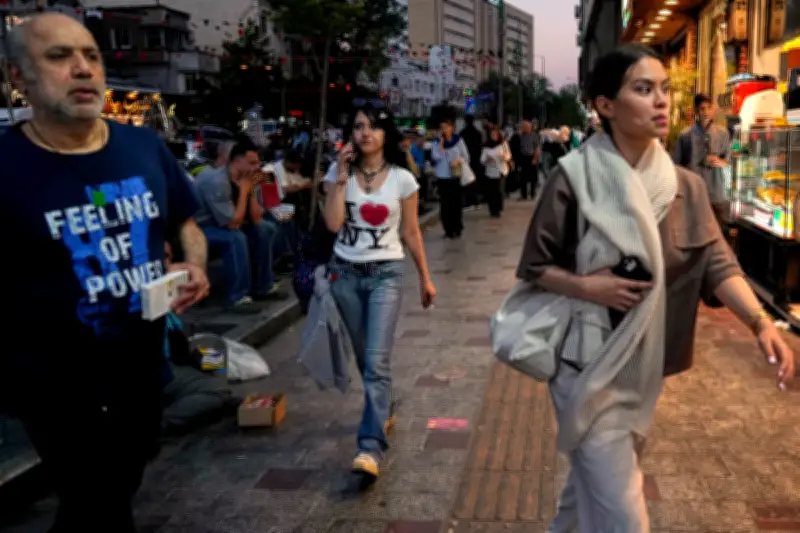
Iran's Islamic Republic regime may have survived the war, but it now faces an even greater challenge: making peace with its own population. Iranians are reeling not just from the shock of the war but also the killing of thousands of protesters by the authorities at the start of the year, and an economy in free fall. Instead of removing the regime, an initial declared aim of Donald Trump and Israeli leader Benjamin Netanyahu, the war showcased the Islamic Republic's durability after its leader and layers of other top officials were killed.
Post-War Leadership Faces Competing Demands
Now that the war appears to be over, the new generation of leadership confronts competing demands, from hardliners sticking to rigid principles of the Islamic revolution and a population exhausted by economic hardship and repression. The war caused significant destruction and, according to authorities, pushed two million people out of work. Inflation hit 77% last month. Iranians' living standards had already crashed over the last decade due to international sanctions and domestic mismanagement, with economic anger triggering demonstrations that snowballed in January into an attempt to topple the government.
Economic Reprieve and Nuclear Negotiations
There are glimmers of hope. The framework peace deal, signed by Iran and the US last week, offers economic reprieve, potentially unlocking hundreds of billions of dollars for Iran, with some of that windfall immediate. The longer-term economic benefits of sanctions lifting and money for reconstruction depend, however, on thorny further negotiations over Iran's nuclear programme.

Nationalism and Unity Amid Division
The attack on Iran, including the bombing of civilians and civilian infrastructure, triggered a wave of nationalism – a rare moment of solidarity in the deeply divided country. Analysts say there is a widespread belief that Iran won the war. "Trump and Netanyahu have managed to unite Iranians more than any Iranian politician could," said Foad Izadi, an associate professor at the University of Tehran. "Even people who didn't like the government, don't want to send their children to school and not see them again, and they don't want their local hospital to be bombed."
Elham, an artist in Iran who describes herself as a leftist, said that the war and the bloodshed in January had forced a re-examination of beliefs about the West and protests. "The plan was to do to Iran what they did to Syria, Libya, Iraq, Afghanistan: a collapse and occupation," she said. "There's now an understanding that the idea that the US can save us is a lie." She argued that authorities should allow protests but that "regime change" uprisings are taken over by outside interests and lead to violent crackdowns, as in January. Instead, she advocated for grassroots movements that could win freedoms more gradually.
Scrambled Political Categories
Even the categories of conservatives, hardliners and reformers were scrambled by the war. The peace negotiations split, at least for now, more pragmatic conservatives from ultra-hardliners who opposed any agreement with the US. The idea of striking a bargain with the West had been associated with reformers, but the negotiations with the US were led by someone from the conservative camp: Mohammad Bagher Ghalibaf, the speaker of parliament. The deal received public support from the Revolutionary Guards, the military force often considered a vanguard for hardliners. Ghalibaf said last week that there must now be a focus on economic recovery.
Collective Resilience and Defiance
Zeinab Ghasemi Tari, an associate professor at the University of Tehran, said the big nightly gatherings in public squares across towns and cities, which started during the war and still continue, represent something deeper than nationalism: a form of collective resilience and defiance. She noted that while economic grievances remain, protests like those in January were tied to a now discredited pro-Western outlook. "We are seeing fewer reformists openly advocating for engagement [with the West], and more either recalibrating their positions or remaining silent," said Tari. "The war has reshaped public consciousness in ways that are still unfolding."

Doubt Over Reform
Even with more pragmatic figures in ascendancy, many doubt that the regime would use this moment of unity for reform. The new supreme leader, Mojtaba Khamenei, believed to have been wounded in the war, has yet to appear in public or set out a domestic agenda. Mehran Haghirian, director of research and programmes at Bourse & Bazaar Foundation, a London-based thinktank focused on West Asia, said the Islamic Republic is not capable of change, as that requires being open to the outside world. "With the current system in place, it is impossible for it to alleviate the economic situation of the country," said Haghirian. "It is a country ruled by a minority, so it will always have domestic opposition as its main consideration."
Alex Vatanka, senior fellow at the Washington-based Middle East Institute, said the regime needs sanctions relief and economic recovery, or wartime solidarity will curdle back into the old conflict between state and society. "The real challenge now isn't deterring Washington; it's whether Tehran can convert a moment of forced cohesion into a durable compact with its own citizens," said Vatanka. "That is the harder and more existential test."