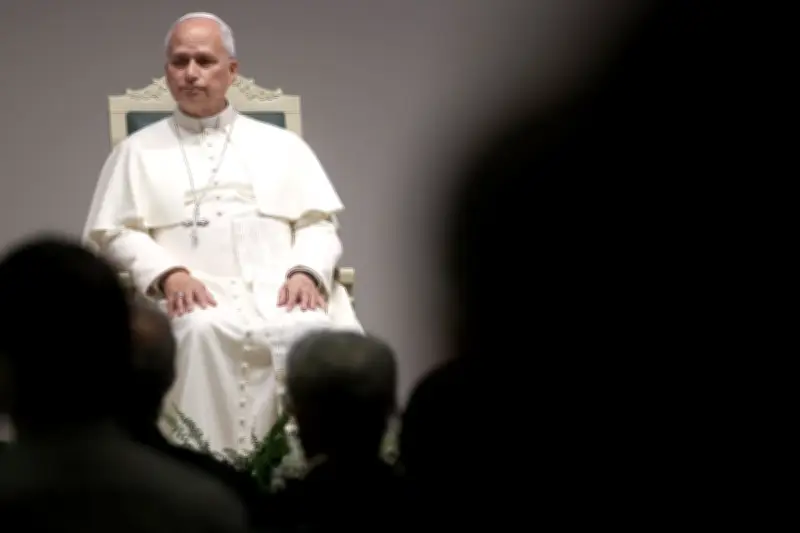
SSPX ordination plan sets stage for Vatican showdown
A far-right Catholic sect’s decision to ordain its own bishops on July 1 has placed it on a collision course with the Vatican, posing a potential crisis for Pope Leo just over a year into his papacy. The move threatens to deepen tensions between the Holy See and rightwing Catholics in the United States and elsewhere.
The Society of St Pius X (SSPX), founded in Switzerland in 1970 to oppose liberalizing reforms in the Catholic church, has gained significant followings in the US, France, Argentina and other countries. The order, which operates a large base in Kansas, claims that more than half a million people worldwide attend its masses, though these numbers are difficult to verify. It counts nearly 1,500 priests, seminarians and other vocational members.
Pope Leo appeals for unity
Pope Leo told journalists in Rome last week that he was “considering making another appeal to say: ‘Do not do this, let us try to live in communion within the church.’” But he said it was the SSPX’s “choice” whether to continue on a trajectory that threatens schism. “If they make that choice,” Leo added, “I am sorry, but we must move forward.”

Under Catholic canon law, ordaining bishops without Vatican authorization is grounds for immediate excommunication. So far, both sides are refusing to blink. The Guardian contacted the Holy See and the SSPX for comment but neither responded.
SSPX defends necessity of ordinations
The SSPX maintains that its planned ordinations of four new bishops – two French, one Swiss and one American – are made from practical necessity and “do not proceed from any desire to claim a power of jurisdiction or to establish a parallel authority within the Church”. The relationship has seen decades of standoffs, stalled negotiations and failed reconciliation attempts.
The first and last time the SSPX ordained bishops, in 1988, the Holy See excommunicated those who participated, including the SSPX’s founder. In 2009, Pope Benedict lifted those excommunications as a gesture of goodwill and granted greater permission for the use of the Latin mass, which traditionalist Catholics favor but has been largely replaced by vernacular liturgy.
Francis and Leo continue dialogue
Pope Francis, Benedict’s more liberal successor, abolished a commission set up three decades earlier to negotiate with the SSPX, though he also recognized the order’s sacraments as valid for marriage and confession. The SSPX exclusively practices the Latin mass and advocates strict gender roles, discouraging women from wearing trousers and often requiring head coverings in church.
Yet the sect’s contentions with the Vatican are more fundamental, according to Massimo Faggioli, a professor of theology at Trinity College Dublin. The SSPX rejects doctrines of reform formulated during the 1962-1965 second Vatican council, which are core to the modern Catholic church. “It’s not something that you can solve by saying: ‘OK, you can celebrate mass in Latin,’” Faggioli said.
Theological rift at the heart of the conflict
The second Vatican council promoted unity between Christian churches, acknowledged universal freedom of religion, argued that other world religions could “reflect a ray of truth”, condemned antisemitism, and disavowed the notion that Jews bore collective responsibility for Jesus Christ’s death. The SSPX believes these reforms were essentially heretical, Faggioli said, and has not given any sign of shifting position.
If the Vatican excommunicates the SSPX, the big question is how conservative Catholics who are not in the order but are sympathetic to some of its views will react to the schism. The mounting tension comes as rightwing Catholics have shown increasing willingness to tussle with the Vatican over political and theological disagreements. Some US Catholics, where influential lay members tend to be both conservative and wealthy, have supported the Trump administration even as its stances on immigration and foreign policy clash with those of the Vatican.

SSPX’s history of far-right ties
The SSPX founder, Marcel Lefebvre, was a French royalist fiercely opposed to communism, decolonization and secularism. He was one of a small percentage of bishops who voted against key documents of the second Vatican council. He died in 1991.
The sect has been dogged by accusations of antisemitism and ties to the extreme right. The Nazi collaborator and convicted war criminal Paul Touvier was arrested at an SSPX priory in France in 1989; the SSPX said it had taken him in as an act of charity. In 2009, an SSPX bishop told the press that he believed no more than 300,000 Jews were killed in the Holocaust. In 2013, the SSPX sparked outrage in Italy by officiating a funeral for convicted Nazi war criminal Erich Priebke, who had been denied burial by the Catholic diocese of Rome.
The SSPX has said that it “completely rejects the false claim that it teaches or practices antisemitism, which is a racial hatred of the Jewish people because of their ethnicity, culture or religious beliefs”.