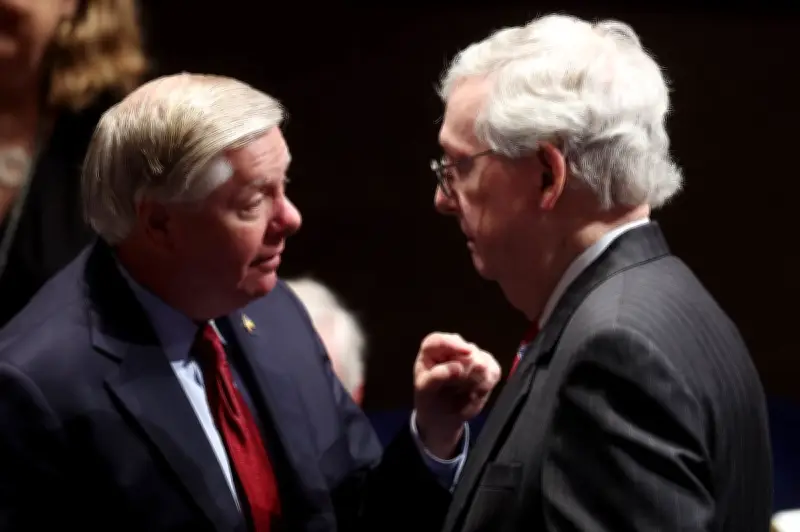
Online conspiracy theories have collided around two of the most powerful Senate Republicans in recent days, with baseless claims spreading about Senator Lindsey Graham's sudden death and Senator Mitch McConnell's health.
Graham's death sparks unfounded speculation
After Senator Lindsey Graham died suddenly over the weekend from what a preliminary medical examiner report said was an aortic dissection, conspiracy theories quickly emerged claiming, without evidence, that foreign adversaries or other frequent conspiracy subjects might have orchestrated the Republican's death. Theories suggested Russia, Israel, Iran, a Covid booster, or even the Clintons were involved.
President Donald Trump cast doubt on any foul play on Tuesday, saying he wasn't sure why the FBI would be at Graham's house. Graham had had heart problems, and an aortic dissection is difficult to detect in advance, the president noted. “I know there’s all sort of conspiracy theories,” Trump, himself a steady purveyor of conspiracy theories, told reporters. “I think the FBI is wasting their time.”

The tactic of spreading rumors, incentivized by social media platforms and creators who make money on them, often accompanies significant political events, especially high-profile deaths or health issues. Trust in institutions, including politicians and the media, has fallen steadily, while trust in the government is at one of its lowest points in seven decades, according to a 2025 Pew Research survey.
McConnell's absence fuels death hoaxes
For McConnell, conspiracies that he is not actually alive have swirled for weeks after his disappearance from the public eye in mid-June. His office created an information vacuum by not addressing the reason for his absence with any depth. A spate of McConnell friends tweeted that they had had long conversations with the 84-year-old former Republican Senate leader, attempting to quell the rumors, but the disclosures only led to further suspicion because the tweets seemed coordinated and shared a common tone.
After Graham's death, McConnell's office released a photo of him with his wife, holding a copy of Sunday's Washington Post sports section—an attempt to prove definitively that he was alive. But it only led to another round of doubt over whether the image was real. In a statement, McConnell revealed for the first time that he had suffered a fall and was hospitalized, adding he also had a mild case of pneumonia. The Post analyzed the photo and its metadata, finding no evidence that it was fake. However, in an era of artificial intelligence, the conspiracy theory that the image was AI-generated persists, with some users falsely claiming it was a recirculated image from 2023.
Republican Senator Ron Johnson, prone to sharing conspiracy theories, told a rightwing news station: “I’ve just heard from some other sources that was an older photo. So I really don’t know.” Johnson later said that was a rumor and assumed it was false. Senator John Cornyn of Texas also said he wished McConnell's office had been more transparent, arguing that more information would have “resolved a lot of questions.”
Graham's overseas trip fuels doubt
Graham's travel overseas in the immediate lead-up to his death, where he appeared healthy on a trip to Ukraine, helped fuel disbelief over his cause of death and calls for an investigation. Graham was a prominent Russia hawk who once appeared to call for the assassination of Vladimir Putin. FBI Director Kash Patel fueled more speculation by saying the agency was “assisting local authorities and has made every necessary resource available” in the wake of the senator's death.
Laura Loomer, a rightwing commentator and Trump ally with nearly 2 million followers on X, has elevated claims about both Graham and McConnell. “I didn’t realize 20 FBI agents were needed to convince everyone that Lindsey Graham died from an Aortic Dissection,” she wrote on X. “Did the toxicology report come back? 2 things can be true at once.”

Marc Thiessen, a political commentator and former George W. Bush speechwriter, said it was “entirely possible” that Graham died from a heart attack but “not a conspiracy theory to suggest something else might be at play.” “Putin has poisoned and assassinated many of his opponents, and Graham was just in Kyiv where there are certainly FSB agents operating,” Thiessen wrote on X. “There should be a full autopsy and tox screen to rule out foul play.”
Calls for transparency and toxicology reports
Graham's office said in a statement that the cause of death on his death certificate “will be PENDING until all the toxicological and microscopic testing are finalized.” Cornyn told reporters on Monday that he wanted a toxicology report on Graham released to “rule out any foul play.” “Given where he was and the sorts of things he was advocating for, I think we just ought to resolve all those questions by seeing what the toxicology reports show,” he said.
Joseph Uscinski, a political science professor at the University of Miami who studies conspiracy theories, noted that while online chatter may seem pervasive, it does not necessarily translate into widespread belief. “If we were having these conversations at the water cooler, our words would be here and gone, and nobody would see it,” Uscinski said. “But because social media is sort of there forever, people who want to know what other people are talking about can easily see it and access it. But it doesn’t mean that it’s persuading anyone.”
Conspiracy theories are popular among rightwing influencers, some of whom have called into question the assassination attempts against Trump, including the one in Butler, Pennsylvania, where the president's ear was injured. Some have also repeatedly cast doubt on the assassination of rightwing commentator Charlie Kirk, who was shot and killed at a university event in Utah. His alleged killer is now on trial.