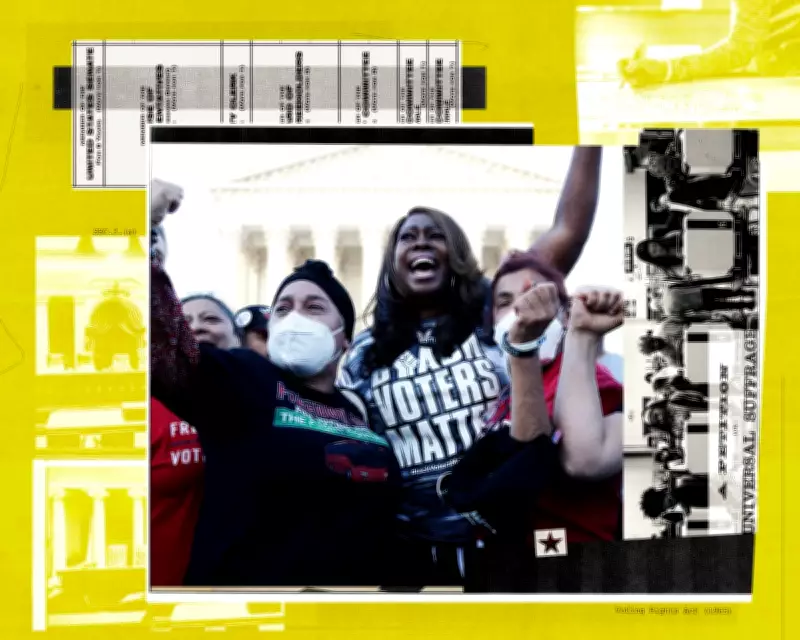
Voting rights activists have expressed shock at the speed with which southern US states are moving to redraw congressional maps to favor white voters, following the Supreme Court's ruling in Louisiana v. Callais. The decision has triggered a wave of redistricting efforts in Alabama, Mississippi, Tennessee, Florida, and other states, effectively eliminating Democratic-majority districts that are often Black-majority.
Swift Response to Supreme Court Ruling
One week after the Callais decision, Louisiana's governor ordered the state's ongoing congressional election to be set aside while lawmakers redraw maps to eliminate a Democratic-majority seat covering Baton Rouge. Alabama's Republican-majority legislature is drafting legislation in a special session that would allow it to set aside the results of a completed primary if courts lift an injunction on its redistricting. Florida was already in a special redistricting session when the ruling was handed down, passing a map that packs Black and brown voters into four districts on the south Florida coast and Orlando, eliminating every other Democratic majority.
Mississippi and South Carolina Join the Effort
Mississippi will convene in two weeks in a Confederate-era capitol building that hasn't been used in 100 years, ostensibly to eliminate the Democratic majority in the one Mississippi district held by a Black representative. South Carolina's Republican majority voted to extend its legislative calendar to consider eliminating the state's sole Democratic-majority, Black-majority district, held by long-serving Representative James Clyburn. Tennessee lawmakers voted Thursday morning to eliminate its one remaining Democratic district around Memphis, a city of about 610,000 people, about two-thirds of whom are Black.

Activists Decry 'Swiftest Disenfranchisement Since Reconstruction'
Donald Trump's demand to tear up political norms has been met by Republican states eager to dust off a segregation-era playbook that maximizes the political power of white voters. Democratic state Representative Justin Pearson of Tennessee called the actions "the swiftest disenfranchisement of Black folks since Reconstruction, due to disenfranchisement by racist gerrymandering." He noted that the Memphis district was "cracked into three" and stretched hundreds of miles, diluting Black voting power surgically.
Lawsuits will be filed. Existing Tennessee state law bans mid-decade redistricting, though lawmakers amended that law to conduct this redistricting. Article 2 of the Tennessee constitution requires maps to avoid dividing counties, but the changes have been made with perfunctory regard to opposition.
Stacey Abrams Condemns 'Cowardice'
Stacey Abrams, a voting rights advocate and former Georgia lawmaker, addressed Tennessee lawmakers at the redistricting committee hearing, stating, "Rigged maps that decide elections before a single vote is cast and politicians who rig elections so it's impossible for them to lose: this is not democracy. This is cowardice." Republican lawmakers ignored her pleas, moving the meeting to another room without allowing the public in to watch, and passed it out of committee.
Activists Mobilize Across the South
Genesis Robinson, executive director of the Equal Ground Education Fund and Action Fund in Florida, described the reaction to the Callais ruling as immediate and devastating. He filed a lawsuit in Florida immediately after the state passed its new maps, calling Florida "the epicenter of all attacks on voting and the right to access the ballot box." The most dramatic map changes have been around Miami and south Florida, eliminating two Democratic-majority seats by packing Black voters into one district and breaking the rest across several others.

Alabama: 'Why Does This Country Hate Me So Much?'
Anneshia Hardy, a voting rights activist in Alabama, cried for 30 minutes upon hearing the ruling. She recalled her mother's words: "Baby, you know, the Black struggle is your ancestral truth. You are not privileged enough to be removed from the direct impact of social issues in this country." Alabama's Republican majority is bound by federal court to refrain from mid-decade redistricting, but the attorney general asked a federal district court to lift that injunction. Amid a tornado warning in Montgomery, Republican lawmakers completed their votes.
Louisiana: 'They Can Move Mountains When They Want To'
Jared Evans, an attorney with the Power Coalition for Equity and Justice in Louisiana, noted that when advocates challenged a map with only one Black district four years ago, state leaders argued there wasn't enough time to alter the maps. "Now, I think it is very clear that they can move mountains when they want to, when it's for their own political gain," Evans said. It is unclear whether Louisiana will draw a map with one Black-majority district or none, which could threaten the seats of powerful Republican representatives Mike Johnson and Steve Scalise.
Mississippi's Symbolic Choice of Venue
Mississippi house lawmakers are meeting on May 20 to consider redistricting, opting to use its old capitol building, which housed post-Reconstruction white supremacists who stripped free Black citizens of their rights. Amir Badat, a voting rights attorney in Mississippi for Fair Fight Action, called the choice symbolic and questioned whether it constitutes a deviation from normal legislative process, which courts can use to measure discriminatory intent.
Bennie Thompson: 'This Is Equivalent to a Second Civil War'
Representative Bennie Thompson, Mississippi's only congressional Democrat, whose seat is on the chopping block, said, "This is equivalent to a second civil war. We're going to have to get our act together. We're going to have to resist with every fiber in our body."
Protests and Preparations for a 'Period of Retribution'
As Tennessee lawmakers voted to send new congressional district maps to the governor, state troopers dragged shouting protesters from the gallery. Activists are grimly preparing for the kind of mobilization and protest that led to passage of the Civil Rights Act more than 60 years ago. "We are entering into now the period before the Voting Rights Act," said Pearson. "Now we're in the period of the white-lash, and now we're in the period of retribution, and the retribution is showing up in Black political deprivation."