Thirty years ago, when I watched Pauline Hanson deliver her first speech to the House of Representatives, there was a sense around the halls of federal parliament that she was a radical, racist outlier who would soon disappear. Hanson has survived more than her share of political vagaries to the point her One Nation is topping party popularity polls. Indeed, One Nation's recent success in South Australia and at the Farrer byelection presages potentially far broader electoral wins.
The Problem for Major Parties
The problem Hanson and One Nation pose for the major parties is that the anti-establishment politics juggernaut she has become defies modern Australian political orthodoxy. It's a vibe and a movement as much as a party vehicle. And right now, the bitter mood it harvests is one of contempt, envy, anger (at 'mass migration', Muslims, Aboriginal people and many others besides) that has long simmered at the heart of Australian society.
First Speech Highlights
In hindsight, what she said in her first speech in September 1996 formed a list of greatest hits she's returned – and progressively added – to with ever greater efficacy. Australia, she said, was 'in danger of being swamped by Asians'. She wanted 'multiculturalism abolished'. She also maintained that a 'reverse racism is applied to mainstream Australians' and referenced 'industries that flourish in our society servicing Aboriginals, multiculturalists and a host of other minority groups'. She was 'fed up to the back teeth with the inequalities that are being promoted by the government and paid for by the taxpayer under the assumption that Aboriginals are the most disadvantaged people in Australia'.

This, of course, is no less demonstrably false than it is today; Australian First Nations people remain our most shamefully disadvantaged citizens. But facts have so often eluded her.
Targeting Enemies
Back then she cast her enemies as 'fat cats, bureaucrats and do-gooders'. It was her way of describing the political elite – the institutional pillars of older, centrist political parties and the media that insisted she account for extremist views. Since 2017 Hanson has targeted her perceived enemies by aping the crown prince of virulent political populism, the serving US president, saying she wants to drain the 'Canberra swamp'. It's Trumpian, now Hansonian, code for smashing institutions, political professionals, bureaucracies, perceived politically correct interests and the mainstream media of which she is often contemptuous.
Press Club Speech
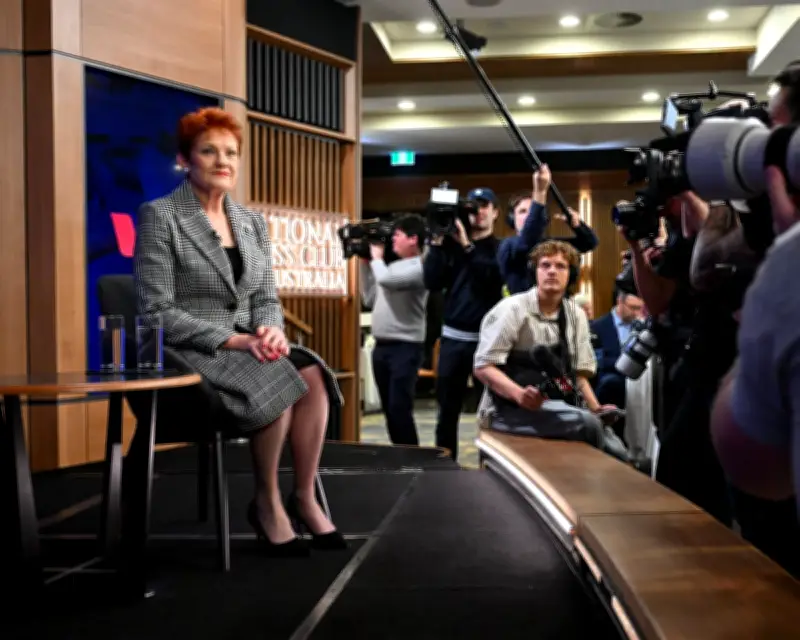
Ironically Hanson's decision to speak at the National Press Club on Wednesday and submit herself to the scrutiny of journalists represents an acceptance (somewhat reluctant perhaps) of an invitation to join – and play more by the rules of – mainstream politics. The perpetual outsider was now inside the tent. She welcomed 'scrutiny', she insisted, but that 'doesn't give you licence to pile on', she told journalists, and, judging from the applause, many active supporters among (mostly) non-media attendees.
Make no mistake – this was the moment an avowed political outsider made it very clear she is serious about becoming prime minister. And, so, she went around the world restating her old hits – welfare envy, multi-culturalism and -lingual-ism, Islam, the 'Aboriginal Department' [sic], the 'immigration catastrophe', the political establishment, to name but a few. And she added some more recent ones: transgender people; the net zero 'hoax'; the global warming 'hoax'; the purported siege on western values; SBS and the ABC; a Guardian reporter; the taxpayer cost of subsidised childcare; the 'contempt of the political establishment' for Australians.
Winning the Base
All Hanson had to do to 'win' in the eyes of her movement's burgeoning base was turn up as the flaming beacon of their discontent. She was as characteristically phantomic on policy detail, costings and sources as ever. But rank populism eschews the institutional factcheck. Indeed, it thrives – just as the vibe does – on obfuscation and denial in the face of factual challenge. Trumpism showed her that. It's the oxygen of the institutional bulldozer she fancies herself as.

Unchanged Views
One undeniable truth she spoke today was that 'my views haven't changed'. But so much about Australian social demography has. Inequality and poverty have never been more acute. Generational inequity, fuelled by resentment over access to housing, is a tinderbox. Access to education and rising student debt is breeding ever greater disenchantment in young people. There are rising rates of poverty and homelessness, and the inexorable march of the cost of living against wages.
This all requires major structural reform to address, something the major parties clearly recognise. But that can take decades to change. Meanwhile, the vibe is burning hot with rage in the zeitgeist – right now.
Hanson's Moment
Add to this the rallying community capacity of social media platforms, diminished major party tribalism, long-held assumptions in sections of traditional media and established major parties that compulsory preferential voting was a firewall against the type of populism raging in the US and the United Kingdom and Hanson may finally, no matter how improbable it seemed in 1996, have found her moment.
A handful of polls do not make a federal election. But they are portentous. John Howard as newly elected Liberal prime minister moved slowly to criticise Hanson back in 1996 – both when she was disendorsed during the election campaign and after her socially toxic first speech. Biographers and chroniclers of the 1996 election often credit Howard with taking a principled moral stand by intervening to disendorse her in that campaign. But it's worth repeating the words of Bob Tucker, the Queensland Liberal federal president at that election who, quoted in 1998, said that it was he and Jim Barron, the Queensland party director, who ousted her.
'There's always been this impression that John Howard and Robb [former federal Liberal director Andrew Robb] had initiated the action to. But it certainly wasn't initiated by them. It was us … we made the decision, Jim Barron and I – and put it to Howard … and we never really knew if Howard even knew what we were doing.'
Softly-Softly Approach
For the most part the major parties are still adopting a softly-softly approach to Hanson. Criticising her on the facts, and on her absence of policy detail, seems to strengthen her base. And it is undeniably treacherous ground when criticism of Hanson can be misconstrued – deliberately or otherwise – as a 'deplorables'-style criticism of her supporters. As her deputy Barnaby Joyce says, 'Pauline sometimes says things that aren't pitch perfect'. Indeed. But, he also said she did have Australians' best interests at heart. True or not, it's certainly critical to the vibe.