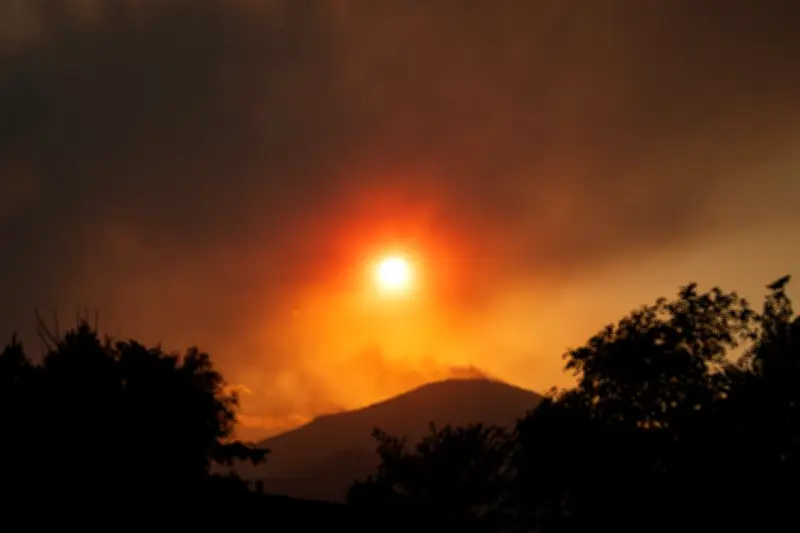
Utah's National Weather Service in Salt Lake City has issued a 'particularly dangerous situation red flag warning' for the first time in its history, as the state battles unprecedented wildfires. The warning, announced on Thursday, comes amid extreme fire conditions fueled by high winds, hot temperatures, and low humidity.
First-of-its-kind warning issued
Chase Thomason, a meteorologist for KUTV, Utah's CBS affiliate, described the situation as 'extremely rare,' noting that wind gusts of 40-50+ mph combined with hot temperatures and extremely dry air could cause explosive wildfire growth. 'Any new fire that starts could spread rapidly and become difficult to control,' he said.
On the same day, Utah Governor Spencer Cox declared a state of emergency and temporarily banned personal fireworks until July 5. The executive order allows the state forester to prohibit fireworks anywhere in the state, temporarily suspending a 2024 law that prevented such a ban in cities.
State of emergency and fireworks ban
'It's not about taking decisions away from local communities. In fact, we want to put local knowledge at the center of this process,' Cox said during a Thursday press conference. He added that while the default position is that fireworks are prohibited, local fire chiefs and officials can designate areas where fireworks are allowed if conditions permit. 'We think this strikes the right balance,' he said.
The emergency measures come as Utah experiences a severe wildfire season. As of Friday, nine active wildfires were burning across more than 143,000 acres, according to the state's wildfire dashboard. So far this year, Utah has had 373 wildfires, with all but 100 caused by humans.
Cottonwood fire most destructive in state history
Among the current blazes is the Cottonwood fire, discovered on Monday and described by Cox as the most destructive fire in state history. It has burned nearly 72,000 acres and is at 0% containment, according to Utah fire info. The fire has forced the closure of Eagle Point ski resort and damaged several surrounding structures.
Evacuations have been ordered in Eureka, a small town about 80 miles south of Salt Lake City, as the Iron fire and other blazes threaten communities. Smoke from the fires continues to blanket surrounding areas, affecting air quality at popular vacation spots such as Zion and Bryce Canyon national parks, located far south of the flames.
Heatwave exacerbates fire danger
More fire danger is expected as a heatwave blankets the west coast of the US, with troubling conditions for states such as Colorado and Arizona. The red flag warning remains in effect as firefighters struggle to contain the blazes.