
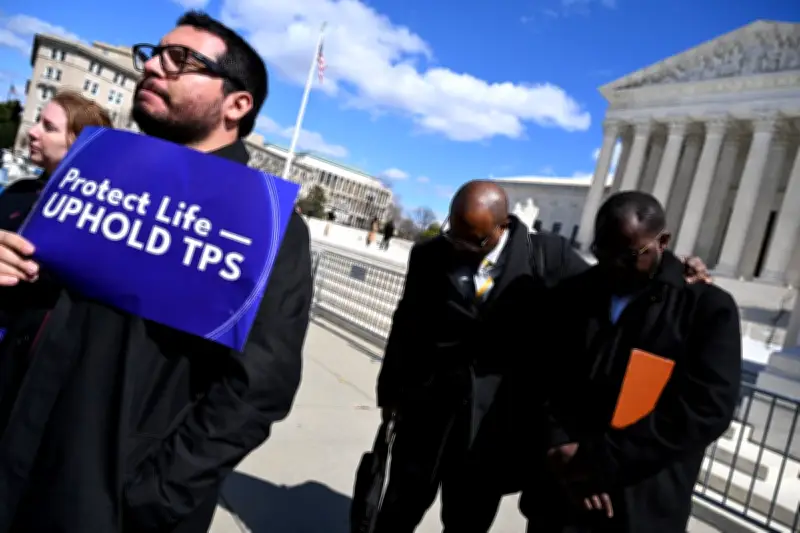
Supreme Court Upholds Termination of TPS, Endangering Over One Million Immigrants
The US Supreme Court has authorized the Trump administration to end Temporary Protected Status (TPS), a decision that could expose more than 1.3 million people to potential deportation. The ruling, issued on Thursday, specifically affects approximately 350,000 Haitian and 6,000 Syrian TPS holders, but the precedent threatens many more.
Background of Temporary Protected Status
TPS was enacted in 1990 under President George H.W. Bush to protect individuals from countries experiencing ongoing armed conflict, environmental disasters, or pandemics—situations that do not meet the strict legal definition of asylum. Asylum requires a well-founded fear of persecution based on race, religion, nationality, membership in a particular social group, or political opinion.
Unlike asylum, TPS does not offer a pathway to permanent residency. It provides temporary protection from deportation and work authorization, renewable for six, 12, or 18 months. Over time, many TPS holders have built lives in the United States. For example, Yemeni TPS holders run half of New York's bodegas, according to a judge's observation.
Impact of the Supreme Court Decision
The Supreme Court's 6-3 ruling allows the executive branch to terminate TPS at its discretion, with the judiciary unable to intervene. Justice Samuel Alito wrote that President Trump's statements about Haitian immigrants—including false claims that they eat dogs and that immigrants are poisoning the blood of the nation—are not overtly racial but express policy views that could rest on race-neutral justifications.
This decision overturns lower court rulings that had blocked termination. Judge Ana Reyes had previously issued an 85-page decision arguing that the administration's motivation was racial animus, citing a social media post by Homeland Security Secretary Kristi Noem recommending a travel ban on countries flooding the nation with killers, leeches, and entitlement junkies. Reyes also noted that while the US government claimed Haiti was safe, it maintained a Level 4: Do Not Travel advisory due to crime, terrorism, and limited healthcare.
Economic Contributions of TPS Holders
TPS holders contribute significantly to the US economy, paying over $29 billion and nearly $8 billion in taxes, according to the author Heba Gowayed. They are ineligible for most public benefits but pay into systems they cannot use. The ruling leaves them vulnerable to an expanding for-profit mass deportation regime.
Broader Immigration Crackdown
The TPS decision comes amid a broader assault on legal immigration. On the same day, the Supreme Court allowed the administration to block asylum seekers at the Mexico border. Domestically, courts are pretermitting asylum seekers with strong claims and sending them to third countries. New policies require people to return to their home countries to apply for green cards, and travel bans prevent them from returning. By some estimates, legal migration could drop by 30% to 55% as a result.
Call for Congressional Action
Heba Gowayed, an associate professor of sociology at CUNY Hunter College and author of Refuge: How the State Shapes Human Potential, argues that the attack on TPS shows that what is legal and illegal is a political construct by those in power. She calls on Congress to immediately create pathways to residency for TPS holders and pass a bill that has already cleared the House with bipartisan support to protect Haitians. Without action, over a million people could be pushed into undocumented status, facing deportation to unsafe countries.




