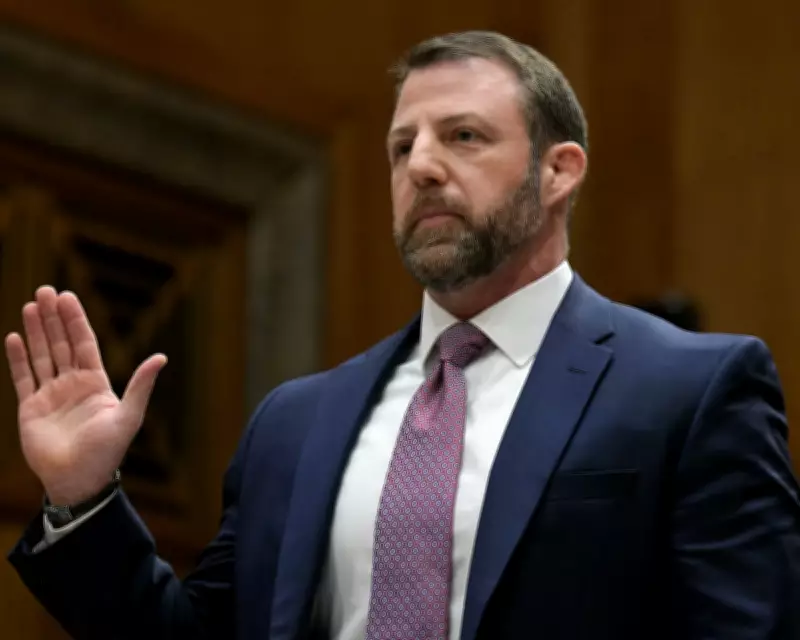
Senate Confirms Trump Loyalist Markwayne Mullin as Homeland Security Secretary
The United States Senate has officially confirmed Republican Senator Markwayne Mullin to serve as the Secretary of the Department of Homeland Security. This pivotal appointment elevates Mullin to a key position where he will become one of the primary public faces of President Donald Trump's aggressive crackdown on undocumented immigrants across the nation.
Vote Breakdown and Political Dynamics
The Republican-controlled chamber confirmed Mullin largely along strict party lines, with a final vote tally of 54-45. Senator Rand Paul of Kentucky emerged as the sole Republican to vote against the confirmation, while Democrats John Fetterman of Pennsylvania and Martin Heinrich of New Mexico provided unexpected support in favor of Mullin.
While Fetterman had endorsed Mullin shortly after his initial nomination, Heinrich's affirmative vote came as a genuine surprise to political observers. Following his weekend vote to advance the nomination, Heinrich released an official statement describing Mullin as a "friend" who "is not someone who can simply be bullied into changing his views."
Heinrich further emphasized, "I look forward to having a secretary who doesn't take their orders from Stephen Miller," directly referencing the White House official who has served as a principal architect of Trump's controversial immigration policies.
Mullin's Background and Immediate Challenges
A former House representative who was elected as Oklahoma's junior senator in 2022, Mullin now assumes leadership of a massive federal department employing approximately 260,000 personnel. This department encompasses critical sub-agencies including Immigration and Customs Enforcement (ICE) and the U.S. Border Patrol.
Among his most pressing initial tasks will be accelerating efforts to reopen departmental operations that were partially shuttered in mid-February. This shutdown occurred when Democratic legislators rejected funding legislation for the department because it lacked new guardrails on immigration enforcement operations.
Democrats demanded these restrictions following a tragic incident where immigration agents killed two U.S. citizens during an intensive weeks-long enforcement operation in Minneapolis. Their specific demands include:
- A complete ban on officers wearing masks during operations
- A mandatory requirement that agents display proper identification at all times
- Strict adherence to established rules governing use of force
- Comprehensive investigations into all alleged violations
Notably, the recent shutdown did not impact ICE or other agencies directly involved in immigration enforcement, as Republicans had previously authorized tens of billions in operational funding through the One Big Beautiful Bill Act passed last year.
Funding Complications and Policy Stances
The funding negotiations have grown increasingly complex following President Trump's declaration that no deal should be made with Democrats until they support the Save America Act. This proposed legislation would impose new voter identification requirements that the minority party is currently blocking in the Senate.
During his confirmation hearing last week, Mullin adopted a diplomatic tone while signaling he would pursue a less publicly visible approach to leading DHS compared to his predecessor Kristi Noem. Trump reportedly fired Noem after becoming dissatisfied with her personal appearances in departmental advertisements.
"My goal in six months is that we're not in the lead story every single day. My goal is for people to understand we're out there, we're protecting them, and we're working with them," Mullin told senators during the hearing.
While expressing regret for previously describing Alex Pretti—the second U.S. citizen killed in Minneapolis—as "a deranged individual that came in to cause maximum damage," Mullin either deflected Democratic questions about specific immigration arrests and tactics or signaled his intention to maintain current policy directions.
Controversial Positions and Operational Guidelines
Among the policies Mullin refused to endorse was keeping immigration agents away from polling stations, where some Trump allies have suggested they should be deployed. This has prompted significant concerns that their presence could intimidate and scare off legitimate voters during the upcoming November elections.
"I don't understand what the concern about enforcing immigration at polling places is anyways. Because, honestly, if you're not a citizen, you shouldn't be voting anyways," Mullin stated during questioning.
However, Mullin did affirm that immigration agents would not enter private homes or businesses without a judicial warrant signed by an authorized judge. This clarification came following recent reports that ICE agents had been instructed they could enter properties with only administrative warrants—internal documents authorized by agency supervisors.
"We will not enter a home or place of business without a judicial warrant unless we're pursuing the individual that runs into a place of business or a house," Mullin explicitly told senators.
Senate Vacancy and Electoral Implications
Mullin's departure from the Senate creates a vacancy that Oklahoma's Republican Governor Kevin Stitt will fill through appointment. Under state law, the appointed replacement must belong to the same political party as the incumbent and cannot stand in the next election for the seat. The special election to permanently replace Mullin will coincide with the midterm elections scheduled for November.
Mullin now assumes his role at a critical juncture, as public opinion polls indicate Trump's immigration policies are growing increasingly unpopular among the general population. These policies will be a central issue during the November midterms, where Republicans will be defending their control of both the Senate and House of Representatives.