
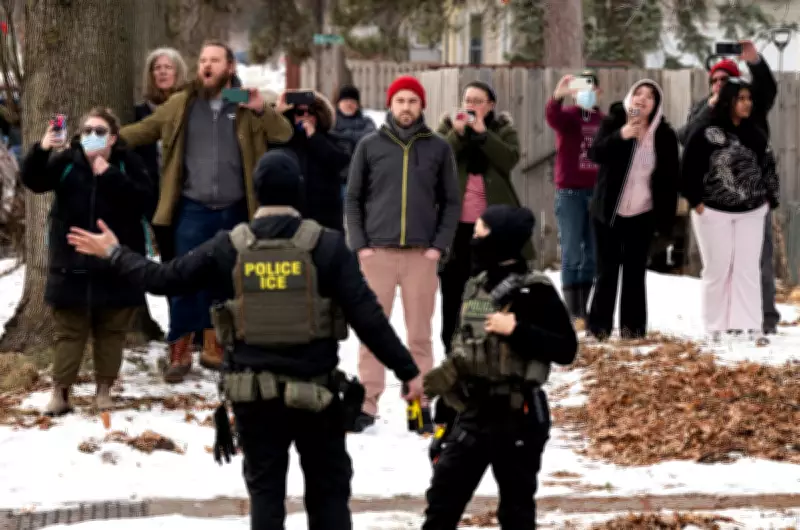
ICE Crackdown Transforms Minnesota Suburbs into Conflict Zones
Federal immigration enforcement activities have fundamentally altered daily life across Minnesota, transforming quiet suburban communities into zones of conflict and fear. Despite recent announcements about scaling back operations, the impact of Immigration and Customs Enforcement (ICE) agents continues to reverberate throughout the state.
Widespread Disruption Across Communities
From Minneapolis to outer suburbs, federal agents have conducted operations that have left no part of Minnesota untouched. In one striking incident on February 5, 2026, observers documented ICE agents maintaining a perimeter around a disabled vehicle on Penn Avenue in Minneapolis, highlighting the constant surveillance and response mechanisms that have developed in reaction to federal presence.
Tom Homan, serving as border czar under the Trump administration, declared on Thursday that the federal surge in Minnesota would conclude, with agents gradually withdrawing over the coming weeks. However, this announcement comes after months of intensive operations that have created lasting trauma and disruption.
Suburban Response and Underground Support Networks
The response to ICE activities varies dramatically between urban and suburban areas. In Minneapolis proper, dense population centers allow for rapid mobilization of observers who can quickly outnumber agents on the streets. Suburban communities face different challenges, with larger geographic areas making rapid response more difficult and political dynamics creating complex environments for support networks.
"In Minneapolis, it's a little easier because you know most of the city supports you," explained the co-founder of an immigrant-led organization in an outer suburb, who requested anonymity due to safety concerns. "In other places, it is not as clear who is on your side."
This organization now operates entirely underground, with locked doors, appointment-only services, and donations processed through third parties. The co-founder remains in hiding and keeps their child away from community activities for protection.
Education System Under Siege
School districts across the metro area have been particularly affected. Brenda Lewis, superintendent of Fridley schools north of Minneapolis, now spends her days driving between district schools to monitor federal agent activity. Her district, serving predominantly students of color including large East African and Hispanic populations, has seen safety completely undermined.
"It has literally ended any sense of safety for our children and our families and our staff," Lewis stated. Each school now maintains dedicated security personnel at entrances, and Lewis herself has been followed by agents after speaking publicly about the situation.
The district has filed a lawsuit against the federal government regarding enforcement activities near schools, and absenteeism has skyrocketed as families keep children home out of fear.
Community Organizations Mobilize
Religious and community groups have stepped into the breach. Pastor Miguel Aviles of La Viña church in Burnsville has organized massive food delivery operations serving thousands of families who are too afraid to leave their homes. Sunday attendance at his church has dropped by more than half, and he now raises funds for rent assistance as community members struggle with lost income.
"This is the kind of story that will never appear in popular news headlines," Aviles wrote about families quietly leaving the state or returning to their home countries, "yet it is the reality many of us have been living here."
Political Response and Bipartisan Concern
Local officials across party lines have expressed alarm at the scope and nature of enforcement activities. Joe Atkins, a commissioner in Dakota county southeast of Minneapolis, noted that initial promises to target "the worst of the worst" have not materialized in practice.
"You expect them to be arresting the murderers and the pedophiles," Atkins explained, "and it's been the gardeners and the housekeepers and the roofers and the construction guys."
Democratic state senator Erin Maye Quade from Apple Valley described a situation where immigration agents outnumber local police in her district at any given time. "The best way to describe it is that it is everywhere at any given time," she said.
Personal Safety Concerns and Community Solidarity
Nadia Mohamed, mayor of St. Louis Park and the first Somali American elected mayor of a U.S. city, revealed that her mother, a U.S. citizen, will only leave home with an escort. Despite the fear, Mohamed has found unexpected community support, with neighbors leaving food and notes during this difficult period.
Matt Little, a Democratic congressional candidate, continues to document and confront agents despite recognizing the risks. His six-year-old daughter even suggested he wear snowboarding goggles for protection during protests. "I have to be out there doing whatever I can," Little stated.
As federal agents prepare to withdraw, Minnesota communities face the challenge of rebuilding trust and normalcy after months of disruption that has affected every aspect of daily life from education to religious practice to basic mobility.




