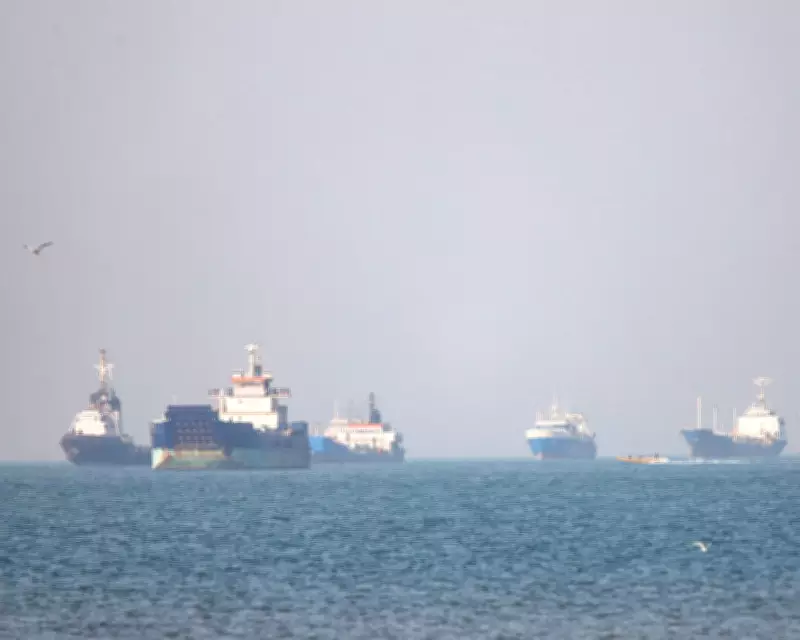
The United States and Iran exchanged fire late Thursday in the most serious test yet of their month-long ceasefire, raising fears of a return to full-scale conflict. Iran accused the US of violating the truce by targeting two ships in the Strait of Hormuz and attacking civilian areas, while Washington insisted it acted in retaliation.
Details of the Exchange
The US military said it struck sites responsible for attacking three American destroyers transiting the strait, calling the Iranian actions “unprovoked.” Iran’s Press TV reported that after several hours of fire, “the situation on Iranian islands and coastal cities by the strait of Hormuz is back to normal now.” The United Arab Emirates said it intercepted Iranian missiles and drones hours after the US thwarted attacks on the USS Truxtun, USS Rafael Peralta, and USS Mason.
Trump’s Response
President Donald Trump insisted the ceasefire remains intact, describing the strikes as a “love tap.” Speaking to reporters near the Reflecting Pool in Washington DC, he said, “They trifled with us today. We blew them away. I call that a trifle.” When asked about prospects for a negotiated end to the conflict, Trump said a deal “might not happen, but it could happen any day,” adding, “I believe they want the deal more than I do.”
Economic Impact
Brent crude oil rose to about $101 a barrel on news of the attacks, reflecting concerns over stability in the vital waterway through which about a fifth of the world’s oil passes.
Background and Negotiations
Before the strikes, there were reports that the US and Iran might be close to a temporary agreement to halt the war, with a one-page memorandum being shared through Pakistan. However, senior Iranian officials have rejected concessions in recent days, with some favoring dragging out negotiations closer to the November US midterm elections, when the Trump administration may face intense pressure to settle.
Regional Perspectives
Regional diplomats believe Iran could overplay its hand, as the current moment offers an opportunity to finish the war and claim a victory—something harder if all-out fighting resumes. If no agreement is reached, Washington could unilaterally end the war and walk away, leaving Iran under suffocating economic sanctions.
Military Statements
US Central Command (Centcom) said Iranian forces launched “multiple missiles, drones and small boats” at the three destroyers, but no US assets were struck. Centcom added that its forces eliminated “inbound threats and targeted Iranian military facilities,” including missile and drone launch sites, command and control locations, and intelligence nodes. “Centcom does not seek escalation but remains positioned and ready to protect American forces,” it said.
Iran’s military accused the US of breaking the ceasefire by targeting an Iranian oil tanker and another ship entering the strait. A spokesperson said the US carried out airstrikes on “civilian areas” along the coasts of Bandar Khamir, Sirik, and the island of Qeshm—home to about 150,000 people and a water desalination plant—and that the strikes were launched “with the cooperation of some regional countries.” Iran’s armed forces responded by attacking US military vessels, “reportedly inflicting significant damage on them.”
Broader Context
The US has been pressuring Iran to reopen the strait, enforcing a naval blockade of Iranian ports. On Monday, the US military said it destroyed six Iranian small boats, as well as cruise missiles and drones, after Trump sent warships to “guide” stranded tankers through the strait in a campaign called “Project Freedom.”
In a social media post, Trump praised the crews of the destroyers for transiting under fire, stating the US vessels sustained “no damage” while Iranian attackers were “completely destroyed.” He railed that the attack showed Iran is “not a normal country” and its “lunatic” leaders would not hesitate to use a nuclear weapon if they had one, warning that without swift diplomatic action, the US could respond “a lot more violently.”
Pakistani Prime Minister Shehbaz Sharif had struck an optimistic tone before the exchanges, saying, “I firmly believe that this ceasefire will turn into a long-term ceasefire.”
Regional Implications
Any agreement between the US and Iran could also help lower tensions in Lebanon, where a separate truce was under renewed strain after an Israeli strike on southern Beirut killed a Hezbollah commander on Wednesday. A US State Department official confirmed that new Israel-Lebanon talks would take place on 14 and 15 May, marking the third meeting in recent months between the two countries, which have technically been at war for decades.