Trump's Iran Brinkmanship Echoes Britain's Historic Suez Crisis
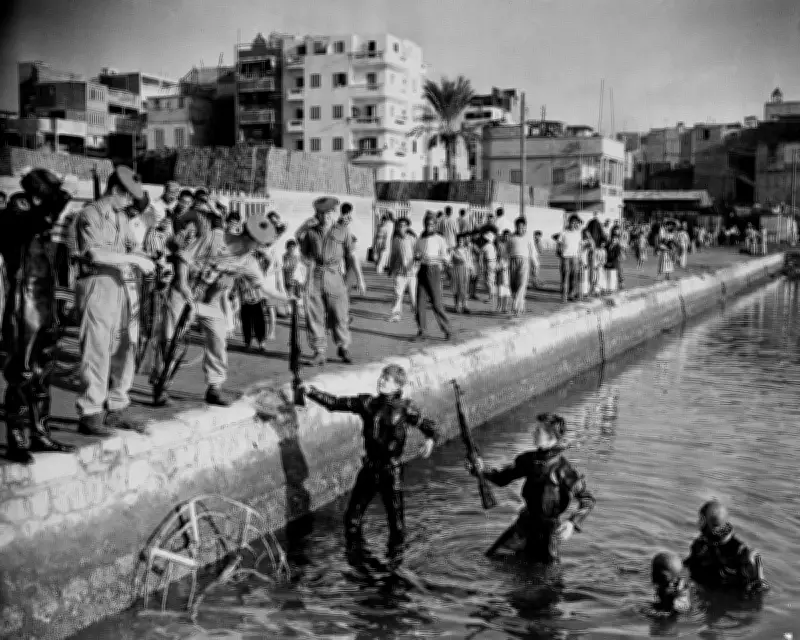
Members of the British expeditionary force in Egypt removed weapons from a backwater of the Suez Canal in November 1956, a moment captured in historical photographs that now serves as a haunting parallel to current events. The United States under Donald Trump faces a strikingly similar crossroads in its confrontation with Iran, with global consequences that could reshape international power dynamics for decades to come.
Parallels Between Past and Present Crises
Britain's standing in the world was never the same after its ill-fated assault on Egypt in 1956, and now the United States risks repeating this history in the Middle East. Donald Trump's tendency to frame every international event in apocalyptic terms has created a dangerous pattern of brinkmanship that threatens to undermine American credibility and power.
Trump's recent threats against Iran, including his declaration that a 7,000-year-old civilization would "die ... never to be brought back" if it did not comply with his demands, demonstrated his reckless approach to foreign policy. The president had to be extricated from this position through a rescue mission involving Pakistan and China, pulling back just 88 minutes before implied destruction in a social media post that highlighted the chaotic nature of his decision-making.
Chaotic Diplomacy and International Fallout
The White House scramble that ensued revealed deep divisions and confusion within the administration. Claims of "a legitimate misunderstanding" regarding ceasefire terms and contradictory statements about diplomatic frameworks created international uncertainty. White House press secretary Karoline Leavitt insisted that published Iranian plans were merely wishlists immediately discarded, while Iranian diplomats maintained that Trump had promised Pakistani mediators more than he intended to deliver simply to extricate himself from a failed coercive strategy.
From Tehran's perspective, Trump has proved entirely untrustworthy over a decade of dealings, and current tensions have only reinforced this perception. The president finds himself trapped between criticism from political opponents and the consequences of his own errors, including what some describe as the "original sin" of believing Israeli Prime Minister Benjamin Netanyahu's assessment that war with Iran could be won quickly.
Global Economic and Political Consequences
The worldwide impact of this crisis has been substantial and far-reaching. Americans face gasoline prices exceeding four dollars per gallon, while the International Monetary Fund predicts lower global growth and higher inflation due to unprecedented oil market disruption. Russian President Vladimir Putin stands to benefit significantly, with estimates suggesting Russian coffers could swell by forty-five to one hundred fifty-one billion dollars over the next year according to the Kiel Institute thinktank.
Across the Gulf region, carefully crafted images of stability and modernity appear suddenly fragile. Qatar faces years of work to repurpose its liquid gas industry, while British Airways has ended flights to Jeddah in anticipation of shrinking tourism. The Gulf Cooperation Council faces complex debates about regional security and the presence of American military bases.
Human Cost and Regional Impact
Inside Iran, the human toll has been devastating. Schools, universities, and medical research centers have been bombed, with the US-based group Human Rights Activists in Iran estimating that 3,636 Iranians have been killed, including 1,701 civilians. Citizen journalism reports describe scenes of terror with women in neighborhoods screaming and on the verge of nervous breakdowns amid endless dust that seemed to cling to throats.
Despite beginning 2026 mired in economic crisis that sparked significant popular protests, the Iranian government now appears strengthened through regime-backed shows of patriotic solidarity. The prospect of regime change or ideological rethinking has receded, with the Revolutionary Guards maintaining their ability to control the Strait of Hormuz and influence civil society despite infrastructure losses.
Nuclear Negotiations and Diplomatic Challenges
As talks approach in Islamabad, Iran's stockpile of highly enriched uranium remains in place, and American negotiators have begun hinting at potential concessions. Vice President JD Vance stated that the United States does not want Iran to enrich uranium with a view to developing nuclear weapons, though he did not formally deny Iran the right to domestic enrichment—the central point of previous disputes in talks brokered by Oman.
Former Iranian Foreign Minister Javad Zarif proposed in Foreign Affairs magazine that Tehran should cap domestic uranium enrichment, blend down existing nuclear material stockpiles, transfer enriched uranium to a multilateral consortium, and reopen the Strait of Hormuz in return for sanctions relief. While supported by former President Hassan Rouhani, this plan has been pilloried by hardliners in conservative media and at demonstrations.
European Response and Transatlantic Relations
Europe now faces difficult choices about maintaining its alliance with the United States in light of what many perceive as American incompetence and recklessness. European countries were excluded from nuclear talks, declined to support a war they considered unnecessary and were not consulted about, and have repeatedly been blamed by Trump for refusing to support American actions.
Unlike divisions during the 2003 Iraq war, European unity has remained stronger regarding opposition to conflict with Iran and inclusion of Lebanon in any truce. A Politico poll across six European countries found that only twelve percent of respondents saw the United States as a close ally, while thirty-six percent viewed it as a threat—compared to twenty-nine percent who saw China as a threat.
Historical Parallels with Suez Crisis
The parallels between current tensions and Britain's 1956 Suez crisis are numerous and striking. Faced with the nationalization of the Suez Canal—an artificial waterway of similar strategic importance to the natural Strait of Hormuz—British Prime Minister Anthony Eden declared that Egyptian President Gamal Abdel Nasser could not "be allowed to have his thumb on our windpipe." Nasser retorted that if the British and French did not like his actions, they could "choke to death on their fury."
When Britain, France, and Israel developed a plan to reoccupy the canal and remove Nasser, US President Dwight Eisenhower intervened to stop it, disapproving of British actions for multiple reasons including regarding Suez as an unnecessary distraction from more important conflicts. Only Australia backed Britain, while Pakistan threatened to leave the Commonwealth, and anti-war protests erupted across the United Kingdom.
What Britain had hoped to prevent through its actions in November 1956, it actually succeeded in guaranteeing. Egypt maintained control of the canal with United Nations and American support, the waterway closed to traffic for five months due to sunken ships, and Britain faced fuel and oil shortages. Nasser emerged significantly strengthened, with Britain's decline in the Middle East exposed as irreversible.
Future Implications and Global Order
Michael Cox, professor of international relations at the London School of Economics, noted in a recent seminar that if the American era is over, nobody told the Americans—and they certainly did not tell Donald Trump. However, the United States may find itself in a paradoxical situation where it remains the dominant global player but no longer promotes a liberal international order.
Princeton professor John Ikenberry insisted that the virtues of the liberal order—open trade, rule-enforcing institutions, democracy, and interdependence—remain robust and more attractive than alternatives including "fractured zones of micro-imperial oppression." Yet the future role of the United States in any new global order remains uncertain, with political scientist Nathalie Tocci arguing that something fundamental has changed in America, which she now describes as "neither liberal nor a leviathan."
As a personality, Trump may represent what some commentators call a once-in-a-century aberration, but he also represents the tip of an iceberg of structural, irreversible forces that will diminish American hegemony. In a profound historical irony, Iran—nominally a backward-looking country—may ultimately serve as the midwife of a new international era, just as Egypt's resistance transformed Britain's global standing after Suez.