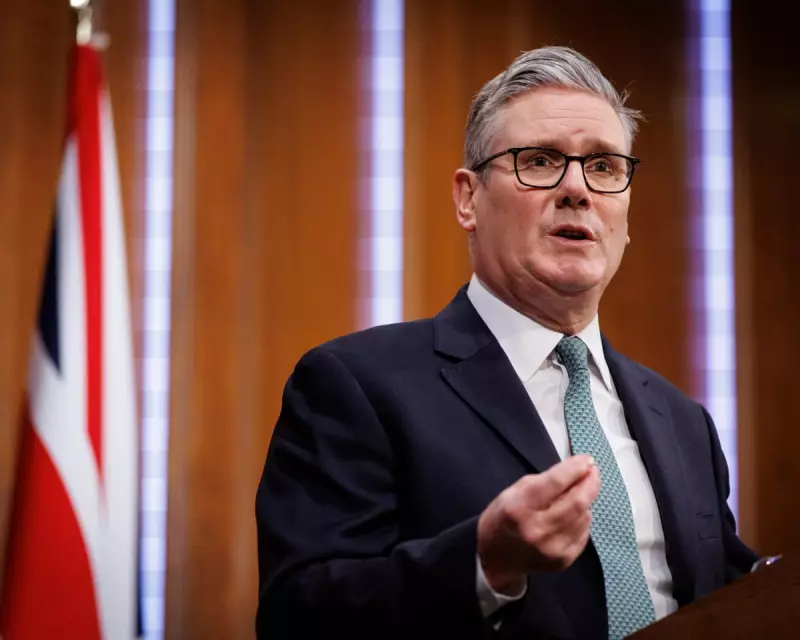
The delicate balance of international diplomacy is being tested as global power dynamics shift under the volatile presidency of Donald Trump. For British Prime Minister Sir Keir Starmer, this presents a profound challenge that extends beyond mere statecraft into the realm of political leadership.
The Fading Rules-Based Order
Canadian Prime Minister Mark Carney delivered a stark assessment at the World Economic Forum in Davos this week, declaring that "the rules-based order is fading" and making way for an era of "great-power rivalry." This seismic shift compels middle powers like Canada and Britain to forge new coalitions, strengthen security investments, and diversify economic relationships.
Carney's warning carries particular resonance given Trump's previous threats toward Canada and his more recent designs on Greenland. The Canadian leader's response represents one of the clearest-eyed analyses from any democratic nation facing the Trump administration's disruptive foreign policy approach.
Britain's Awkward Position
The United Kingdom finds itself in a uniquely difficult position as its closest military ally, the United States, provokes tariff wars with its nearest trading partner, the European Union. Starmer has attempted to navigate this complex landscape by cultivating working relations with Trump while simultaneously aligning the UK economy more closely with Europe as part of a post-Brexit reset strategy.
Supporters of this approach argue that maintaining dialogue with the White House is essential to prevent complete American abandonment of Ukraine to Russian aggression. They contend that performative denunciation of Trump would achieve little beyond making NATO less popular in Washington and potentially jeopardising Kyiv's position in ceasefire negotiations.
The Limits of Quiet Diplomacy
Earlier this week, when threatened with punitive US tariffs for supporting Danish sovereignty over Greenland, Starmer advocated for "calm discussion" to resolve the issue. The American president responded to this measured tone with characteristic aggression, attacking Starmer's plan to transfer the Chagos Islands to Mauritius as "stupidity" despite previous White House approval of the arrangement.
The prime minister rightly pushed back against this criticism, telling Parliament he would not be pressured into changing his position. This exchange demonstrates that the strategy of maintaining mid-Atlantic equidistance has reached its practical limits.
The Need for Political Leadership
Trump's contempt for traditional US alliances represents a fundamental aspect of his political philosophy. While Carney may be premature in declaring the complete rupture of the old international order, the transformation is undoubtedly imminent. Former Prime Minister Gordon Brown made a similar point recently, calling for a "coalition of the willing" to "build a new global framework."
Starmer typically avoids such grand pronouncements, preferring instead to focus on practical problem-solving in the moment as his preferred method for achieving results. However, this approach is being tested to its limits. Without articulating a broader vision of the changing global landscape, the prime minister risks failing to secure public consent for the difficult choices facing Britain.
Naming Reality
As Carney notes, one crucial task for middle powers in this new era is to "name reality" rather than indulging in the pretence that old ways can endure indefinitely. Starmer has demonstrated considerable diplomatic skill in navigating complex international relationships, but he serves as a political leader first and foremost, not merely as a diplomat.
His duty extends beyond working behind the scenes to include candid communication with the British public about the epoch-defining global crisis the nation must now navigate. The quiet diplomacy that has characterised his approach thus far has reached its natural boundary, requiring a more forthright articulation of Britain's position in a rapidly changing world order.