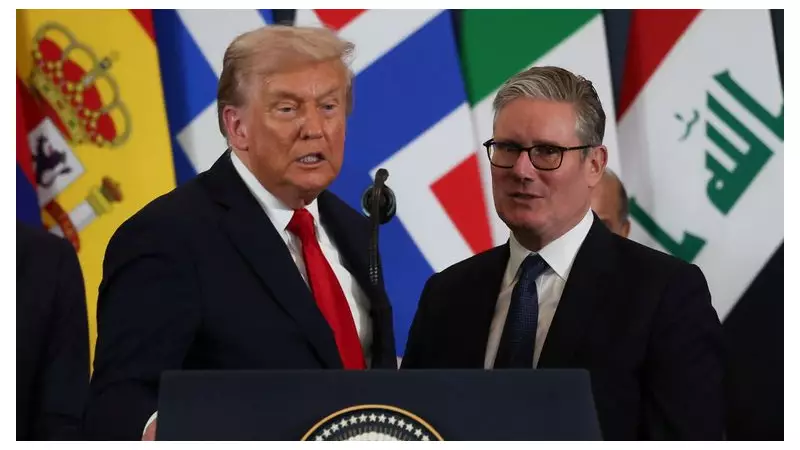
Prime Minister Sir Keir Starmer has begun a significant pushback against former US President Donald Trump, labelling his threat of new tariffs against the UK as "completely wrong". The confrontation centres on a minor NATO mission to Greenland and marks a sharp turn in a relationship the PM has painstakingly cultivated.
A Relationship Turns "Decidedly Abusive"
Sir Keir has invested considerable political capital and personal effort into fostering a strong connection with Donald Trump, despite their clear ideological differences. This effort, particularly in coordinating support for Ukraine, has been viewed as a relative success in his premiership.
However, that "special relationship" has soured dramatically. The trigger was a UK deployment of a single military officer to Greenland, part of a small, multinational reconnaissance mission ahead of a future NATO exercise. The move was intended as a show of solidarity with Denmark and to demonstrate the alliance's attentiveness to Arctic security concerns, a topic Starmer has discussed repeatedly with Trump and European leaders in recent weeks.
Trump responded on Truth Social, accusing the UK and European allies of "playing a very dangerous game" in Greenland for unknown purposes. He has threatened to impose tariffs of 10% and 25% on the UK, potentially atop existing levies, and remains fixated on acquiring Greenland as a US state.
Cross-Party Support for Starmer's Stance
In a rare moment of political unity, Sir Keir's key opponents have rallied behind his position. Conservative leader Kemi Badenoch agreed with the PM, also calling Trump's approach "completely wrong". Reform UK's Nigel Farage stated his party certainly does not agree with the US government.
Liberal Democrat leader Ed Davey urged the Prime Minister to "stand firm against the bully in the White House". Backbench criticism was even fiercer, with one Conservative MP describing Trump as a "gangster pirate" and another questioning the value of Labour's "sycophantic fawning".
The High-Stakes Dilemma for Downing Street
The Prime Minister now faces a profound strategic challenge. How does the UK effectively stand up to an American president threatening a trade war, without causing severe damage to the already fragile British economy? Options being considered include:
- A potential emergency diplomatic visit to Washington by European leaders.
- Leveraging the influence of other allies, like Italian Prime Minister Georgia Meloni.
- The risk of being forced into a capitulation that would sacrifice both Greenland and the principle of NATO solidarity.
While Sir Keir's rebuttal is more measured than French President Macron's pledge of defiance, it represents a clear line in the sand. As of Sunday 18 January 2026, the path forward for European leaders remains uncertain, but the Prime Minister has signalled that the era of unchecked accommodation may be over.