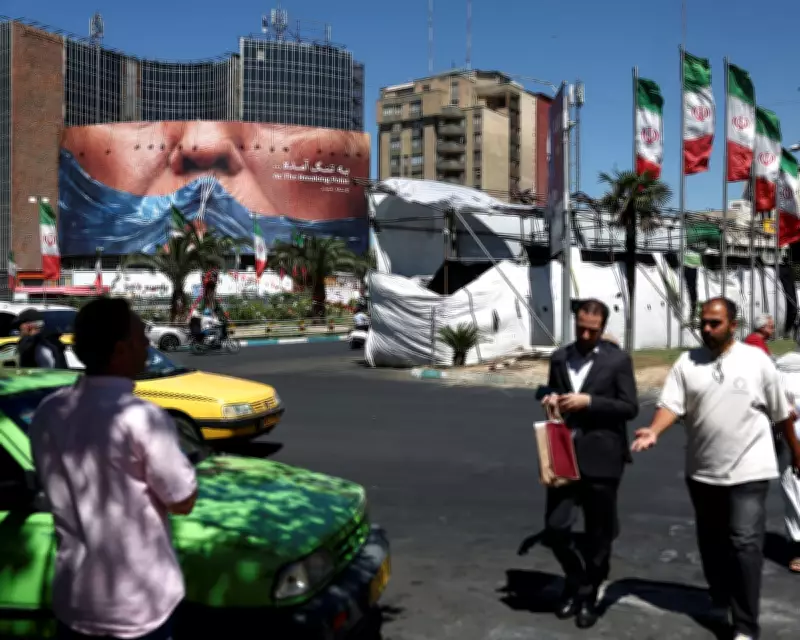
People in Tehran on Tuesday walked past an anti-US billboard depicting Donald Trump and the Strait of Hormuz, as Iran remained in peace talks despite US bombings of Iranian targets. Tehran condemned the strikes as a definitive violation of the ceasefire but announced no specific reprisals, signaling its commitment to negotiations nearing a decisive stage.
US Bombings and Iranian Response
The Iranian foreign ministry denounced the US attack, which targeted missile launchers and mine-laying efforts in the Strait of Hormuz, as an act of bad faith and a violation of the ceasefire. It stated that aggression would not go unanswered. However, Iran did not withdraw from talks mediated by Pakistan and Qatar. The military announced no specific reprisals, suggesting it did not want the attack, which killed four Iranian soldiers, to disrupt the final steps toward an agreement hailed as a milestone in Iran's history of resistance.
Impact on Oil Markets
Brent oil futures climbed 4% after news of the renewed fighting. Donald Trump had planned a rare cabinet meeting at Camp David but postponed it due to bad weather, according to a post on Truth Social. He continued to face questions about the peace deal's objectives, repeating a rambling social media post claiming Democrats and media would declare an Iranian victory even if Tehran surrendered.
Negotiations in Doha
Iran's parliamentary speaker and chief negotiator, Mohammad Bagher Ghalibaf, remained in Doha for a second day, working to unlock over $12 billion in frozen Iranian assets. The funds would be sent to an Iranian account, with sanctions relief for oil and petrochemical exports during a 60-day period for negotiating constraints on Iran's nuclear program. A separate 30-day timeframe would lift the US blockade of Iranian oil ports and allow commercial shipping through the Strait of Hormuz, restoring maritime traffic to pre-war levels.
Political Sensitivity
The brief agreement, ending the war but not delineating peace, is fraught with political sensitivity. Hardliners in Washington, Tehran, and Jerusalem pressure negotiators not to make concessions. Mahmoud Nabavian, a member of Iran's parliamentary national security commission, insisted no agreement should relinquish Iranian control of the Strait. But Ghalibaf, re-elected as speaker, can marginalize opposition. Reports indicate he is focused on accessing frozen assets, described as the last serious dispute.
Progress and Threats
Consultations in Qatar have made progress on frozen assets, but MP Ahmad Bakhshayesh Ardestani claimed a plan to transfer $12 billion from Qatar to a Russian account before reaching Iran was thwarted by the US. He warned that if war restarted, Iran knew the whereabouts of hotels used by US negotiators Jared Kushner and Steve Witkoff and would target them next time. Tehran is also strengthening the section committing Israel to a ceasefire in Lebanon, as Israel expanded ground operations, escalating the war.
Escalation in Lebanon
On Tuesday, the Israeli military issued evacuation warnings for 19 villages in southern Lebanon, expanding ground operations. The Lebanese health ministry reported Israeli strikes killed 31 people and wounded 40. Iran's supreme leader, Mojtaba Khamenei, claimed the tide of history favored Iran and called for Muslim unity, predicting Israel's elimination by 2040. He stated that the US would lose its regional foothold and that Israel was approaching its end.
Khamenei's remarks contrasted with Trump's claim that Arab states, Turkey, and Iran should normalize relations with Israel. The negotiations continue amid mutual distrust and regional tensions.