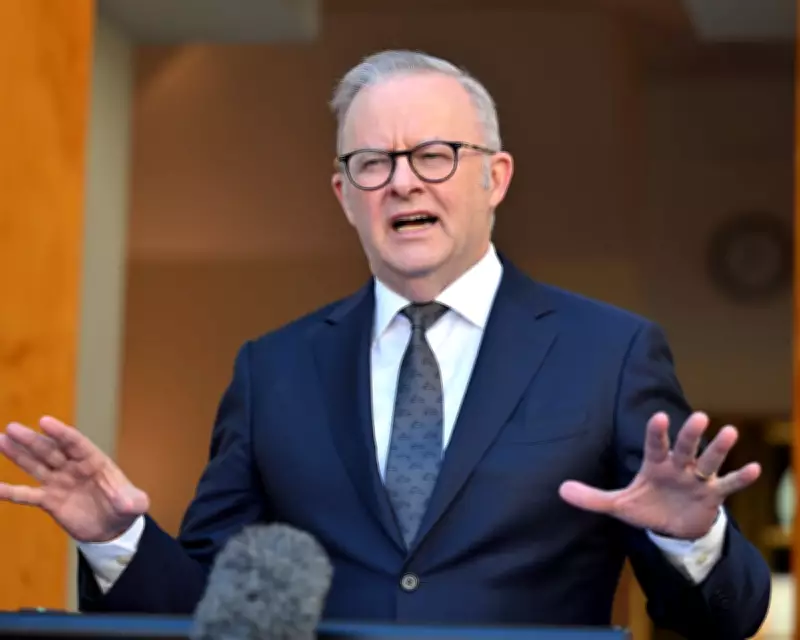
Australian Leader Condemns Trump's 'Civilization' Threat Over Iran
Australian Prime Minister Anthony Albanese has delivered a rare diplomatic rebuke of former U.S. President Donald Trump, specifically targeting his aggressive rhetoric surrounding the Iran conflict. The criticism emerged as Albanese welcomed a newly announced two-week conditional ceasefire between the United States and Iran, an agreement that has temporarily reopened the vital Strait of Hormuz and triggered a significant plunge in global oil prices.
Ceasefire Brings Relief Amid Escalating Tensions
The prime minister's comments followed Trump's inflammatory threat that a "whole civilization will die" if conflict with Iran escalated. While Albanese praised the diplomatic breakthrough that led to the temporary ceasefire, he explicitly distanced Australia from Trump's bellicose language. Political correspondent Dan Jervis-Bardy reported that this represents one of the few instances where the Australian leader has publicly criticized the former American president.
Shadow Treasurer Angus Taylor offered measured support for the ceasefire outcome, stating that while he wouldn't have echoed Albanese's criticism verbatim, the resulting de-escalation was "what I want to see." Meanwhile, Nationals Senator Matt Canavan had earlier urged the prime minister to clarify Australia's position, insisting the nation should not support Trump's threat of widespread bombings against Iran, which he described as a situation that had "gotten out of hand."
Domestic and International Reactions Diverge
While the international diplomatic community focused on Middle East tensions, economic analysts questioned the sustainability of the economic policies being promoted domestically. Economics editor Patrick Commins characterized certain proposals as an economic "mirage," creating a stark contrast between global diplomatic concerns and domestic economic debates.
The ceasefire announcement brought immediate market reactions, with oil prices dropping significantly following news that the strategic Strait of Hormuz would temporarily reopen to commercial traffic. However, the Albanese government cautioned Australians that the ceasefire would not immediately translate to cheaper fuel prices at the pump, with petrol costs continuing to rise due to other market factors.
Broader Political Context and Climate Concerns
The diplomatic developments occurred alongside several other significant news stories, including a Republican victory in a Georgia runoff election to replace Marjorie Taylor Greene, and troubling climate warnings about Pacific island nations. Former UN climate chief Christiana Figueres warned that countries like Tuvalu, Kiribati and Fiji face becoming uninhabitable within decades due to sea-level rise, describing climate change impacts as "the mother of all injustices."
In a separate development, mining magnate Gina Rinehart questioned the extensive investigation into alleged war crimes by Australian soldiers in Afghanistan, specifically referencing the case of former SAS soldier Ben Roberts-Smith, who faces charges but maintains his innocence. Rinehart criticized the $300 million cost of the investigation, asking how such expenditure could be justified against veterans who served their country.
Cultural Reflections on U.S.-Australia Relations
The Guardian Australia's new podcast "Decoding America" examined the deteriorating relationship between the two allies, analyzing Trump's escalating rhetoric against Iran and his surprising criticism of traditional partners like Australia. The podcast revealed deleted speeches that showed the former president's growing frustration with allies and the American public, suggesting a significant shift in international diplomatic norms.
Adding a personal dimension to the political tensions, human rights professor Simon Adams wrote about his family's decision to leave the United States after fifteen years, describing their return to Australia as feeling "like an escape" from a country where "performative cruelty has become the guiding principle of government." His reflection highlighted how political rhetoric and policy decisions affect real families and their life choices.
As the temporary ceasefire holds in the Middle East, Australian leaders continue navigating the complex relationship with their most important security ally while maintaining diplomatic principles that sometimes conflict with American political rhetoric. The situation remains fluid, with global markets watching closely for any signs of renewed tensions that could again threaten vital shipping lanes and energy supplies.