
Coordinated Strike Targets Iranian Leadership in Daylight Assault
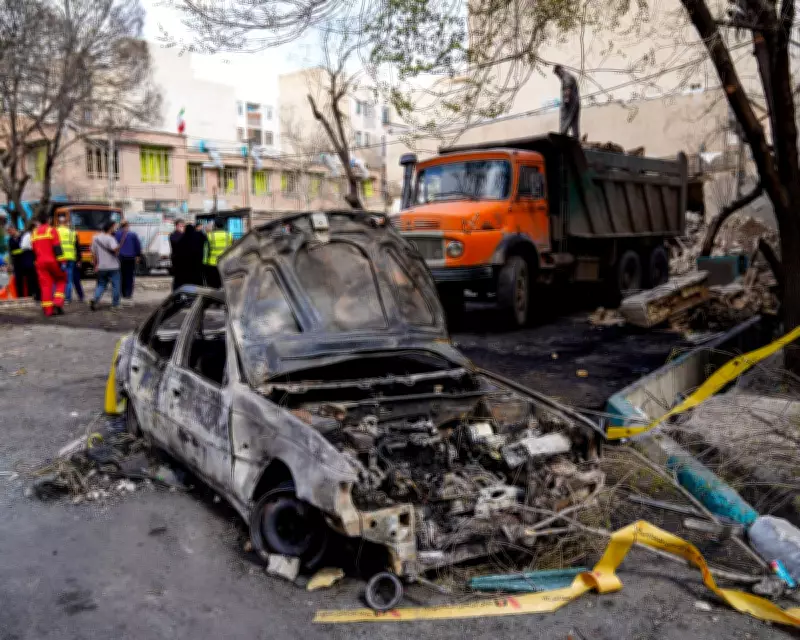
A damaged car lies abandoned on the ground in Tehran following a significant daylight military operation conducted by the United States and Israel on February 28, 2026. The coordinated bombing campaign, which began in the morning to achieve operational surprise, primarily targeted the compound of Iran's supreme leader, Ali Khamenei, with social media footage showing heavy plumes of smoke emerging from the site. Satellite imagery later confirmed the compound's destruction in what appears to have been a precisely targeted attack aimed at eliminating senior regime figures.
Uncertain Fate and Regime Survival Plans
The fate of Ali Khamenei remains uncertain following the assault, which represents a clear attempt at regime change through military force without established justification under international law. This tactic, while easy to initiate, yields profoundly unpredictable outcomes. In preparation for such scenarios, Khamenei had reportedly established a multi-layered succession plan for key government and military positions last summer, naming three potential successors and creating four layers of contingency leadership to ensure regime continuity.
"There is no indication that the United States or any other nation intends to deploy ground forces, meaning domestic control of force remains firmly with the Iranian regime," explained HA Hellyer, a senior fellow at the Royal United Services Institute. "This dynamic would only shift if a substantial uprising occurred with mass defections from within the system."
Broad Regional Assault and Military Disparities
The military operation extended beyond Tehran, with explosions reported in Isfahan, Kermanshah, Qom, and several other major Iranian cities. According to Israeli military statements, hundreds of targets were struck in multiple waves with minimal opposition from Iran's already depleted air defense systems, which suffered significant damage during last summer's twelve-day conflict with Israel and again during Saturday's attacks. The Israeli military deployed approximately two hundred fighter jets to strike air defense installations and ballistic missile launch sites.
Over the preceding month, the United States had strategically positioned two carrier strike groups in the region—the USS Abraham Lincoln in the Arabian Sea and the USS Gerald R. Ford in the eastern Mediterranean. Each carrier possesses an air wing of about seventy-five combat aircraft, while accompanying destroyers and submarines carry Tomahawk cruise missiles with ranges exceeding one thousand miles.
Iran's Retaliatory Measures and Regional Escalation
Facing what it perceives as an existential threat, Iran responded swiftly by launching ballistic missiles and drones against Israel and United States allies across the Middle East. The retaliation targeted military bases and assets in Jordan, Kuwait, Bahrain, Qatar, the United Arab Emirates, and Saudi Arabia, immediately drawing six additional nations into the expanding conflict. Although the United Kingdom did not participate in the initial assault on Iran—apparently considering it unlawful—it has already been drawn into the conflict by providing fighter jets to protect regional allies.
Initial assessments suggest a stark military imbalance in the conflict. The Israeli military thinktank Alma reported that Iran launched twenty-five separate attack waves against Israel by 5:30 PM local time, while Israel's Magen David Adom ambulance service documented eighty-nine casualties from these assaults. Regional retaliation has resulted in at least one fatality in Abu Dhabi from falling missile debris and a fire at Dubai's Fairmont hotel following a direct hit.
Civilian Casualties and Strategic Maritime Threats
A particularly tragic incident occurred when a primary school for girls in Minab, southern Iran, was struck, resulting in eighty-five fatalities according to Iran's Tasnim news agency. This event underscores the grim reality that precision bombing often fails to protect civilian populations. Meanwhile, Iran appears to be attempting to enforce closure of the Strait of Hormuz, through which approximately twenty percent of global oil supplies transit from Iran and Gulf nations.
The United Kingdom's Maritime Trade Organisation has reported warnings being broadcast to merchant shipping via VHF radio. Iran could potentially deploy its Russian Kilo-class and midget Ghadir submarines to mine the strait's two 1.9-mile-wide shipping lanes, though the success of such an operation remains uncertain given likely United States submarine presence designed to prevent mine-laying activities.
Strategic Calculations and Uncertain Conclusions
Current indications suggest the United States and Israel plan to sustain a bombing campaign potentially lasting weeks, while Iran gradually depletes its estimated stockpile of two thousand ballistic missiles. Iran's capacity for large-scale retaliation may diminish within days, whereas the United States can conduct over one hundred twenty-five bombing missions daily from each aircraft carrier alone. With limited strategic options, Iran's regime may focus on enduring anticipated assault waves, continuing retaliation while possible, and maintaining domestic control given the absence of declared ground invasion intentions from the United States or Israel.
"In summary, the United States and Israel have initiated this conflict with ambiguous and potentially unattainable objectives, lacking foundation in international law and receiving minimal support from Gulf states or other American allies," observed Lord Ricketts, former United Kingdom national security adviser. The pathway to conflict resolution remains unclear as military engagements continue to escalate across the Middle East.




