
The 'Iron River' of American Guns Flooding Mexico
Mexico's ongoing struggle against powerful drug cartels has been dramatically underscored by recent violent outbreaks, revealing a critical vulnerability: the overwhelming majority of weapons used by criminal organizations originate from the United States. This cross-border firearms trafficking has created what lawmakers describe as an "iron river" of weapons flowing south, directly fueling Mexico's epidemic of cartel violence and organized crime.
Recent Violence Highlights Deadly Pipeline
This week, Mexico experienced a devastating wave of brutality following the capture of notorious drug lord Nemesio Rubén Oseguera Cervantes, known as "El Mencho." Members of his Jalisco New Generation Cartel responded with coordinated attacks, detonating trucks, assaulting police stations, and engaging in intense gun battles with Mexican security forces. The chaos resulted in 62 fatalities, including a pregnant woman caught in crossfire, before eventually subsiding.
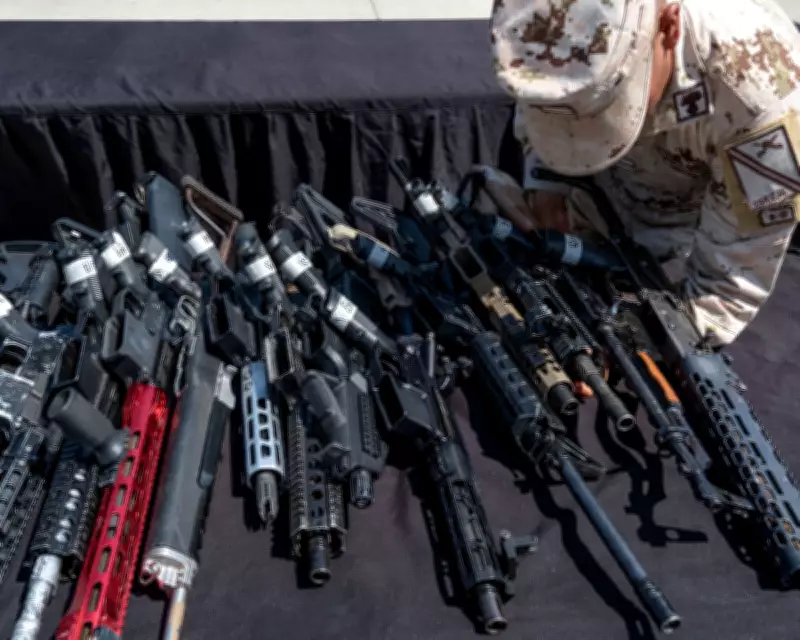
Mexico's Defence Minister Ricardo Trevilla Trejo revealed that the vast majority of weapons seized after El Mencho's capture—including Barrett rifles, rocket launchers, grenades, and mortar rounds—had been trafficked from the United States. Since President Claudia Sheinbaum's administration began, Mexican authorities have confiscated 23,000 weapons, with approximately 80% originating north of the border.
Contrasting Gun Laws Enable Trafficking
Mexico maintains extremely restrictive firearm regulations, with only two government-operated gun stores nationwide, both managed by the military. Conversely, the United States features comparatively lax gun legislation and a deeply ingrained firearms culture that makes weapons readily available for purchase and subsequent smuggling operations.
"The ability of criminal groups to exercise this type of power and exercise this type of violence is closely linked to firearms trafficking," explained Cecilia Farfán-Méndez, an expert on Mexican organized crime. "If we want to see less violence in Mexico, this is a very important conversation."
Scale of Cross-Border Weapons Flow
Conservative estimates suggest 135,000 guns are trafficked into Mexico annually, though some studies indicate the number could reach as high as 730,000 American firearms smuggled across the border each year. This translates to approximately 2,000 U.S. weapons entering Mexico daily through various smuggling channels.
While large gun stores contribute to this flow, approximately 83% of trafficked weapons originate from independent dealers operating in border states including Arizona, Texas, New Mexico, and California. These smaller establishments often supply the most powerful firearms, including .50-caliber sniper rifles and 7.62mm assault-style weapons that significantly enhance cartel firepower.
Smuggling Methods and Enforcement Challenges
Weapons trafficking occurs through both large-scale operations and piecemeal smuggling. Last year, U.S. authorities arrested a father and son in Texas attempting to transport 300 rifles and pistols along with ammunition and magazines into Mexico. However, most firearms enter divided among multiple smugglers, complicating detection efforts.
"It is very easy to hide a gun in a vehicle without being detected and it is very difficult to stop every single car and every single truck," noted Ieva Jusionyte, a Brown University professor specializing in arms trafficking research. "It's like trying to find a needle in a haystack."
Political and Legal Obstacles
Analysts identify Washington's political landscape as a fundamental obstacle, where well-funded gun lobbying has stalled meaningful regulatory progress for years. Democratic Senator Dick Durbin emphasized this connection last year while introducing legislation to address arms smuggling: "Our country's lax gun laws have created a deadly, vicious cycle of firearms trafficking that's riddled with violence and chaos."
Arturo Sarukhán, former Mexican ambassador to Washington, highlighted the systemic nature of the problem: "Certainly, Mexico and Mexican customs need to do much more to prevent those guns from coming into Mexican territory. But at the end of the day it's the loopholes in how you can buy guns in gun shows and gun shops in the U.S. that are allowing proxy purchases of firearms that are then illegally trafficked over international borders."
Diplomatic Efforts and Limited Success
Mexico has repeatedly urged the United States to intensify efforts to stem the southbound weapons flow. President Sheinbaum has consistently raised the issue in meetings and conversations with U.S. leadership, including President Trump. In 2021, Mexico filed a lawsuit against eight American gun manufacturers alleging negligent marketing, distribution, and sales practices, but the U.S. Supreme Court unanimously rejected the suit based on existing liability protections for firearm manufacturers.
Recent enforcement statistics reveal the scale of the challenge. Since January of last year, the U.S. Bureau of Alcohol, Tobacco, Firearms and Explosives (ATF) has seized 4,359 guns and 648,975 rounds of ammunition destined for Mexico. Even by conservative trafficking estimates, this represents interception of merely 3% of weapons crossing the border.
"It is a minuscule amount," observed Jusionyte. "The technologies are evolving, both how the guns are being hidden in vehicles as well as the scanners that can detect them, but it's a cat and mouse game that is stacked against [the authorities] because of how profitable it is to smuggle guns into Mexico."
This ongoing cross-border weapons pipeline continues to empower Mexican cartels with sophisticated arsenals, perpetuating cycles of violence that claim thousands of lives annually and challenge security forces on both sides of the international boundary.




