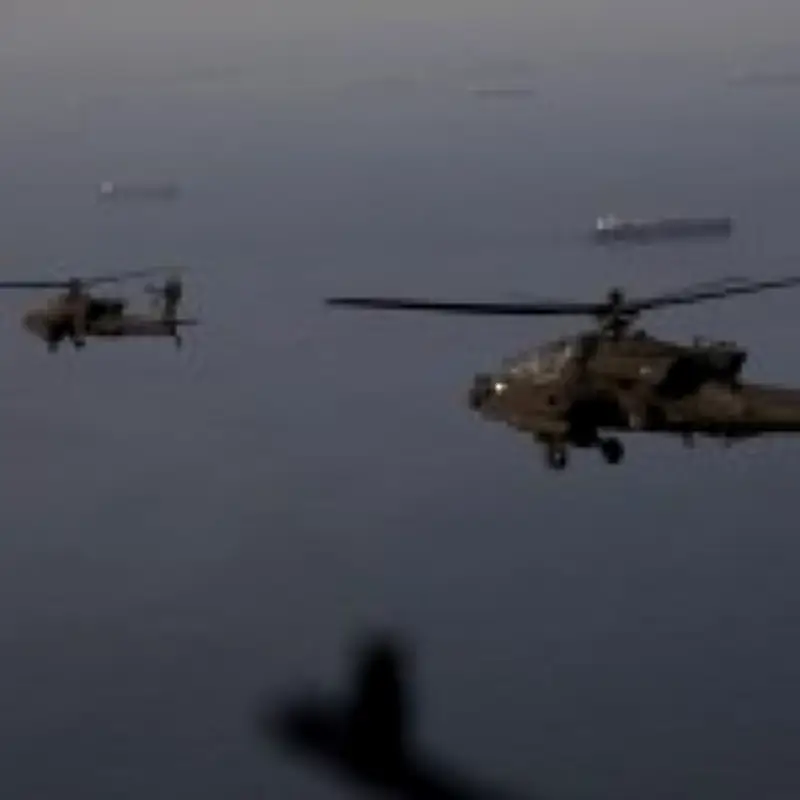
A US Apache helicopter that crashed near the Strait of Hormuz was reportedly involved in a covert mission to transfer oil out of the Middle East, according to a new investigation. The incident occurred while the helicopter was on patrol off the coast of Oman at approximately 3:30 am last week, as stated by the US military's Central Command in a subsequent press release.
Secret Oil Transfer Operation
Reuters has uncovered evidence suggesting that the helicopter was part of a US military operation that allegedly moved oil from ship to ship to maintain energy exports. The operation, overseen by the US military, reportedly used aerial and water drones to guide oil convoys to waiting tankers. Satellite imagery indicates that the oil transfers began in early May, with the Apache helicopter involved in an unspecified capacity.
The US Defense Department has denied that any forces in the Middle East are currently participating in offshore ship-to-ship oil transfers. This technique is not new; Iranians have employed it for years to circumvent sanctions and conceal the origin of their oil. Initial estimates from Reuters suggest that at least 90 million barrels of crude oil may have been transferred through the US-linked operation since May.
Strategic Importance of the Strait of Hormuz
The Strait of Hormuz is a critical chokepoint for significant shipments of oil, natural gas, and related products like fertilizer. Its effective closure had a profound impact on the global economy. Approximately one-fifth of the world's oil passes through this shipping lane, which separates Iran from Oman and the UAE, connecting the Persian Gulf to the Gulf of Oman and the Arabian Sea in the Indian Ocean.
Yesterday, the US announced that a peace deal with Iran 'is now complete,' with the Strait set to reopen without tolls. The deal returns the region to a pre-war status, but with thousands dead and Iran gaining new leverage through its ability to influence transits. Tehran emphasized that it wanted a deal focused on ending the war, with discussions on its nuclear program postponed.
According to the International Atomic Energy Agency, Iran possesses 440.9 kilograms (972 pounds) of uranium enriched up to 60% purity, a short technical step from weapons-grade levels of 90%. Iran maintains that its nuclear program is peaceful and has not publicly committed to relinquishing the enriched uranium, believed to be buried under three nuclear sites heavily damaged by US strikes last year.