
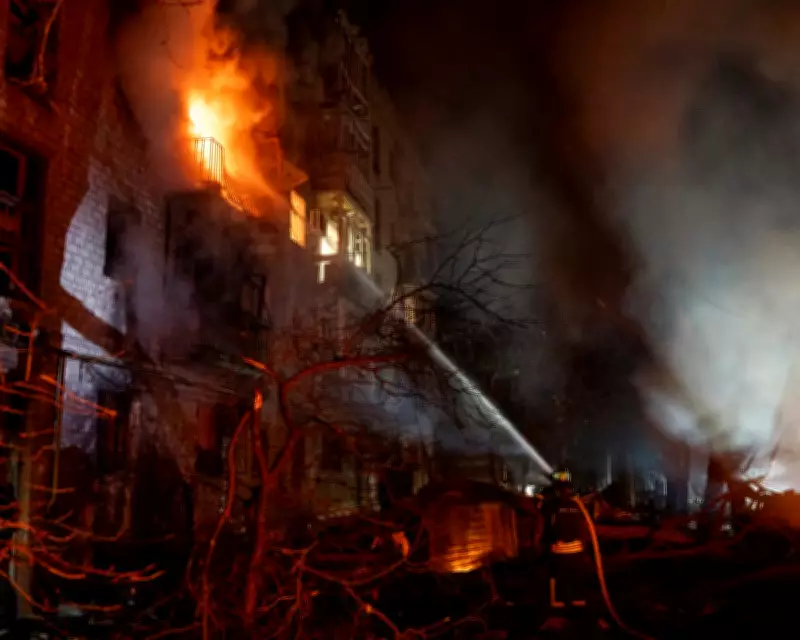
Ukrainian civilian casualties caused by explosive violence surged dramatically by 26% during 2025, according to exclusive research from a global conflict monitoring organization. The alarming figures reflect a significant escalation in Russian military targeting of urban centers and critical infrastructure across the country.
Striking Statistics Reveal Escalating Violence
Action on Armed Violence (AOAV) reported that English-language media documented 2,248 civilians killed and 12,493 injured by explosive attacks in Ukraine throughout 2025. Perhaps most disturbingly, the average number of civilians reported killed or injured in each individual strike reached 4.8 people – representing a 33% increase from the previous year's figures.
The research indicates a troubling pattern of intensified violence against civilian populations. Iain Overton, executive director of AOAV, stated that these numbers demonstrate "Ukraine fits a wider collapse of restraint that is now visible across multiple wars." He further argued that respect for the fundamental principles of distinction and proportionality in warfare "has broken" across contemporary conflicts.
Devastating Attack in Dnipro
The single worst incident documented occurred in Dnipro on June 24, 2025, when Russian missiles struck multiple civilian targets simultaneously. The attack hit a passenger train, residential apartment buildings, and educational institutions, resulting in 21 fatalities and 314 injuries. Among the wounded were 38 children, highlighting the indiscriminate nature of the violence.
Missile and drone attacks became almost nightly occurrences across Ukraine throughout 2025, continuing into 2026 and leaving millions of citizens with severely limited or completely disrupted access to electricity, heating, and clean water. The largest recorded air raid of the conflict occurred on September 9, 2025, when 805 drones and 13 missiles targeted Ukrainian territory in a single night.
Global Context of Explosive Violence
While Ukrainian civilian casualties increased significantly, global figures for explosive violence against civilians actually decreased by 26% from a ten-year high recorded in 2024. This reduction was largely attributed to the October ceasefire in Gaza, which had previously been the world's most deadly conflict for civilian populations.
According to AOAV's comprehensive monitoring, Gaza recorded 14,024 civilian casualties in 2025 – a 40% decrease from the previous year. However, researchers acknowledge that English-language media reports inevitably undercount the true scale of civilian suffering, as demonstrated by the discrepancy between AOAV's figures and the Gaza health ministry's documentation of 25,718 Palestinians killed and 62,854 injured during the same period.
International Accountability Crisis
Deliberately targeting civilians or civilian infrastructure in a manner disproportionate to military advantage constitutes a war crime under international law. Yet experts warn that the principle of proportionality has reached a breaking point across multiple contemporary conflicts, including those in Gaza, Sudan, Congo, and Ukraine.
"We have watched this erosion unfold over years, from Homs to Aleppo to Mariupol and on to Gaza," Overton observed. "What seems different now is the sense that there is no longer a functioning international rules-based order capable of ever holding those responsible to account."
Worldwide Casualty Distribution
AOAV's global monitoring documented 45,358 civilian casualties from explosive violence during 2025, comprising 17,589 reported fatalities and 27,769 injuries. This represents a substantial decrease from the 61,353 casualties recorded in 2024.
Israel was identified as responsible for the highest number of civilian casualties from explosive violence worldwide, marginally exceeding Russia's documented impact. Israel's involvement in multiple conflicts resulted in it being recorded as causing 35% of all reported casualties, compared to Russia's 32%. Wars in Sudan and Myanmar followed as the next most deadly conflicts, with total recorded casualty numbers of 5,438 and 3,178 respectively.
"Across Ukraine, Myanmar, Gaza and Sudan, the message is the same," Overton concluded. "When impunity becomes normalized, war crimes stop being shocking exceptions and begin to resemble a method of warfare." The research methodology relies consistently on English-language media reports of explosive violence incidents worldwide, providing comparative data while acknowledging inherent limitations in capturing the complete picture of civilian suffering in conflict zones.




