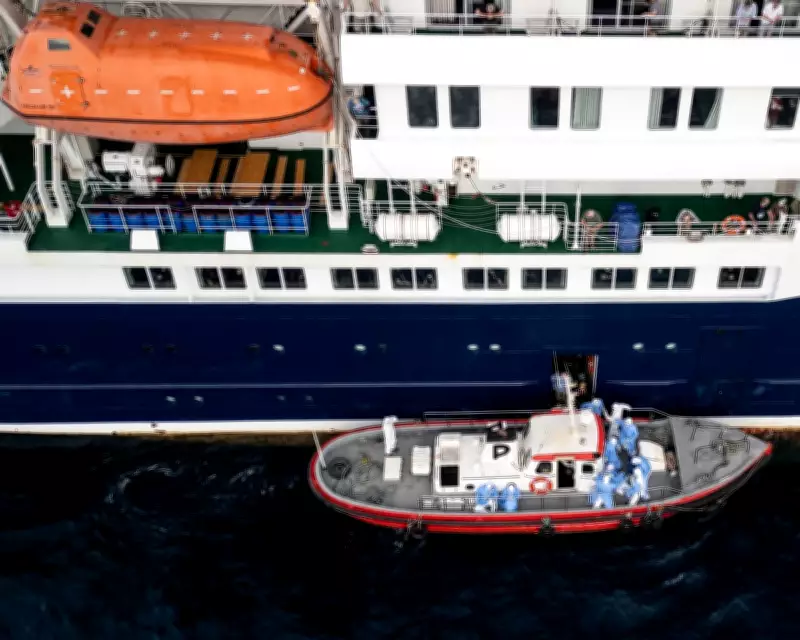
Two Britons who were medically evacuated from the hantavirus-hit cruise ship MV Hondius are reportedly improving, according to global health officials. A 69-year-old British passenger was airlifted to South Africa on 27 April and is receiving care at a private health facility in Sandton, Johannesburg. Another Briton, Martin Anstee, 56, an expedition guide, was taken off the ship on Wednesday and flown to the Netherlands for specialist medical treatment.
Dr Maria Van Kerkhove from the World Health Organization (WHO) confirmed that two patients in the Netherlands remain hospitalized, while the British patient in South Africa is in intensive care. She stated: 'I am very happy to say the patient in South Africa is doing better, and the two patients in the Netherlands we hear are stable. So that is actually very good news.' As of Thursday, there are eight suspected cases, with five confirmed as hantavirus through laboratory tests. Hantavirus is a rare family of viruses carried by rodents.
Outbreak Linked to Birdwatching Trip
The outbreak, associated with three deaths, has been traced to a birdwatching excursion to Argentina, Chile, and Uruguay that two passengers undertook before boarding the ship. Spanish authorities have granted permission for the MV Hondius to anchor in the Canary Islands, despite local concerns. The vessel departed Cape Verde at 3:15 PM local time on Wednesday, according to tour operator Oceanwide Expeditions, and is expected to arrive at the port of Granadilla in Tenerife early Sunday.
Morale and Medical Response
Morale on board has improved since the ship began its journey to Tenerife, the WHO reported. Two doctors are currently on board, along with infectious disease specialists from the WHO and the European Centre for Disease Prevention and Control, who are conducting medical assessments of all passengers and crew. While the public risk remains low, Dr Tedros Adhanom Ghebreyesus, WHO director-general, warned that more cases could emerge due to the incubation period of the Andes virus, a hantavirus variant, which can extend up to six weeks.
Dr Tedros noted: 'While this is a serious incident, WHO assesses the public health risk as low.' He thanked the ship's operator for its cooperation and acknowledged the passengers and crew 'who are going through a very difficult and frightening situation.' The WHO does not anticipate an epidemic, citing a similar outbreak in Argentina in 2018-2019 that resulted in 34 cases.
Evacuations and Quarantine Measures
Seven British nationals were among 30 people from 12 countries who left the ship when it docked at Saint Helena, a remote South Atlantic island. This group included a Dutch woman who fell ill during onward travel and subsequently died. She was accompanying her husband's body, who had died on the ship on 11 April. On Thursday, a flight attendant in Amsterdam who had contact with the deceased woman reported potential symptoms.
Oceanwide Expeditions confirmed that disembarked guests have been contacted. The UK Health Security Agency (UKHSA) has been asked whether it has communicated with all seven Britons who left the ship on 24 April. The UKHSA previously announced that two Britons who returned from the vessel are isolating at home without symptoms. Contact tracing is underway for anyone who may have sat near them on the flight back.
Isolation and Repatriation Plans
Nineteen British nationals were listed as passengers on the MV Hondius, which sailed from Argentina to Cape Verde, along with four British crew members. UK health experts have advised British passengers on board to self-isolate for 45 days upon return. Prof Robin May, chief scientific officer at the UKHSA, stated: 'For the broader public, not directly involved in this cruise ship, the risk here is really negligible.'
The Foreign Office is arranging a charter flight to repatriate remaining Britons on board who are asymptomatic once the ship docks in Tenerife. According to the UKHSA, none of the British citizens on board are currently reporting symptoms, but they are being closely monitored. May noted that the 'most extreme case of incubation' of hantavirus 'may be up to eight weeks,' but the general recommendation is isolation for 'probably six weeks, and so that’s the period of isolation, 45 days, that we’re likely to be recommending.'
Three people were taken off the ship on Wednesday for treatment in the Netherlands, including Anstee, a former police officer. Speaking from hospital, he told Sky News: 'I’m doing OK. I’m not feeling too bad. There are still lots of tests to be done. I have no idea how long I’ll be in the hospital for. I’m in isolation at the moment.'