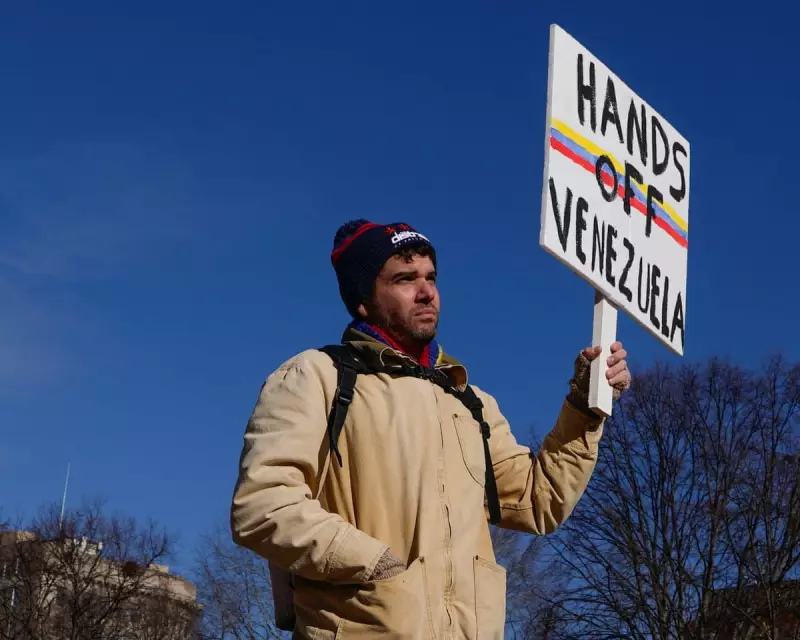
The recent military incursion ordered by US President Donald Trump into Venezuela, aimed at arresting President Nicolás Maduro on drug trafficking charges, has been condemned as a flagrant act of aggression that threatens the very foundations of international law.
A Blatant Violation of the UN Charter
The United Nations charter permits the use of military force against a sovereign state in only two scenarios: with explicit Security Council authorisation, or in self-defence against an actual or imminent armed attack. Trump's operation meets neither condition. No Security Council resolution sanctioned the move, and Venezuela posed no credible military threat to the United States.
The administration's justification—defending the US from drugs emanating from Venezuela—establishes a dangerous and expansive precedent. The UN General Assembly previously denounced a similar rationale when used for the 1989 invasion of Panama to arrest Manuel Noriega. Crucially, drug trafficking is universally treated as a criminal matter for law enforcement, not an 'armed attack' legitimising military force.
Hypocrisy and the Real Motives
The stated motive rings hollow amid demonstrable hypocrisy. In November, Trump pardoned former Honduran president Juan Orlando Hernández, who had been convicted of large-scale drug trafficking. This suggests the issue is less about narcotics and more about political alignment, with friendly right-wing leaders receiving clemency.
Some have questioned whether the doctrine of 'Responsibility to Protect' (R2P), endorsed by the UN in 2005, could provide cover. While Maduro's regime was brutally repressive and created a refugee crisis of nearly 8 million people, R2P is intended as a last resort to halt genocide or comparable mass slaughter—a threshold not met in Venezuela.
The real offence appears to be a combination of geopolitics and resources: Maduro's alliances with Russia, China, and Iran, coupled with Venezuela sitting atop the world's largest oil reserves—a prize the Trump administration covets.
A Chilling Precedent for Global Autocrats
Beyond legality, the invasion sets a perilous precedent. If the US can invade Venezuela to arrest a leader on criminal charges, what stops Russia's Vladimir Putin from invading Ukraine, or China's Xi Jinping from seizing Taiwan? The principle of national sovereignty, a cornerstone of the post-war order, is severely undermined.
The international response has been tellingly weak. Russian and Chinese governments condemned the Venezuela action while ignoring parallels to their own aggression. European leaders, including France's Emmanuel Macron and the UK's Keir Starmer, offered tepid statements focused on upholding international law broadly, failing to explicitly label Trump's act illegal, seemingly to keep him engaged in supporting Ukraine.
Trump's selection of Maduro's vice-president, Delcy Rodríguez, as a replacement, over democratic opposition leader and 2025 Nobel Peace Prize winner María Corina Machado, reveals a focus on securing oil interests rather than fostering democracy. Rodríguez has not denounced the former regime's abuses and has asserted Maduro's legitimacy.
The Dangerous Return of 'Might Makes Right'
The action signals a potential revival of spheres of influence, where major powers dictate terms in their backyards—a concept the UN Charter was designed to end. This 'Trump corollary' to the Monroe Doctrine invites global chaos.
As Kenneth Roth, former head of Human Rights Watch, warns, embracing a world where 'might makes right' is an act of 'naive hubris' for Washington. Global economic and military power is shifting, and abandoning the rules-based alliances it helped build could ultimately weaken US security. The belief that 'Washington will always be the alpha male for whom rules are made to be broken, not followed' is a dangerous gamble for global stability.